Sreeshankar Battles Through Injury to Win Back-to-Back Asian Games Silver Medals
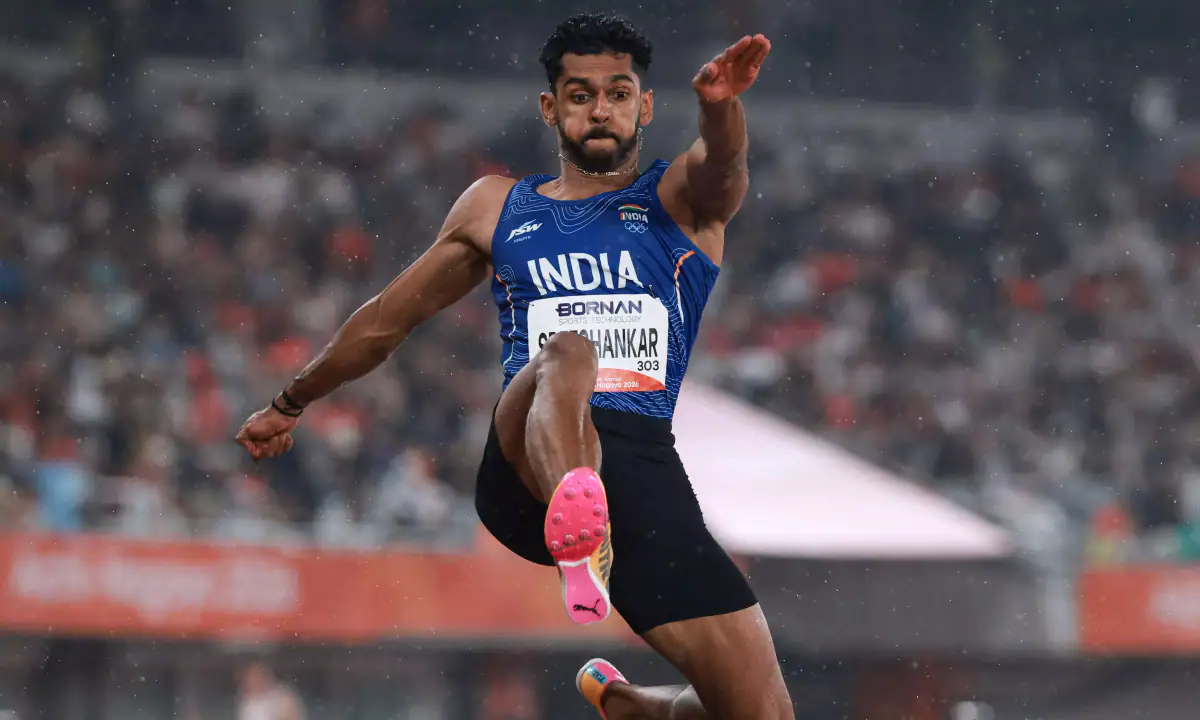
Sreeshankar produced another medal-winning performance on the Asian Games stage, but this one came at a significant physical cost.
The Indian long jumper secured silver in the men's long jump at the 2026 Asian Games, recording a best effort of 8.07m before an injury forced him out of the competition after the fourth round. It was Sreeshankar's second consecutive Asian Games silver medal, following his runner-up finish in Hangzhou in 2023. But unlike his previous Asian Games medal, this time the Indian had to battle through considerable pain after a difficult landing to protect his position on the podium.
China's Shi Yuhao claimed gold with a season-best 8.17m, while Uzbekistan's Anvar Anvarov won bronze with 8.06m. Sreeshankar's 8.07m, achieved on his second attempt, ultimately proved enough for silver despite the Indian being unable to complete his final two jumps.
Sreeshankar opened the competition with a 7.66m jump, placing him third after the opening round. Anvarov had moved into first with 7.94m, while Shi was second at 7.91m.
The Indian, however, quickly found his rhythm. In the second round, Sreeshankar produced his best jump of the competition — 8.07m — becoming the first Indian to cross the eight-metre mark in the final and moving into second place. It was an important response after Shi had produced the competition's first 8m-plus jump.
The Chinese jumper launched himself to 8.17m, a season best, putting him firmly at the top of the standings. Sreeshankar's 8.07m was nevertheless enough to move him ahead of Anvarov and establish himself as Shi's closest challenger. The Indian could not improve on the mark in the third round, but his 8.07m remained a strong foundation.
The fourth jump changes everything
The decisive moment of Sreeshankar's evening came during his fourth attempt. He overstepped the board and, while attempting to complete the jump, slipped and landed heavily.
The landing immediately raised concerns. Sreeshankar appeared to be in significant pain and removed his spikes after the attempt. Medical personnel advised him to get his ankle assessed, with a wheelchair also suggested. But the reigning Asian Games silver medallist was determined to continue.
The problem was that the injury left him with little realistic opportunity to improve his position. Sreeshankar eventually skipped his fifth attempt as the pain persisted.
At that stage, he remained second with 8.07m, while Anvarov had moved to 8.06m and Chinese Taipei's Lin Yu-tang was at 8.04m. The Indian was therefore still vulnerable, but the field had only one remaining opportunity to overtake him.
With Sreeshankar unable to take his final attempt, the pressure shifted entirely to the athletes chasing him. Anvarov needed to surpass 8.07m to take silver. Lin also remained within striking distance. Neither could produce the required leap.
That meant Sreeshankar's second-round effort stood as his best and secured him another Asian Games silver medal. The result was remarkable given the circumstances.
The Indian had effectively been competing on one strong jump after suffering the injury, yet his earlier effort was good enough to withstand the challenge from the rest of the field. Anvarov eventually settled for bronze with 8.06m, while Lin finished fourth with 8.05m.
At the front of the competition, Shi Yuhao's second-round effort proved decisive. His 8.17m season best remained untouched for the rest of the final and secured him the Asian Games title. The gap between Shi and Sreeshankar was exactly 10 centimetres.
The final standings were:
Shi Yuhao (China) — 8.17m, Season Best
Murali Sreeshankar (India) — 8.07m
Anvar Anvarov (Uzbekistan) — 8.06m
Lin Yu-tang (Chinese Taipei) — 8.05m, Season Best
Riku Ito (Japan) — 7.97m, Season Best
Yuki Hashioka (Japan) — 7.94m
David Solomon Patturaj (India) — 7.70m
Lin Mingfu (Hong Kong) — 7.55m
Yuan Chenlong (China) — 7.50m
Ildar Akhmadiev (Tajikistan) — 7.40m
Janry Ubas (Philippines) — 7.39m
Ansar Abbas (Pakistan) — 7.09m
India had a second representative in the final, with David Solomon Patturaj finishing seventh. Patturaj, who had surprised earlier in the season by crossing eight metres and securing his place at the Asian Games, recorded a best of 7.70m. He remained competitive through the middle of the competition but could not match the marks required to challenge for the podium.
His presence alongside Sreeshankar, however, gave India two finalists in an event where the overall standard was high.
Back-to-back Asian Games silver
For Sreeshankar, the medal represents another significant chapter in an increasingly decorated Asian Games career. He arrived in Nagoya looking to improve on his silver from Hangzhou. Instead, he leaves with another silver — but the context surrounding this medal makes it particularly memorable. His 8.07m was good enough to secure second place, and he managed to protect that position despite being unable to complete his final two jumps.
The bigger concern now will be the extent of the injury suffered during the fourth attempt. For the moment, though, the record will show another Asian Games silver for Murali Sreeshankar.
Hangzhou silver. Nagoya silver. Back-to-back Asian Games podium finishes.
And this time, the medal was earned after an eight-metre jump and a determined effort to remain in the competition despite a painful landing.
Comments (0)
to post comments, replies, and votes.
Loading comments…