Udhayveer Sidhu Wins 10m Air Pistol Gold at Cairo ISSF World Cup, Edges Olympic Champion Reitz
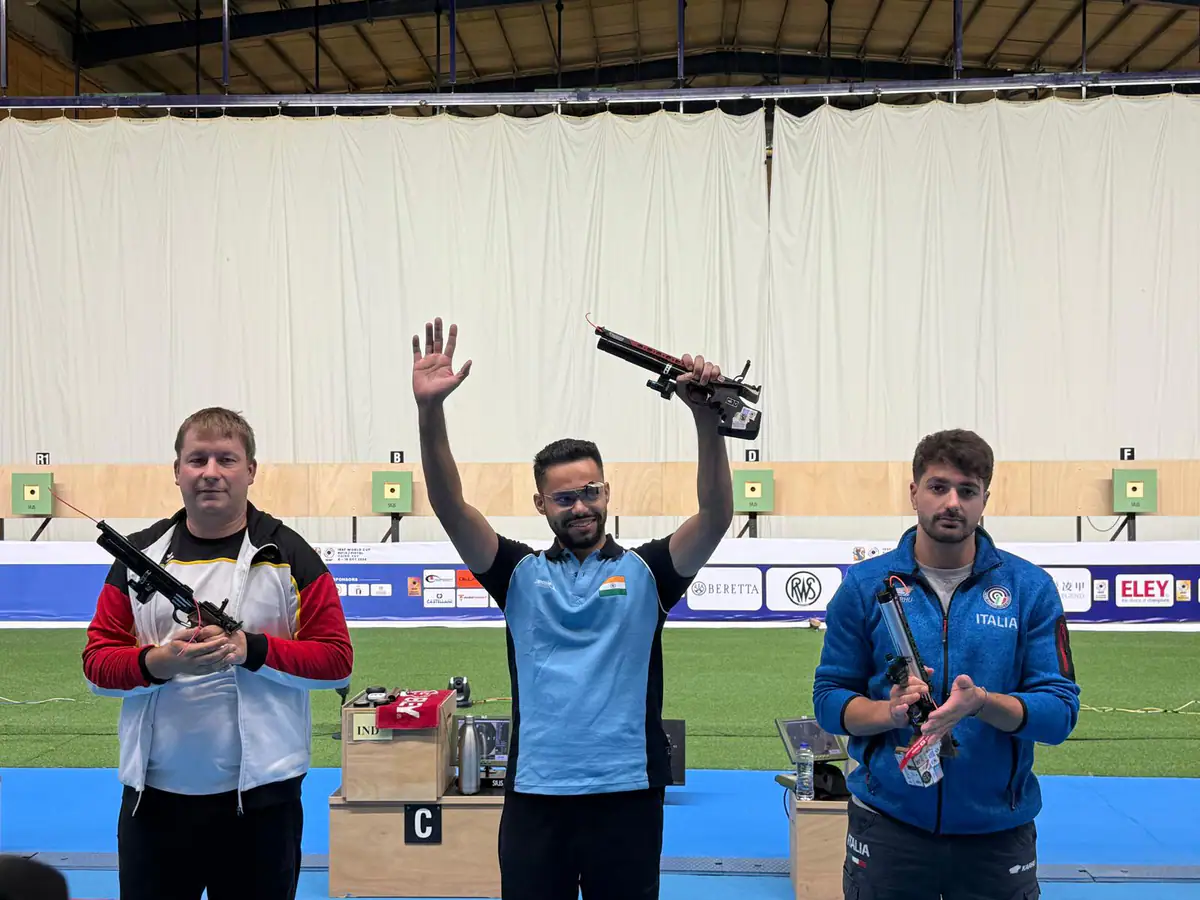
Udhayveer Sidhu wins men’s 10m air pistol gold at the ISSF World Cup in Cairo with 240.6, edging Olympic medallist Christian Reitz by 0.5 points in a dramatic final.
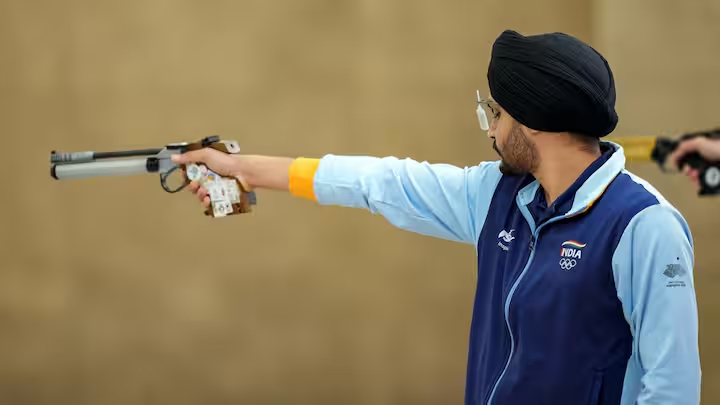
India’s Udhayveer Sidhu produced a composed performance under pressure to win gold in the men’s 10m air pistol at the ISSF World Cup Rifle/Pistol in Cairo, Egypt, on Sunday.
The 24-year-old secured the top position with a score of 240.6, edging Germany’s multi-Olympic medallist Christian Reitz by just 0.5 points in a thrilling final. Reitz claimed silver with 240.1, while Italy’s Paolo Monna completed the podium with 219.8. The victory marked an important achievement for Sidhu, who held his nerve during the closing stages to prevail against a field featuring several accomplished international shooters.
The Indian marksman’s decisive performance came in the final two shots, when the contest remained finely balanced. Trailing Reitz by 0.3 points, Sidhu delivered scores of 10.2 and 9.8 to keep himself in contention. Reitz, meanwhile, recorded two consecutive 9.6s, allowing the Indian to take the lead and secure the gold medal on the final shot.
The narrow margin highlighted the importance of composure and execution in a final where a single shot could determine the medal positions.
Sidhu entered the eight-man final after qualifying in fourth position, registering a total of 585 across six series. His qualification scores were 99, 98, 98, 97, 97 and 96, providing a consistent foundation for the medal round.
Although he did not top the qualification standings, the Indian improved his position when it mattered most. The final demanded sustained accuracy, particularly as the field narrowed during the elimination stages and the pressure increased with every shot.
Reitz proved to be a formidable challenger. The German shooter has extensive Olympic experience and is among the established names in international pistol shooting. His presence in the final ensured that Sidhu had to maintain a high level of performance throughout the closing stages.
The Indian’s response under pressure ultimately proved decisive. With the gold medal within reach, Sidhu produced a 10.2 before following it with a 9.8. Reitz's twin scores of 9.6 opened the door for the Indian, who converted the opportunity to finish on 240.6.
Monna finished third with 219.8, comfortably behind the leading pair but clear of the remaining finalists.
For Sidhu, the victory demonstrated his ability to compete against elite international opposition and deliver in a high-pressure medal match.
Jonathan Antony Tops Qualification Among Indians
India also had a strong showing in qualification through Jonathan Gavin Antony, who was competing in the Ranking Points Only (RPO) category. Antony recorded 586 points to equal the highest qualification score with Monna. His performance placed him among the leading shooters in the preliminary round, although his RPO status meant he was competing for ranking points rather than a place in the medal standings.
Sidhu's 585 placed him just one point behind the joint leaders and secured his qualification for the eight-man final in fourth position. Among India's other participants, Ajendra Singh Chauhan finished 14th with a score of 580. Olympic medallist Sarabjot Singh recorded 574 to place 31st, while Kumar Yogesh scored 573 in the RPO section.
The results presented a mixed picture for the Indian contingent in qualification, but Sidhu's performance in the final ensured that India finished the day with the most significant individual achievement in the event.
His progression from fourth in qualification to the top of the podium also underlined the importance of carrying consistency into the final while managing the pressure of elimination shooting.
The final featured several prominent international shooters, including Turkey's Yusuf Dikec, a Paris 2024 Olympic medallist. Dikec finished seventh with a score of 138.0. Greece's Georgios Gampierakis took fourth position with 198.7, while Latvia's Emils Vasermanis finished fifth with 177.6.
The presence of experienced international competitors added depth to the field and made Sidhu's gold-medal performance particularly notable. Reitz's challenge in the closing stages ensured that the Indian had to produce his best shots at a crucial point in the contest.
The final also illustrated how quickly the standings can change in 10m air pistol shooting. Qualification provides an indication of form, but the medal round places a premium on accuracy under immediate pressure, especially during the elimination phase.
Sidhu managed that transition effectively, maintaining his focus despite entering the final behind the leading qualification scores.
Sidhu's victory in Cairo provides a valuable result for Indian shooting at the international level. Beating an Olympic champion in a closely contested final offers encouragement as the country's shooters continue to compete against the world's leading marksmen.
The 24-year-old's ability to recover from a narrow deficit in the closing stages was central to the outcome. Rather than allowing Reitz's experience to dictate the finish, Sidhu responded with a high-value shot and remained composed through the final exchange.
The 0.5-point winning margin reflected the closeness of the contest, with the outcome determined by the execution of the final two shots rather than a sustained gap between the leading pair.
While Antony's qualification performance and Chauhan's finish also offered useful indicators of India's presence in the event, Sidhu's gold medal was the day's defining result.
By converting a fourth-place qualification into a World Cup victory, Sidhu delivered a performance that combined consistency, precision and composure. His triumph over Reitz in Cairo will stand as an important milestone in his international campaign and a positive result for Indian shooting.
Comments (0)
to post comments, replies, and votes.
Loading comments…