14-Year-Old Jensi Kanabar Breaks Sania Mirza’s 25-Year-Old Record at ITF W15 New Delhi
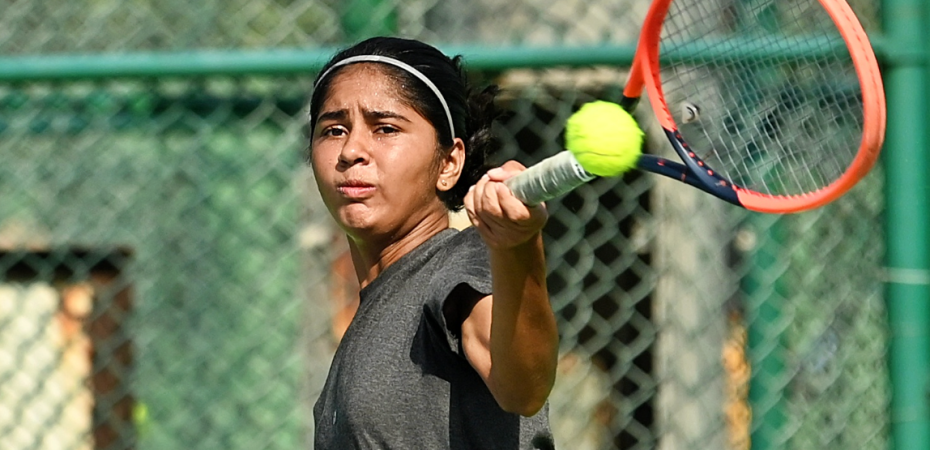
Indian tennis may have found its newest teenage sensation. At just 14 years and five months old, Junagadh’s Jensi Kanabar has become the youngest Indian female player to reach the quarterfinals of a professional singles event, surpassing a record held by Sania Mirza for the last 25 years.
Competing at the ITF W15 New Delhi tournament, Jensi defeated 22-year-old compatriot Sandeepti Singh Rao 6-3, 7-5 in the Round of 16 to enter the last eight in only her second-ever professional ITF event. In doing so, she broke Sania Mirza’s long-standing mark by 11 days, a statistic that immediately places the young Gujarati among the most exciting prospects in Indian women’s tennis.
The scoreline itself only partially reflected the quality of Jensi’s performance. While she controlled large phases of the first set with confident baseline hitting and remarkable composure for her age, the second set tested her temperament. Facing an older and more experienced opponent, Jensi was pushed into pressure moments where Sandeepti threatened to force the match into a decider. The teenager, however, showed impressive resilience by saving four set points before eventually closing out the match in straight sets.
For a player competing in only her second professional tournament, the maturity she displayed stood out as much as the result itself. The victory came just days after Jensi had already announced herself with a dominant 6-1, 6-1 opening-round win over Jaya Kapoor.
Breaking one of Indian tennis’ iconic records
The significance of the achievement becomes even clearer when viewed in historical context.
Sania Mirza’s record had survived for a quarter of a century and symbolised the beginning of one of India’s greatest tennis careers. Jensi now sits at the top of that prestigious list.
Youngest Indian females to reach a professional singles quarterfinal:
Jensi Dipakbhai Kanabar – 14 years, 5 months
Sania Mirza – 14 years, 5 months, 11 days
Ankita Bhambri – 14 years, 8 months
Tara Iyer – 15 years
Isha Lakhani – 15 years
Rutuja Bhosale – 15 years, 2 months
Sanaa Bhambri – 15 years, 2 months
Maaya Rajeshwaran Revathi – 15 years, 6 months
Shruti Ahlawat – 15 years, 7 months
Parthsarthi Arun Mundhe – 15 years, 7 months
Mahak Jain – 15 years, 8 months
Source IndianTennisDaily
Breaking into a list that includes some of India’s most recognised tennis names highlights the scale of Jensi’s early rise.
Jensi’s breakthrough in New Delhi is not an isolated result. Over the past eight months, she has steadily emerged as one of India’s most promising junior players through consistent performances on the international junior circuit. Earlier this year, she reached the final of the prestigious ITF J300 Pune event the Asia/Oceania Closed Regional Championships where she pushed Korea’s Siyoen Sim in a nearly three-hour final before narrowly losing 4-6, 6-3, 3-6.
That performance triggered a massive jump in the ITF junior rankings. Jensi climbed 139 places to a career-high junior ranking of World No. 178, becoming the second-youngest player globally inside the girls’ Top 200 rankings at the time. Her junior record over the last eight months an impressive 21 wins and just three losses reflected a player rapidly learning how to compete consistently at international level.
Fearless tennis and natural aggression
One of the most striking aspects of Jensi’s game is her willingness to play aggressively despite her age. Many young players entering professional events tend to rely heavily on retrieving and consistency. Jensi, however, already shows a willingness to dictate rallies, take the ball early, and attack opportunities when they arise. Her movement and anticipation allow her to stay balanced during longer exchanges, while her mental composure has repeatedly stood out during pressure moments.
Against Sandeepti Singh Rao, those qualities became particularly visible in the second set, where she absorbed momentum swings without panicking.
For a player still several years away from physical maturity, her ability to stay composed under scoreboard pressure is especially encouraging. Indian women’s tennis has spent years searching for the next major singles breakthrough after Sania Mirza transformed the sport in the 2000s. While several talented juniors and professionals have emerged over the last decade, sustaining progression from junior promise to elite senior success has remained difficult.
That is why Jensi’s rise is attracting attention. At just 14, she is already competing effectively against older professional players while simultaneously establishing herself on the junior circuit. Importantly, her development still remains in the very early stages. Managing expectations, physical workload, and long-term growth will now become critical as her profile begins to rise within Indian tennis.
Teenage success in tennis does not guarantee future stardom. The sport’s history is filled with juniors who rose early but struggled with the transition to the senior tour. But what makes Jensi Kanabar’s emergence particularly exciting is the combination of results, temperament, and trajectory she is currently showing. Breaking a 25-year-old record once held by Sania Mirza is symbolic. Doing it in only her second professional tournament makes it even more remarkable.
For Indian tennis fans constantly looking toward the future, Jensi’s performances in New Delhi may well feel like the beginning of something significant.
Comments (0)
to post comments, replies, and votes.
Loading comments…