Headline: Chandrasekar and Yuzuki Finish Runners-Up at ATP 75 Gwangju Challenger After Tight Final Battle
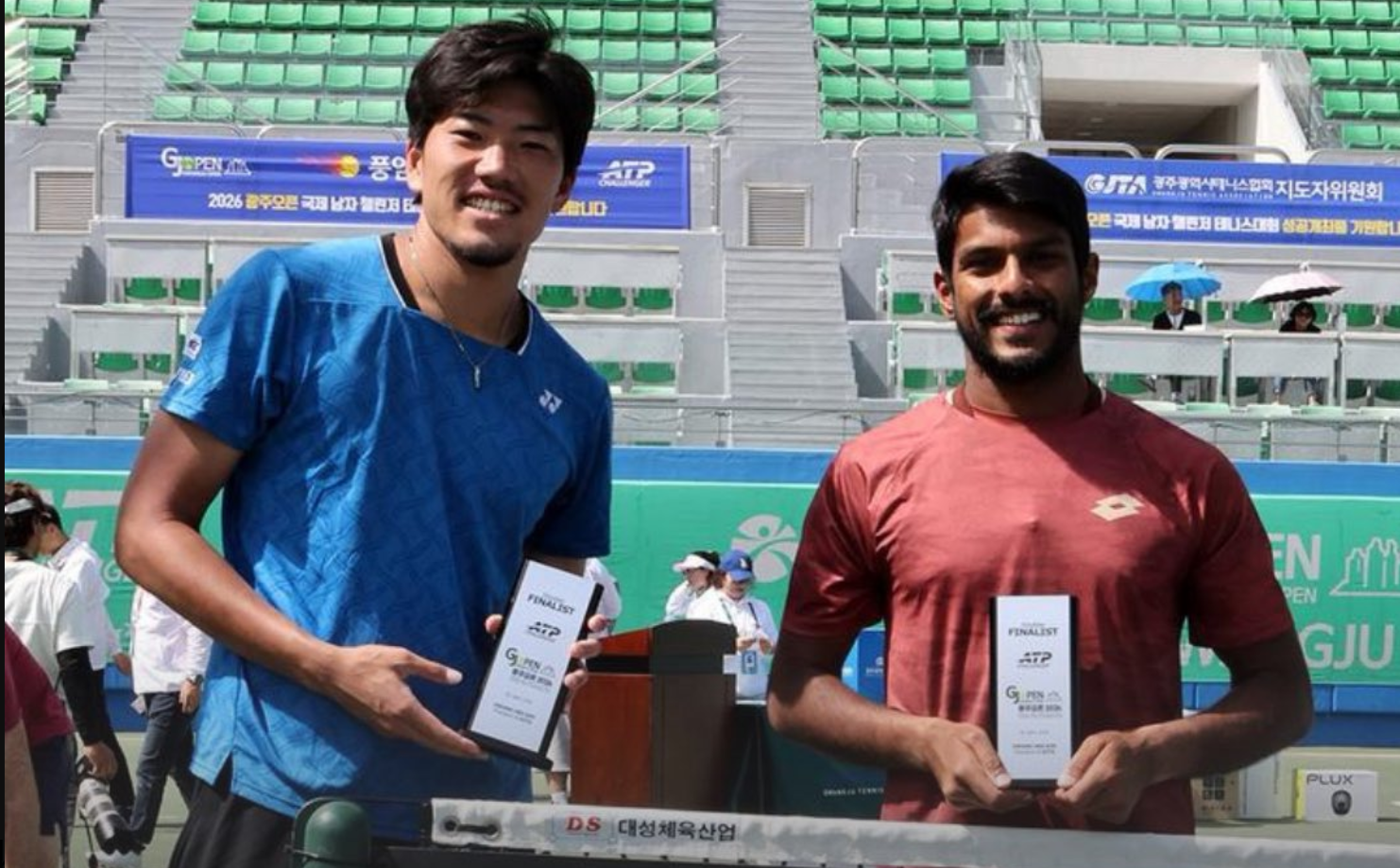
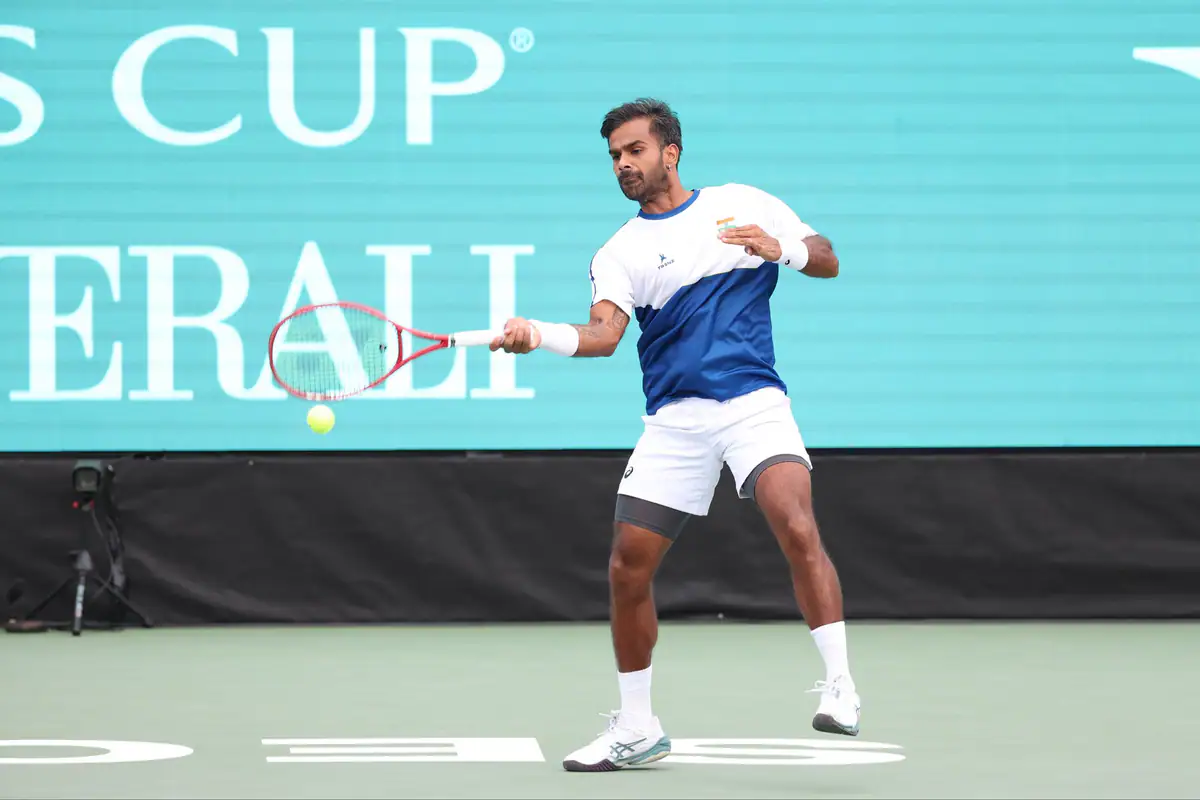
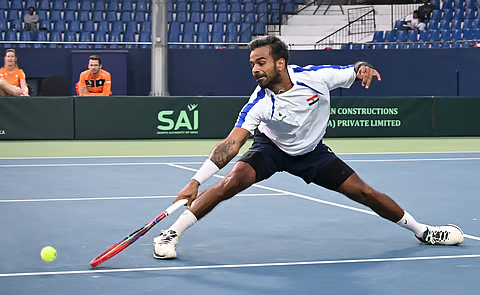
India’s Anirudh Chandrasekar, partnering Japan’s Takeru Yuzuki, produced a strong run at the ATP 75 Gwangju Challenger, finishing as runners-up in the doubles event after a closely contested final.
India’s Anirudh Chandrasekar, partnering Japan’s Takeru Yuzuki, produced a strong run at the ATP 75 Gwangju Challenger, finishing as runners-up in the doubles event after a closely contested final.
The second-seeded pair pushed the top seeds, Mac Kiger and Reese Stalder of the United States, to the limit before going down 4-6, 7-6(7), [8-10] in a match that was decided by fine margins. The final, played on center court, showcased the competitive edge that has defined Chandrasekar’s doubles game in recent seasons. Facing the top-seeded American duo, the Indo-Japanese pair had to navigate a challenging opening set where Kiger and Stalder imposed early pressure. The Americans secured the first set 6-4, capitalising on key points and maintaining a steady service rhythm.
Despite the setback, Chandrasekar and Yuzuki responded with composure in the second set. The pair tightened their service games and began to find better coordination at the net, an area that proved decisive as the match progressed. With neither team able to secure a decisive break, the set moved into a tiebreak.
In the tiebreak, the second seeds showed resilience under pressure. They managed crucial points at key moments, edging out the Americans 9-7 to level the match. The ability to recover from a set down against the top seeds reflected both tactical adaptability and mental strength, particularly in a format where momentum shifts can be decisive. The match then moved into a super tiebreak, a format that often compresses the contest into a high-pressure sequence of points. Chandrasekar and Yuzuki stayed within reach throughout, matching their opponents point for point. However, in the closing stages, Kiger and Stalder held their nerve to secure a narrow 10-8 win, sealing the title.
While the final result went in favour of the American pair, the performance of Chandrasekar and Yuzuki throughout the tournament highlighted their growing effectiveness as a partnership. Their run to the final included a series of strong wins, demonstrating consistency across rounds. In the quarterfinals, they overcame JiSung Nam and Patrik Niklas-Salminen in a tight three-set contest, winning 7-6, 3-6, [10-7]. The match required sustained focus, particularly in the deciding super tiebreak, where they executed key points effectively to progress.
The semifinal presented another test, where they faced the pairing of Pruchya Isaro and Niki Kaliyanda Poonacha. Chandrasekar and Yuzuki came through in straight sets, 7-6(5), 7-5, in a match that again highlighted their ability to handle pressure situations. Their performance in both tiebreaks across matches suggests a level of composure that is critical in doubles tennis. For Chandrasekar, this result adds to a consistent run on the Challenger circuit. The Indian doubles specialist has been steadily building his ranking through performances like these, where deep runs translate into valuable points. His ability to adapt to different partners and still deliver results is a notable aspect of his game.
The partnership with Yuzuki also showed promise. Doubles success often depends on chemistry as much as individual skill, and their coordination improved across the tournament. By the final, they were able to challenge a top-seeded team on nearly equal terms, indicating a partnership that could deliver more results with continued collaboration.
From a broader perspective, reaching the final of an ATP Challenger 75 event reflects a competitive level just below the main tour. Performances at this level are critical stepping stones for players aiming to break into higher-tier tournaments. For Chandrasekar, consistent results in such events will be key to improving his ranking and gaining entry into ATP Tour-level competitions.
The narrow loss in the final also underscores the fine margins in doubles tennis. Matches often hinge on a few points, particularly in tiebreaks and super tiebreaks. In this case, the difference between the two pairs was minimal, with both teams displaying strong serving and net play throughout. Despite falling short of the title, the campaign can be viewed as a positive outcome. A runner-up finish at a Challenger event provides ranking points, match confidence, and validation of performance levels against quality opposition.
Looking ahead, the focus for Chandrasekar will be on maintaining this level of consistency. Building on such performances and converting finals into titles will be the next step in his progression. For the partnership with Yuzuki, the experience of competing deep into the tournament could serve as a foundation for future events. The Gwangju Challenger campaign ultimately reflects a broader trend in Indian doubles tennis, where players are increasingly competitive on the international circuit. While titles remain the goal, performances like this indicate that Indian players are consistently positioning themselves within reach of success.
For Chandrasekar and Yuzuki, the final may have ended in a narrow defeat, but the journey through the tournament reinforces their capability to compete at a high level. The next challenge will be turning such close contests into victories.
Comments (0)
to post comments, replies, and votes.
Loading comments…