India U17 Held by Qatar in Doha as Preparations Intensify for Asian Cup
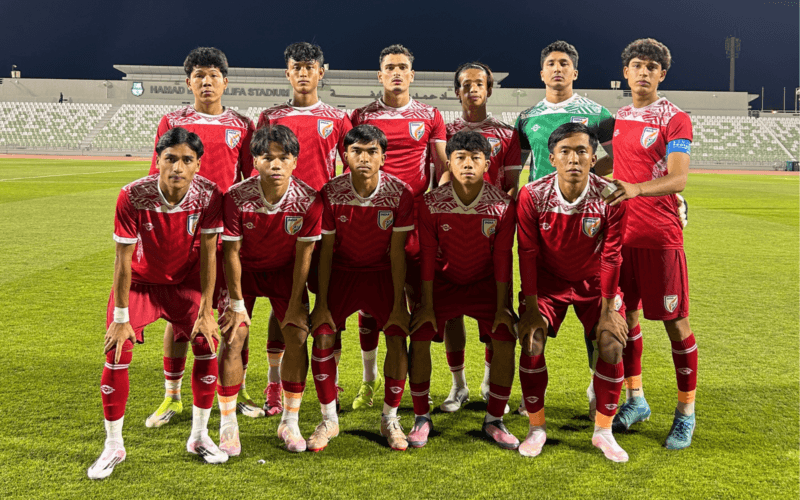
India’s U17 men’s team continued their preparations for the AFC U17 Asian Cup Saudi Arabia 2026 with a competitive 1-1 draw against Qatar in an international friendly held in Doha.
India’s U17 men’s team continued their preparations for the AFC U17 Asian Cup Saudi Arabia 2026 with a competitive 1-1 draw against Qatar in an international friendly held in Doha.
The match, played behind closed doors at the Hamad bin Khalifa Stadium, offered both sides an opportunity to assess their squads ahead of the continental tournament. The Blue Colts, who are entering a crucial phase in their development cycle, showed resilience and structure against a technically strong Qatari side. While the result ended level, the performance provided valuable insights into areas of strength and aspects requiring refinement before the tournament begins in early May.
The first half was characterised by cautious play from both teams, with possession largely contested in midfield. Qatar, playing at home, attempted to control the tempo through short passing sequences and structured build-up. India, meanwhile, focused on maintaining defensive discipline and looked to exploit transitions when opportunities arose.
Chances were limited in the opening period, as both defences held firm. India’s backline remained organised, restricting Qatar’s ability to create clear openings in the final third. At the other end, India showed glimpses of attacking intent but struggled to convert their forward movements into shots on target. The game opened up more in the second half, with both sides increasing their attacking urgency. India began to find better rhythm, particularly in wide areas, and looked more confident in possession. Their efforts were rewarded in the 67th minute through Denny Singh Wangkhem.
The goal came as a result of a well-constructed attacking move, with India capitalising on space in the Qatari defence. Denny showed composure in front of goal, finishing effectively to give India the lead. The strike not only reflected his individual quality but also highlighted the team’s ability to execute under pressure. Taking the lead allowed India to shift their approach, focusing on maintaining structure and managing the game. However, Qatar responded by increasing their attacking intensity, pushing numbers forward in search of an equaliser.
The hosts eventually found their breakthrough in the 82nd minute. Sustained pressure led to a goal that brought Qatar level, ensuring that the match ended in a draw. While India will view the concession as an area to improve, it also reflected the competitive nature of the contest, with both teams testing each other until the final stages. From a tactical perspective, the match served its purpose as a preparatory fixture. India demonstrated defensive organisation and the ability to remain competitive against a strong opponent. The midfield showed moments of control, while the attacking unit created opportunities when space was available.
At the same time, the game highlighted areas that require attention. Maintaining concentration in the closing stages, improving decision-making in the final third, and converting possession into consistent goal-scoring chances will be key focus points as the team moves forward. The draw also underlined the importance of match experience at this level. Facing teams with different styles of play allows young players to adapt and develop a better understanding of in-game scenarios. Such exposure is critical ahead of a tournament where margins are often minimal.
India and Qatar are scheduled to meet again on April 28 for a second friendly, which will provide another opportunity to fine-tune strategies and assess player combinations. These matches are part of the final phase of preparation before the AFC U17 Asian Cup, where India will face Australia, Uzbekistan, and DPR Korea in Group D.
The upcoming fixtures will be significantly more demanding, with each opponent presenting unique challenges. Australia’s physicality, Uzbekistan’s tactical discipline, and DPR Korea’s structured approach will test India across multiple dimensions. In this context, the draw against Qatar can be viewed as a constructive step. It offered a realistic assessment of the team’s current level and provided a platform to build upon in the days leading up to the tournament. For the Blue Colts, the focus now shifts to consistency and execution. While performances in friendlies are important, translating those into results on the continental stage will define their campaign.
The result in Doha may not have produced a winner, but it delivered exactly what was needed a competitive environment, valuable lessons, and a clearer picture of the road ahead for India’s U17 squad.
Comments (0)
to post comments, replies, and votes.
Loading comments…