Vishal TK and Gurindervir Singh: How Indian Sprinting Crossed Two Long-Standing Barriers at Ranchi
On a warm May evening in Ranchi, Indian athletics quietly crossed two thresholds it had been chasing for a very long time.
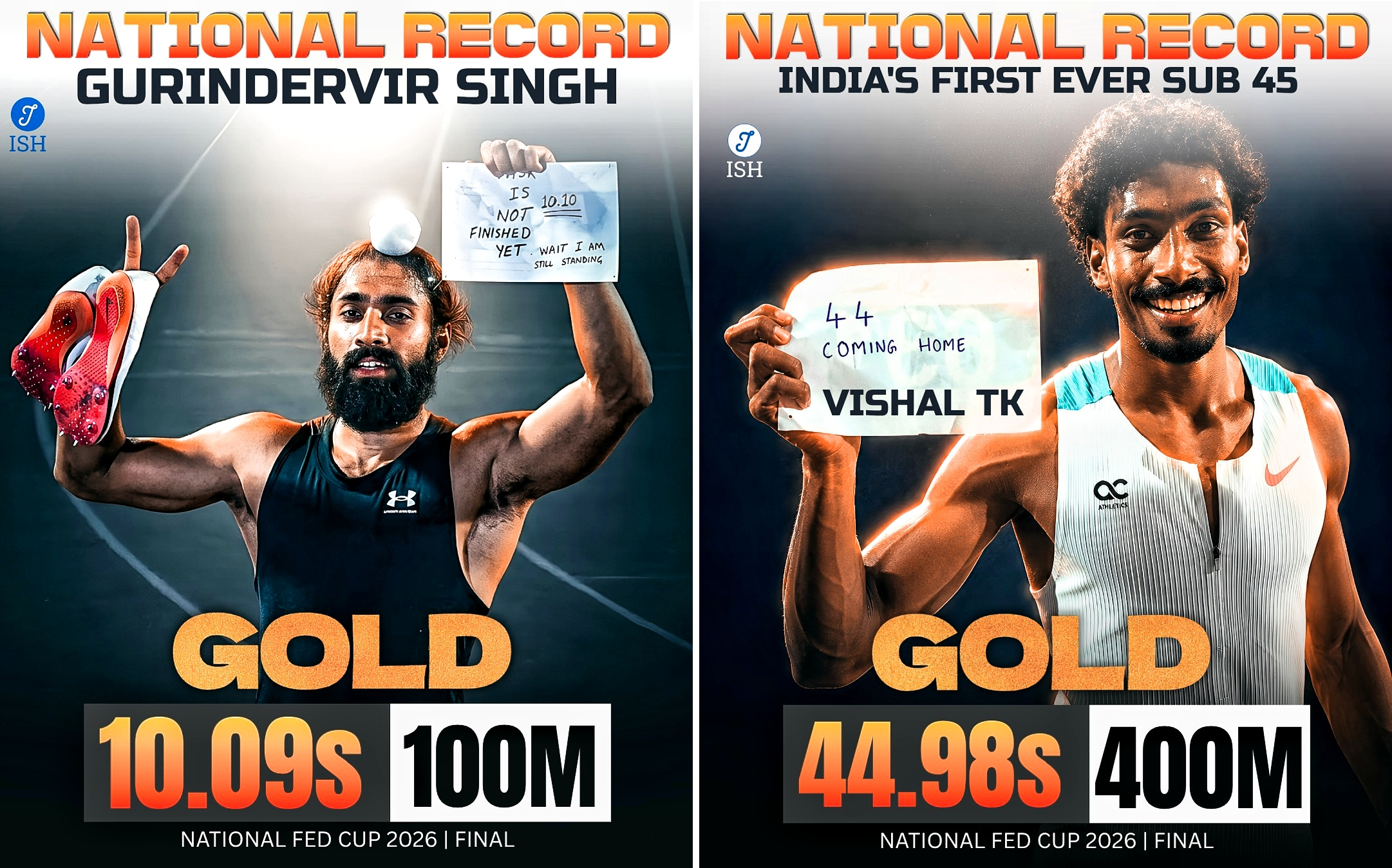
On the same track, in two finals separated by a few hours, Gurindervir Singh ran the 100m in 10.09 seconds and Vishal TK ran the 400m in 44.98 seconds. Both are new national records. Both came at the 29th National Senior Athletics Federation Cup at the Ranchi on 23 May 2026. And both, in their own way, are records the country had been waiting on for years.
If you do not follow track and field closely, here is a short version of why this matters.
The 100m: a 25-year-old ceiling, finally undone
For most of this century, Indian sprinting was defined by one number. In July 2000, in Bengaluru, Anil Kumar ran the 100m in 10.21 seconds. But in the absence of doping control the time was not ratified by the Indian Federation. That mark stood unofficially for a very long time as the national record. Through several Olympic cycles, multiple coaching regimes, and generations of athletes coming and going, nobody ran faster.
The first crack appeared on 28 March 2025 in Bengaluru, when Gurindervir Singh, a 24-year-old sprinter from Jalandhar, clocked 10.20s at the Indian Grand Prix, erasing the previous mark set by Manikanta Hoblidhar (10.23s) in 2023. Three and a half months later, Animesh Kujur of Odisha ran 10.18s at the Dromia International Sprint and Relays in Vari, Greece, and became the first Indian to dip below 10.20 second zone. By September 2025, Manikanta Hoblidhar had run 10.19s in Bengaluru. Three Indians had now run faster than 10.20 after twenty-five years of nobody doing it.
Then came Ranchi.
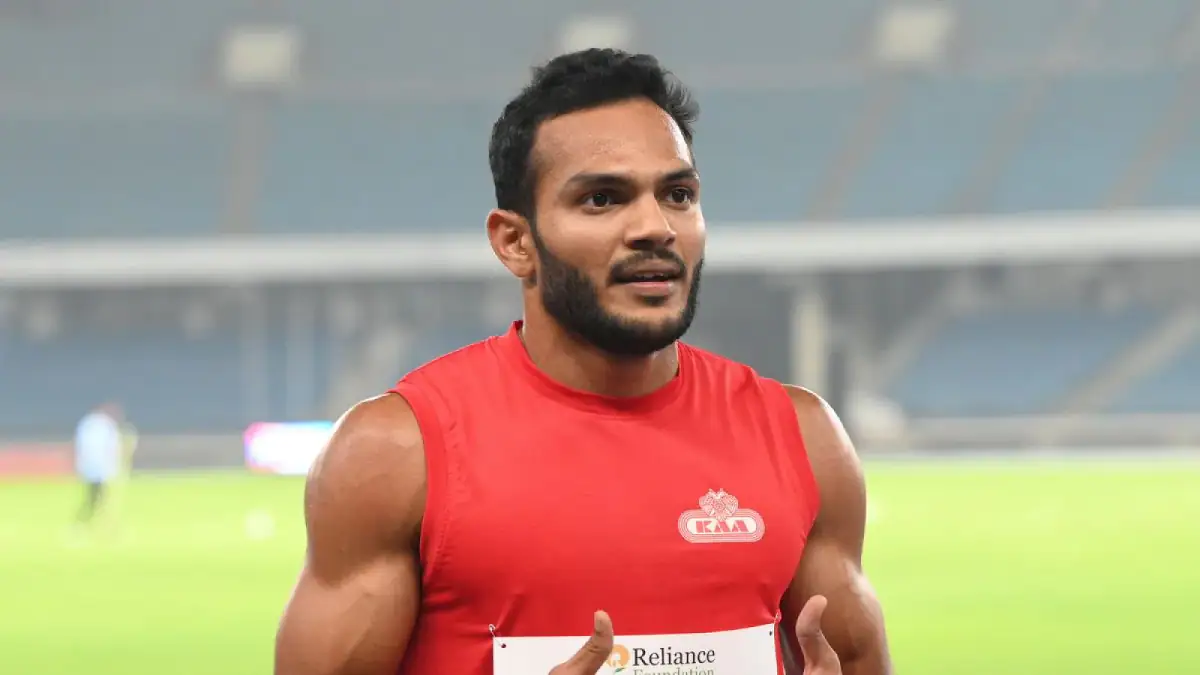
On Friday, 22 May, in the 100m semi-finals at the Federation Cup, Gurindervir Singh ran 10.17s in his heat and broke Animesh's national record of 10.18s. Within five minutes, in the very next semi-final heat, Animesh Kujur responded with 10.15s and took the record back, also clearing the Athletics Federation of India's Commonwealth Games entry standard of 10.16s in the process. Two national records, traded between two athletes, in the same evening.
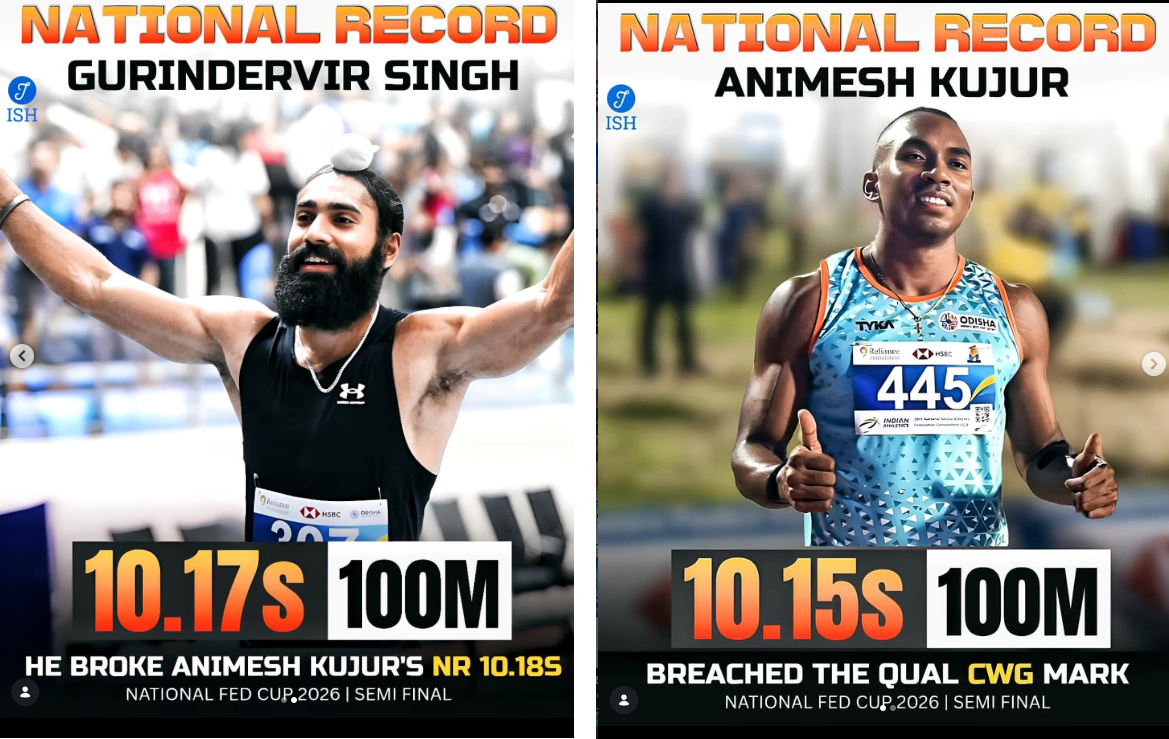
The Shortest National Record. Broken within 5 minutes
Twenty-four hours later, in the final, the script flipped again.
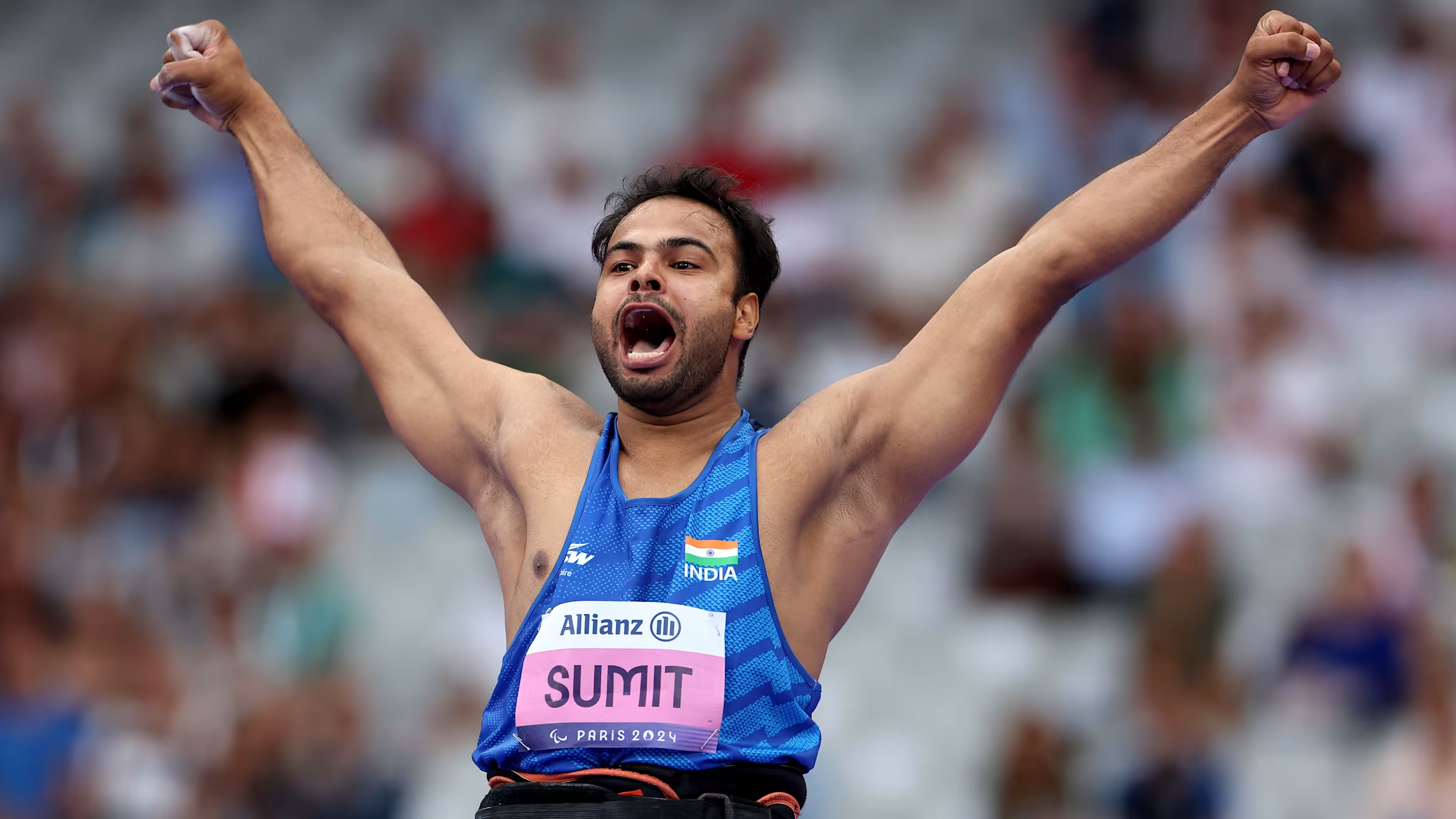
The wind reading was +0.3 metres per second, well within the legal limit for record purposes. Gurindervir, in lane four, got out cleanly, drove hard through the middle phase, and crossed the finish line in 10.09 seconds. The Birsa Munda Stadium scoreboard took a beat to process it. Then everyone else did.
In the space of 24 hours, India's 100m national record had moved from 10.18 to 10.17 to 10.15 to 10.09. Animesh Kujur, who had owned the record before this Federation Cup, finished second in the final with 10.20 - his own personal best from earlier in the year, but a full eleven-hundredths behind Gurindervir. Pranav Gurav, also from Reliance Foundation, was third in 10.29.
Saturday's final has not just rewritten the top of that list - it has pushed every previous best below it by a clear nine-hundredths. The next time World Athletics updates its all-time Indian rankings, 10.09 will sit alone at the top, the kind of gap that does not get closed casually.
The 400m: India's first sub-45-second man
If the 100m story has been one of gradual erosion over last 5 years, the 400m one belongs almost entirely to a single athlete who, who two years ago was not even running this event.
Vishal Thennarasu Kayalvizhi, from Tamil Nadu, switched to the 400m only in April 2024. Before that, he was a 100m and 200m sprinter who had not made much of a national mark. His earlier coach, Sreenivasan Ramaiah at the NCOE in Thiruvananthapuram, suggested he move up to the quarter-mile. Vishal's personal best in 2024 was 46.77 seconds. At one National Open meet in Bengaluru that year, he finished last in his race with 48.59s.
By April 2025 he had won the Federation Cup gold in 46.19s. By May 2025 he had run 45.57s to finish fourth at the Asian Championships in Gumi, South Korea. By August 2025 he had clocked 45.12s in Chennai at the Inter-State Senior Championships to break Muhammed Anas Yahiya's national record of 45.21s, which had stood for six years since being set in July 2019.
The number everyone in the Indian 400m circuit had been talking about ever since was 45.00. Globally, the sub-45-second mark is what separates good 400m runners from world-class ones. No Indian had ever done it. Anas's career best was 45.21. Vishal's 45.12, while a national record, still left him on the wrong side of that wall. In Ranchi on Saturday, with his coach Jason Dawson - the Jamaican who also runs India's 4x400m relay programme - watching from the stands, Vishal ran the final of his life. The official result is 44.98 seconds. India's first ever sub-45 over 400m. Vishal is 22 years old. The bib he held up to the camera afterwards read "44 COMING HOME".
The race itself was strong from front to back. Rajesh Ramesh, Vishal's Tamil Nadu state-mate and the third-ranked Indian on the all-time list with 45.26s set just two months ago in Trivandrum, finished second in 45.31s. Uttar Pradesh's Jay Kumar took bronze in 45.47s. The meet record, held since 2016 by Arokia Rajiv at 45.47s, was bettered by the top three finishers in the same race. A quiet indication of how the depth in this event has grown in the last 12 months. There is one footnote worth being honest about. The AFI's Commonwealth Games qualifying mark for the men's 400m is 44.96 seconds. Vishal missed it by exactly two-hundredths of a second. National record, gold medal, history - and still, technically, on the wrong side of the qualification number by the time you can blink. Whether the AFI picks him on discretion will be a separate conversation in the coming days. The 44.98 itself, however, is not going anywhere.
What today actually says about Indian sprinting
It is tempting to read these two performances as isolated brilliance. They are not. They are the visible part of a larger shift that has been building for a few years now. Two patterns are worth pointing out.
The first is the foreign coaching influence. Vishal trains under Jason Dawson at Thiruvananthapuram. Animesh Kujur trains under Martin Owens. James Hiller, who heads the Reliance Foundation sprint program, coaches Gurindervir Singh. India has, for the first time in a structured way, brought in international coaches and given them a clean runway to work with young Indian sprinters over multiple seasons. The results are showing up on the scoreboard.
The second is the role of private high-performance setups. The top three finishers in Saturday's men's 100m final - Gurindervir, Animesh, Pranav - all train out of the Reliance Foundation sprint group. The four fastest Indian sprinters of the last 14 months - Gurindervir, Animesh, Manikanta Hoblidhar, Pranav - all train within a few hundred metres of each other at the same high-performance centre. They push each other in practice. They race each other at every domestic meet. When the records start to fall, they fall fast, and they fall together.
Indian sprinting was, for a long time, a story of single athletes peaking once or twice and then disappearing. What is happening in 2025 and 2026 is something different. A group of athletes systematically taking the national bar down and dragging the next person along with them. The 100m record has been broken five times in 14 months, after standing untouched for a quarter of a century. The 400m record has now been broken twice in nine months by the same athlete, and the sub-45-second threshold that all of India was waiting for has finally been crossed.
The Commonwealth Games in Glasgow begin on 23 July. The men's sprint events from India just became something to actually watch, rather than something to politely hope about.
For everyone who has spent years writing, broadcasting, and following these athletes outside of the cricket spotlight, 23 May 2026 is a date worth remembering. The country has new fastest men in both the 100m and the 400m. Both were made in Ranchi. And both, going by the trajectories these athletes are on, are still well short of their best.
Comments (0)
to post comments, replies, and votes.
Loading comments…