Indian Men’s Marathon Running Enters Historic Phase as Sub-2:15 Barrier Falls
Indian Men’s Marathon Running Enters Historic Phase as Sub-2:15 Barrier Falls — latest Athletics news, results and analysis for Indian sports fans on IndiaSportsHub.
Indian men’s marathon running is witnessing perhaps its strongest phase in modern history, and the numbers from the last seven months underline a remarkable shift in standards, consistency, and depth.
A total of 10 sub-2:15 marathon performances have been recorded by Indian elite male runners during this period, a statistic that would have seemed almost unimaginable a few years ago. Leading the charge is Sawan Barwal, whose stunning 2:11:58 at the Rotterdam Marathon on April 12, 2026, not only shattered the national record but also signalled the arrival of Indian marathon running on a new level. The performances reflect more than just isolated breakthroughs. They indicate a growing culture of competitive distance running in India, with multiple athletes now consistently threatening elite timings on international courses.
Sawan Barwal’s National Record Headlines the Surge
The defining moment of this marathon boom came in Rotterdam, where Sawan Barwal clocked 2:11:58 to become the first Indian man to officially break the 2:12 barrier in the marathon. It was a landmark run in every sense. Running on one of the world’s fastest marathon courses, Barwal combined intelligent pacing with strong endurance over the final stages to erase the previous national record and establish a new benchmark for Indian distance runners.
The significance of the timing extends beyond the record books. Globally, sub-2:12 marathon performances are considered highly competitive and place athletes in serious contention for qualification standards at major global championships.
For Indian athletics, it represented proof that the country’s marathon ecosystem is beginning to produce internationally credible performances.
While Barwal produced the headline-making run, Man Singh’s consistency across multiple marathons deserves equal attention. The experienced marathoner accounts for four of the 10 sub-2:15 performances during this period:
2:13:15 — New Delhi Marathon (Feb 2026)
2:13:25 — Valencia Marathon (Dec 2025)
2:14:19 — Hamburg Marathon (Apr 2026)
2:14:41 — Eindhoven Marathon (Oct 2025)
That level of repeated high-performance marathon running is rare in Indian athletics. Marathons demand not just fitness but also durability, race planning, recovery management, and mental resilience. Producing four sub-2:15 timings across different international events shows that Man Singh has become one of India’s most dependable long-distance runners.
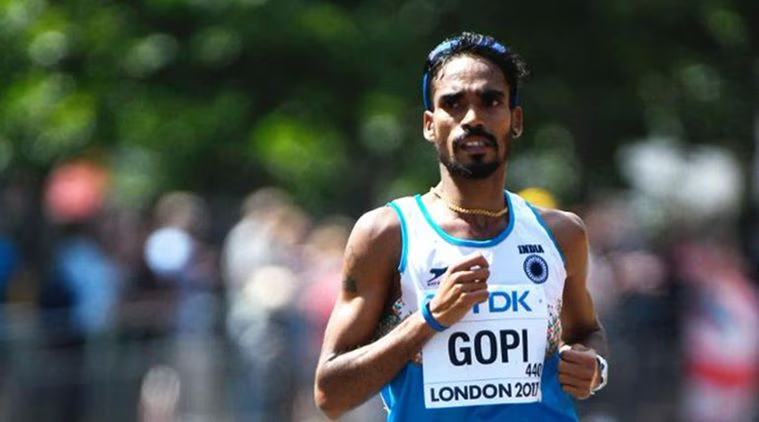
His consistency also highlights a crucial point: Indian marathon running is no longer dependent on one athlete producing a single standout performance. Another major contributor to this strong period has been Gopi T, who recorded three sub-2:15 timings within seven months. His performances include 2:12:23 at Valencia Marathon, 2:13:12 at New Delhi Marathon, 2:13:16 a Rotterdam Marathon
Gopi has quietly established himself as one of India’s most reliable marathon runners over recent years, and these timings reinforce his standing. What stands out most is the narrow gap between his performances across different races. That level of stability is often seen among mature international marathon runners and reflects improvements in training systems, race execution, and endurance conditioning. Beyond the established names, the emergence of athletes like Kartik Karkera and AB Belliappa adds another encouraging layer to Indian distance running. Kartik Karkera clocked 2:13:10 at the New Delhi Marathon in February 2026, while AB Belliappa ran 2:14:07 at the Valencia Marathon. These performances matter because they show increasing depth.
For years, Indian marathon running struggled with a lack of athletes capable of sustaining elite international pace beyond the halfway stage. Now, multiple runners are operating within a competitive time bracket. That depth creates internal competition, raises standards, and improves India’s chances at major international championships where team depth often matters as much as individual brilliance. Historically, Indian athletics has produced stronger results in middle-distance races, race walking, jumps, and throws. Marathon running remained an area where India lagged significantly behind global standards.
But several factors now appear to be changing the landscape with increased international exposure, better sports science support, improved altitude and endurance training, access to faster overseas marathon courses & greater professionalisation in distance running. The current generation is benefitting from more structured preparation and improved race opportunities abroad. Importantly, these runners are no longer merely participating internationally they are competing with credible timings.
The challenge now is sustainability. Producing one strong year is encouraging, but maintaining these standards over multiple seasons will determine whether Indian marathon running has genuinely entered a new era. The next target for Indian marathoners will likely be consistent sub-2:12 performances and eventually pushing toward the 2:10 mark, a barrier that still separates world-class marathon nations from emerging programs.
There is also growing interest around qualification pathways for major events such as the Asian Games, Commonwealth Games, World Championships, and eventually the Los Angeles 2028 Olympics.
https://www.indiasportshub.com/articles/harmanjot-singh-sanjivani-jadhav-lead-indian-charge-at-tcs-world-10k-bengaluru
The numbers from the last seven months tell a powerful story. Ten sub-2:15 performances by five different athletes. We have a new national record and multiple international-quality runs.
Indian men’s marathon running is no longer relying on isolated breakthroughs. It is beginning to build depth, consistency, and belief. And at the centre of this transformation stands a group of runners led by Sawan Barwal, Man Singh, and Gopi T who are steadily redefining what Indian marathon athletes can achieve on the global stage.
Comments (0)
to post comments, replies, and votes.
Loading comments…