Just One Loss in Five Matches: How India’s Women’s Hockey Team Has Rapidly Closed the Gap
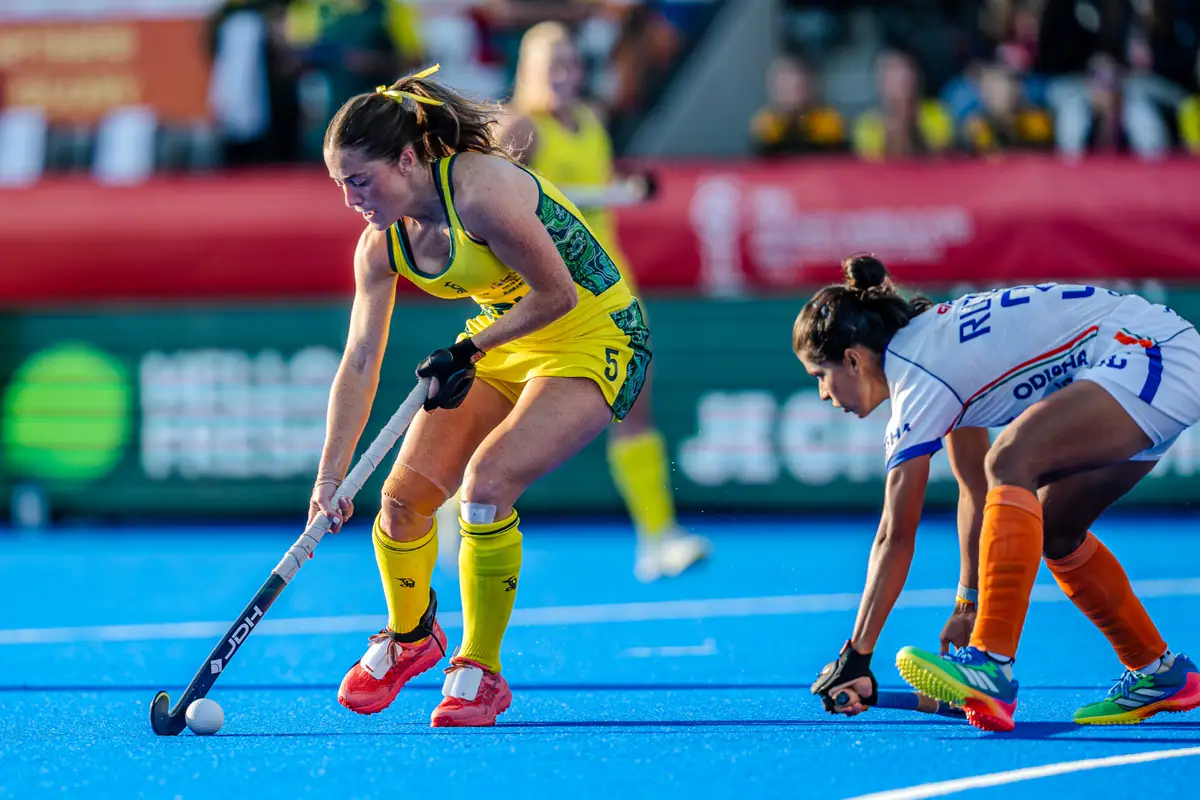
India’s women’s hockey team may have seen its FIH Hockey World Cup 2026 semi-final hopes end, but the broader picture tells a far more encouraging story. Just one loss in five matches.
For a team that has been searching for greater consistency, defensive stability and the ability to compete against the world’s strongest sides, the last few months have offered significant evidence of progress. India is still very much a work in progress, but the trajectory is becoming increasingly difficult to ignore.
The 0-0 draw against Australia, despite ending India’s hopes of reaching the semi-finals, was another example of how competitive this side has become. India needed to win; Australia only needed a draw, yet the higher-ranked Australians were unable to find a way past the Indian defence.
That result followed a World Cup campaign in which India had competed strongly and remained difficult to beat. The team may not yet have all the answers, particularly in the attacking circle, but the foundations appear to be getting stronger. And with the Asian Games and the Los Angeles Olympics 2028 still ahead, India has time to turn this progress into something more substantial.
The biggest positive from India’s recent run has been the increased sense of structure. This is no longer a side that looks capable of producing only occasional upsets. India are increasingly putting together complete performances, staying competitive for longer periods and making life difficult for established teams. The defensive organisation against Australia was particularly impressive.
Australia had greater possession in phases and created several dangerous moments, but India remained composed under pressure. Savita Punia made important interventions before Bichu Devi came into the match and produced some outstanding saves of her own. Salima Tete was also influential at both ends of the field. Her pace and work rate helped India progress down the right, while her defensive interventions became crucial during the closing stages when Australia looked to exploit India’s desperation for a winner.
India even removed their goalkeeper late in the match in an attempt to find the goal that would have sent them through to the semi-finals. It was a risk they had to take. The goal never came, but the performance itself showed a team willing to remain in the contest against one of the world’s strongest opponents.
That is important.
The attacking problem still needs solving
Of course, there are still areas that need improvement. The biggest remains India’s ability to convert promising attacks into goals. Against Australia, India repeatedly entered dangerous areas. Salima and Navneet created openings down the right, Deepika delivered dangerous balls into the circle, and India earned a penalty corner.
Yet the final touch was missing. That has been a recurring issue. India can compete in midfield and defend with discipline, but the margin between being a competitive team and becoming a genuine medal contender often comes down to what happens inside the opposition circle.
The best teams need fewer chances to score. India, at present, still needs to become more ruthless. Improving that aspect will be essential before LA 2028. The defensive platform can take India far, but major tournaments are often decided by one or two moments. India needs more players capable of consistently producing those moments.
The encouraging part is that this problem appears more solvable than some of the issues India has faced in the past. A strong defensive structure is already developing. The next step is to add greater attacking efficiency.
The Asian Games battle with China is getting bigger.
Before Los Angeles, however, there is another major target on the horizon. The Asian Games. India and China have increasingly emerged as the key rivals in Asian women’s hockey, and the battle for continental supremacy could have major consequences beyond the tournament itself. China remains a difficult opponent, and any India-China meeting in the latter stages would carry enormous significance.
For India, winning Asian Games gold would not simply be about adding another medal. It would provide validation that the team’s rebuilding process is working and reinforce its position among the strongest sides outside the traditional European powers. A potential final against China could also become a defining moment for this group.
India has the talent to challenge them. But they will need to continue improving their ability to control matches and score under pressure.
Perhaps the most important factor in the coming months will not even be on the field. It will be whether Hockey India allows this project to continue without unnecessary disruption. The team is showing signs of development. Systems appear to be taking shape, younger players are gaining exposure and the squad is beginning to build greater depth.
This is precisely the stage where continuity becomes crucial. Too often, progress in Indian sport can be interrupted by avoidable changes in personnel, strategy or selection. A team that is beginning to develop chemistry needs time. India does not need to believe that everything is perfect. It clearly is not.
But they also should not overreact to a tournament in which the semi-finals were missed despite a strong overall run. This World Cup campaign should be viewed as part of a larger process.
LA 2028 could be the real destination.
The most exciting part of this story is that the current team still has room to grow. There is time to improve the attacking combinations. There is time to increase depth. There is time for younger players to establish themselves. And there is time for India to build a more complete penalty-corner strategy.
If that happens, India could arrive at the LA Olympics 2028 as a far more dangerous team than they are today. The semi-final dream may have ended at the World Cup, but the larger journey is far from over. One loss in five matches is not a failure. It is evidence of a team that is becoming harder to beat.
India is still unfinished.
But if the current progress continues, and the programme is allowed to develop with stability and patience, this women’s team could become a much bigger threat on the road to Los Angeles.
Comments (0)
to post comments, replies, and votes.
Loading comments…