Manika Batra vs Wang Manyu: Can India’s Star Pull Off Another China Smash Shock?
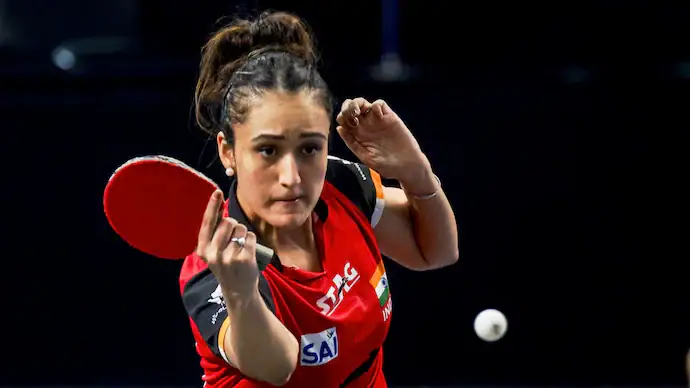
Manika Batra faces world No. 1 Wang Manyu at China Smash 2026 today at 5:15 PM IST. Here is their head-to-head history, current form and Manika’s upset chances.
Manika Batra vs Wang Manyu is one of the most intriguing Round of 32 matches at the WTT China Smash 2026, with the Indian paddler facing the world No. 1 and tournament top seed on Tuesday evening in Beijing.
The match is scheduled for 5:15 PM IST at Shougang Park. On paper, this is a major mismatch. Batra is ranked No. 53 in the world and entered the tournament on a wildcard, while Wang is the top-ranked player in the women's singles field. But their rivalry has already produced one of the biggest upsets of the WTT era.
And that is precisely why Manika cannot be written off.
The history between the two is fascinating. Wang Manyu won their first four singles meetings, including a 4-0 victory at the 2019 Korea Open and another 4-0 win at the 2024 ITTF World Cup. She also defeated Batra 3-1 at the 2024 World Team Championships. Then came May 2024 at the Saudi Smash.
Batra produced one of the biggest results of her career, defeating Wang 3-1 in the Round of 32. She lost the opening game 6-11 but completely changed the rhythm of the contest thereafter, winning the next three games 11-5, 11-7 and 12-10. That victory was significant not only because of Wang's ranking but because of the manner in which Batra dismantled one of the world's best players.
Her combination of long-pimpled backhand blocks, variation, unusual ball trajectories and aggressive forehand attacks prevented Wang from establishing the rhythm she normally imposes on opponents.
Wang eventually found the answer. When they met again at the China Smash 2025, the Chinese star won 3-0, 11-6, 11-5, 11-7. So the recent history is important: Batra has proved she can beat Wang, but Wang has also demonstrated that she can make the necessary tactical adjustments.
Batra's route into this match has already required considerable resilience. The Indian was pushed all the way by Brazil's Bruna Takahashi, the world No. 27, in the opening round.
Batra eventually prevailed 3-2, 8-11, 11-8, 11-9, 5-11, 12-10. The defining moment came in the deciding game. Trailing 8-10, Batra faced two match points. Instead of panicking, she changed the tempo, produced the necessary variation and closed out the contest 12-10. That is exactly the kind of match that can give an underdog confidence before facing the world's best player.
She has already had to solve a high-pressure tactical problem in Beijing. Now she faces an even bigger one.
Wang arrives as Asian Games champion
Wang Manyu's current form makes the task considerably harder. The Chinese star arrives in Beijing after winning the women's singles gold medal at the Aichi-Nagoya Asian Games. Her Asian Games campaign included a 4-0 victory over Shin Yu-bin and a 4-1 win against Miwa Harimoto before she defeated world No. 2 Sun Yingsha 4-2 in the final. At the China Smash, Wang opened her campaign with a comfortable 3-0 victory over Amy Wang, winning 11-3, 11-4, 11-8.
That was exactly the kind of start the top seed would have wanted. There is, however, one possible variable. Wang has had a demanding schedule. Her Asian Games triumph came only shortly before the China Smash, and the turnaround from Japan to Beijing has been short. Batra therefore needs to make the match physically uncomfortable and extend rallies whenever possible.
This is where the matchup becomes particularly interesting. Batra does not play like the majority of Wang's opponents. Her long-pimpled backhand can produce unusual spin and pace, while her ability to twiddle the racket means Wang cannot always predict the type of contact coming from the same side. That creates a problem for an attacking player. Wang's greatest strength is her ability to build pressure through powerful topspin exchanges, particularly from her backhand. She is comfortable taking the ball early, changing direction and eventually opening up the court.
Batra's job is to disrupt that sequence. She cannot simply allow Wang to settle into conventional topspin exchanges. The Indian needs to vary the placement, use her pimpled backhand to change the ball's trajectory and then attack the floating return with her forehand. The body and crossover area could become especially important. If Batra can repeatedly force Wang to make decisions between her forehand and backhand, she can potentially create the hesitation necessary to disrupt the Chinese player's rhythm.
Does Manika actually stand a chance?
Yes.
But the size of that chance depends almost entirely on whether she can recreate the tactical conditions that produced the Saudi Smash upset. The 2024 victory is proof that Wang is not unbeatable against Batra's style. However, the 2025 China Smash showed something equally important: once Wang and the Chinese coaching system have enough information about Batra's patterns, they can make adjustments.
That makes the opening games critical. Batra needs to make Wang uncomfortable before Wang settles. If the Chinese player gets into a rhythm of heavy topspin, controlled placement and consistent pressure, Batra's margin for error will become extremely small. If Batra can steal the opening game, however, the match could become psychologically interesting.
A best-of-five format also gives the underdog less time to be figured out compared with a longer best-of-seven contest.
Ultimately, this match will come down to whether Batra's variation can stay ahead of Wang's adaptation. Manika has the equipment, experience and tactical imagination to create problems for the world No. 1. She has already done it once. But Wang enters this contest with overwhelming consistency, superior ranking, recent Asian Games success and the memory of beating Batra comfortably at this same tournament last year.
That makes Wang the clear favourite on paper. For India, though, the encouraging part is that this is not a matchup without precedent.
Batra has already shown the blueprint. She needs an exceptional start, disciplined serve and receive, aggressive forehand conversion and constant variation from the backhand. Most importantly, she cannot allow Wang to dictate the first three shots of every rally.
At 5:15 PM IST, India's most unconventional table tennis weapon will once again face the world's No. 1 player — and this rivalry has already taught us that ranking numbers alone do not tell the entire story.
Comments (0)
to post comments, replies, and votes.
Loading comments…