Mohammed Ashfaq's Historic U20 World Championships Campaign Signals a Bright Future for Indian 400m Running
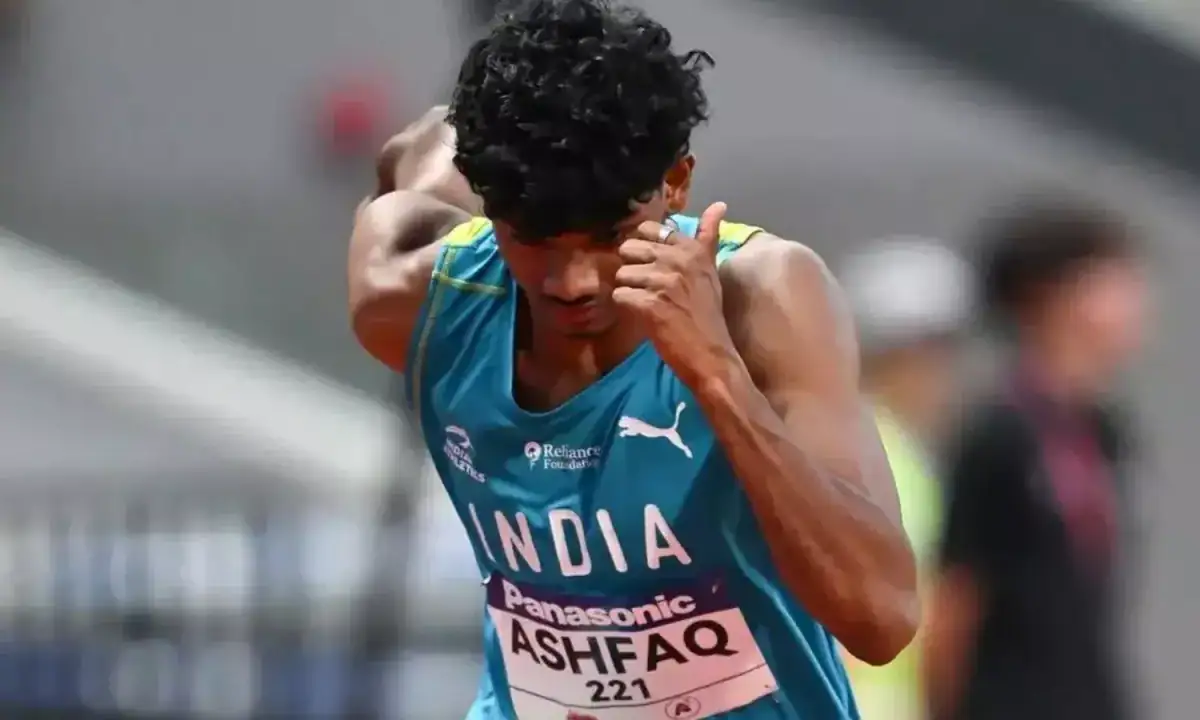
India's Mohammed Ashfaq may have finished eighth in the men's 400m final at the World Athletics U20 Championships 2026 in Eugene, Oregon, but the final result tells only a fraction of the story.
The 19-year-old leaves the championships as one of India's biggest success stories after rewriting the national record books, reaching a world final, and proving that he belongs among the fastest junior quarter-milers on the planet.
Ashfaq clocked 46.20 seconds in the final, bringing to an end an extraordinary three-race campaign that saw him produce the finest performances of his young career. More importantly, he became only one of a handful of Indian athletes to reach a World U20 400m final, underlining the progress Indian sprinting has made in recent years.
Ashfaq entered the championships with a personal best of 46.05 seconds. By the time he left Eugene, he had run faster than that mark twice. His remarkable progression through the competition showcased both his talent and his consistency.
Heats: 45.81s (New Indian U20 National Record)
Semifinal: 46.00s
Final: 46.20s
The opening-round performance of 45.81 seconds was particularly significant. Not only did it shatter his own Indian U20 national record, but it also placed him among the fastest qualifiers heading into the semifinals. He backed that performance up with another composed run of 46.00 seconds in the semifinal, securing his place among the world's top eight junior athletes. Although he could not reproduce another sub-46 performance in the final, reaching the championship race itself represented a major achievement.
A closer look at the official split timings reveals why Ashfaq could not quite match his earlier performances. Compared to the heats and semifinal, the Indian teenager adopted a far more aggressive opening strategy in the final.
Ashfaq's Split Comparison
Round | First 300m | Last 100m | Final Time |
|---|---|---|---|
Heats | 33.62s | 12.19s | 45.81s |
Semifinal | 33.81s | 12.19s | 46.00s |
Final | 33.20s | 13.00s | 46.20s |
The numbers tell an interesting story. During both the heats and semifinal, Ashfaq ran a controlled opening 300 metres before finishing exceptionally strongly over the final stretch. In the final, however, he went out much harder. Official World Athletics timings show that he reached the 200m mark in 21.80 seconds, compared to 22.31 seconds during his record-breaking heat.
That means he was 0.51 seconds quicker through the halfway stage. However, the increased pace came at a cost. Over the closing stages, fatigue set in, and his final 100 metres slowed considerably. While he covered the last 100 metres in 12.19 seconds during both the heats and semifinal, the final saw that split rise to 13.00 seconds.
That 0.81-second difference over the closing metres ultimately resulted in a finishing time 0.39 seconds slower than his national-record performance. It is a valuable learning experience for a young athlete competing in his first global championship final.
The men's 400m final was one of the highest-quality junior races ever witnessed. American Jayden DeLeon stormed to the gold medal in a championship record of 44.57 seconds, narrowly ahead of compatriot Quincy Wilson, who clocked 44.62 seconds. South Africa's Leendert Koekemoer completed the podium in 44.96 seconds.
Remarkably, it was the first time in World U20 Championships history that all three medallists ran under 45 seconds. Competing in such an exceptional field inevitably forced every finalist to make tactical decisions. Ashfaq chose to stay in touch with the leaders over the opening stages, a strategy that ultimately cost him over the final 100 metres.
Yet racing alongside some of the world's fastest junior athletes provides invaluable experience that cannot be replicated in domestic competition.
While the final placing may not fully reflect his ability, Ashfaq's overall campaign will be remembered as one of the finest ever by an Indian junior quarter-miler. His 45.81-second national record now headlines an extraordinary list. Ashfaq currently owns the five fastest performances ever recorded by an Indian U20 athlete in the men's 400 metres:
45.81s – World U20 Championships Heats (National Record)
46.00s – World U20 Championships Semifinal
46.05s – Previous National Record
46.20s – World U20 Championships Final
The fact that three of those performances came within three days on the biggest stage illustrates both his consistency and ability to deliver under pressure.
Indian sprinting has witnessed steady growth over the past decade, particularly in the 400 metres. From relay success on the continental stage to improving individual performances, the event continues to produce promising athletes. Ashfaq now appears to be among the brightest of that generation. At just 19 years of age, he has already shown he can compete with the world's elite juniors.
His record-breaking performances also suggest that further improvements are likely as he gains experience, strength and tactical maturity. The difference between his semifinal and final provides an important lesson in race execution. Learning how to distribute effort more efficiently over one lap could unlock even faster performances in the years ahead.
Medals often dominate headlines, but championships are also about development. Mohammed Ashfaq arrived in Eugene as an emerging talent. He leaves as India's fastest-ever U20 quarter-miler and a World U20 finalist who twice ran faster than the personal best he carried into the competition.
His eighth-place finish should not overshadow the significance of what he achieved across three days of competition. Breaking the national record, qualifying for a world final and consistently competing against athletes running among the fastest junior times in history represents a major milestone in his career.
For Indian athletics, Ashfaq's campaign offers another reason for optimism. With improved race management and continued development, the teenager has already shown he possesses the talent to compete on the biggest international stages. The World U20 Championships may have ended without a medal, but for Mohammed Ashfaq, it could well be remembered as the moment his senior international career truly began.
Comments (0)
to post comments, replies, and votes.
Loading comments…