Santiago Nieva Sets Early LA 2028 Olympic Qualification Target After Breakthrough 2026 for Indian Women Boxers
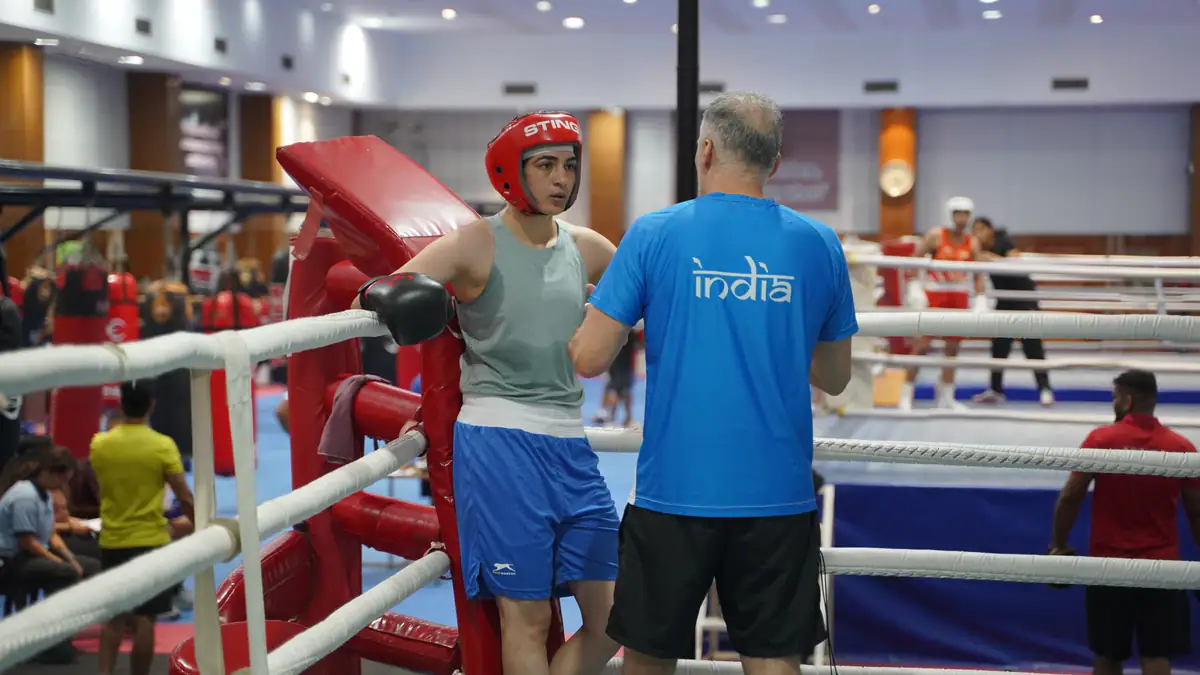
India’s women boxers have given national coach Santiago Nieva plenty to celebrate in 2026, but the Argentine is already looking beyond the medals and towards a much bigger objective: securing Olympic qualification as early as possible for the Los Angeles 2028 Games.
The Indian women’s boxing team capped a remarkable year with six medals, including five gold, at the Commonwealth Games in Glasgow, before adding three medals, including two gold, at the Aichi-Nagoya Asian Games. Yet for Nieva, the success of 2026 is not the destination. It is the foundation for an Olympic campaign that he wants to begin as early as possible. The first major opportunity will arrive at the 2027 World Championships in Kazakhstan, which will serve as the first Olympic qualification pathway.
“The first qualifier will be in Kazakhstan, which is the World Championships, where ideally we get as many quotas there as possible,” Nieva told SAI Media. The pathway will subsequently include the Asian Olympic Qualifier, followed by two further Olympic qualification events in 2028.
For Nieva, qualifying boxers at the earliest opportunity would provide India with something invaluable: time. Olympic preparation is rarely just about training harder in the months immediately before the Games. Once qualification is secured, athletes and coaches can dedicate greater attention to individual tactical preparation, physical conditioning, opponent analysis and competition planning.
“Ideally if we get to qualify next year early on, we get a good preparation time,” Nieva said. The coach, however, is under no illusion about the difficulty of the qualification pathway.
“It will be a tough pathway and hopefully we can qualify as many boxers as possible so we can form a strong team for the Olympics,” he added. That objective could shape India's international calendar from 2027 onwards, with every major competition potentially serving as part of the broader LA 2028 plan.
The success of the Indian women's team in 2026 did not come suddenly. Nieva attributes the results to a year-long preparation programme combining international exposure, domestic camps and high-quality sparring.
The team spent significant time at the Sports Authority of India National Centre of Excellence in Patiala, where the training environment has continued to evolve. For Nieva, the value of the Patiala set-up lies not only in the boxing sessions but also in the wider support system available to the athletes. Around 40 people work with the boxers at the centre, including approximately 20 coaches and another 20 members of the support staff.
“We have a staff of 40 people working with the boxers, around 20 coaches and another additional 20 support staff,” Nieva said. He pointed to improvements across several areas, including sports science, the boxing hall and equipment, arguing that India's high-performance infrastructure now compares favourably with leading international programmes.
“I would say there are not many countries who have better support,” he said. That depth of support has become particularly important as Indian boxing looks to build a sustainable pipeline rather than rely on individual medal contenders.
International sparring played a key role
One of the most significant components of India's preparation was the decision to bring strong international opposition into the training environment. The Dominican Republic and Iran teams travelled to Patiala for training camps, giving Indian boxers access to different styles and competitive sparring without having to wait for a major tournament. The team then travelled to Japan for the final stage of preparation before the Asian Games.
That final camp provided another opportunity to test the boxers against quality opponents and make tactical adjustments before the competition began. “We had a good final preparation in Japan, where we also got good sparring. We came very well prepared for the Asian Games,” Nieva said. The results in Aichi-Nagoya suggest that preparation translated effectively into competition.
India's women boxers returned from the Asian Games with three medals, including two gold, adding to the exceptional Commonwealth Games campaign earlier in the year.
The temptation after such a successful season would be to celebrate and allow the team to enjoy the results. Nieva's message is different. The Asian Games medals are evidence that the system is moving in the right direction, but they do not guarantee success at the Olympics. The LA 2028 qualification process will demand another level of consistency, while the global women's boxing field continues to evolve.
“We cannot rest on this. We have to continue looking forward and in the end we all want great success at the next Olympics,” Nieva said. That mentality could prove crucial.
Indian women's boxers have demonstrated in 2026 that they can deliver on major multi-sport stages. The next challenge is converting that momentum into a strong Olympic qualification campaign and, eventually, a deeper and more competitive team at Los Angeles 2028. For Nieva, the roadmap is already clear.
Qualify early. Prepare properly. Build a strong team. Then target Olympic success.
After a season that has established India's women boxers as one of the country's strongest sporting groups, the real LA 2028 campaign has effectively already begun.
Comments (0)
to post comments, replies, and votes.
Loading comments…