Shahnavaz Khan Soars to 8.23m, Rewrites U20 National Record and Signals India’s Next Long Jump Star
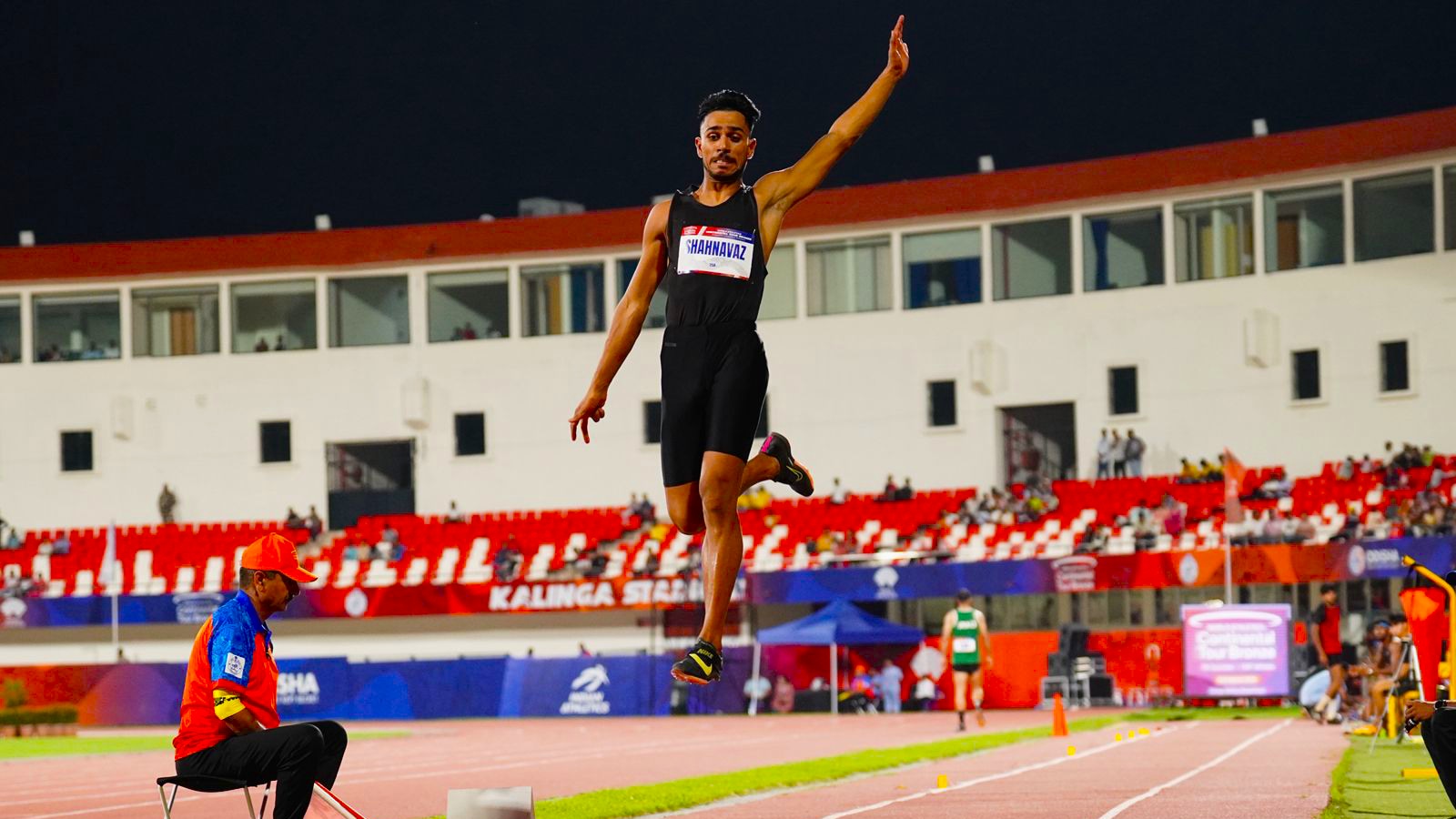
Indian athletics witnessed a landmark performance at the Junior Federation Cup in Tumkur as Uttar Pradesh’s Shahnavaz Khan delivered a jump that has immediately altered the landscape of men’s long jump in the country.
The teenager recorded a stunning 8.23 metres to clinch gold in the U20 category, setting a new national record and announcing himself as a serious contender on the global stage. The mark eclipsed the previous U20 national record of 8.20m set by Murali Sreeshankar in 2018, a benchmark that had stood as a reference point for emerging Indian jumpers. Breaking that record is significant in itself, but the manner in which Shahnavaz achieved it adds further weight to the performance. His best effort came in the fifth round, a phase in the competition where athletes typically balance risk and execution. Producing a jump of that magnitude under pressure indicates both technical confidence and competitive maturity traits not often associated with junior athletes.
From a performance perspective, the 8.23m effort carries multiple implications. It is currently the best jump recorded by any Indian athlete this season, across both junior and senior categories. It also stands as the Asian lead in the U20 division and ranks second globally among junior athletes in 2026. More importantly, the jump comfortably surpasses the qualification standards for both the Asian U20 Championships and the World U20 Championships. In fact, the mark goes beyond the qualification thresholds for senior-level events such as the Asian Games and the Commonwealth Games, highlighting the level of performance achieved.
Long jump, as an event, demands a precise combination of speed, technique, and timing. The approach run must be controlled yet aggressive, the take-off executed with accuracy, and the flight phase optimised for maximum distance. A marginal error in any of these phases can significantly impact the final measurement. Shahnavaz’s jump suggests a high level of efficiency across these components. Clearing the 8.20m mark requires not just physical ability but also technical refinement, particularly in maintaining speed through the board and converting it into vertical lift without losing momentum.
The broader context of Indian long jump adds another layer to this achievement. In recent years, athletes like Murali Sreeshankar and Lokesh Sathyanathan have elevated the standard in the event, consistently crossing the 8-metre mark and pushing the boundaries of performance. Shahnavaz’s emergence introduces a new dimension to this progression. While Sreeshankar and Lokesh represent the current senior elite, performances like this indicate that the next generation is already operating at comparable levels. This depth is critical for sustained success, particularly in an event where international competition is intense.
The progression from junior to senior competition will now be the key phase in Shahnavaz’s career. While the U20 record establishes his credentials, maintaining consistency at this level is the next challenge. The transition often involves adapting to stronger competition, managing higher expectations, and refining technique under varied conditions.
Exposure to international competition will play a crucial role in this process. Competing against global athletes will provide benchmarks and help identify areas for improvement, particularly in aspects such as approach consistency and take-off precision. Another factor to consider is competition management. In elite long jump, athletes must often deliver their best performances within limited attempts, making decision-making during the series critical. Shahnavaz’s ability to produce his best jump in the fifth round suggests a growing understanding of these dynamics.
From a national perspective, this performance reinforces the upward trajectory of Indian athletics. The Junior Federation Cup is increasingly becoming a platform where athletes are not just meeting standards but surpassing them in significant ways. The fact that Shahnavaz’s mark stands above senior qualification benchmarks also raises interesting possibilities for future selection scenarios. While age categories remain distinct, performances of this level inevitably push athletes into consideration for higher-level competitions.
For now, the immediate focus will be on the upcoming U20 international events, where Shahnavaz will have the opportunity to translate this performance onto a global stage. Replicating or approaching this mark in international conditions will be the next indicator of his progression. The timing of this breakthrough is also notable. With Indian athletics entering a phase of increased competitiveness across disciplines, the emergence of athletes capable of delivering world-class performances at a young age adds to the overall momentum.
As the season unfolds, attention will naturally shift to consistency. A single outstanding performance establishes potential, but repeated results at a similar level define careers.
In Tumkur, Shahnavaz Khan delivered more than just a winning jump. He produced a performance that redefined expectations in Indian junior long jump a leap that not only broke a record but also signalled the arrival of a new contender in the event.
Comments (0)
to post comments, replies, and votes.
Loading comments…