Abhay Singh and Nipam Headline Sprint Breakthroughs at Junior Federation Cup
The Junior Federation Cup in Tumkur has once again underlined the depth of sprinting talent emerging in Indian athletics, with Abhay Singh and Nipam delivering performances that signal a shift in the U-20 landscape.
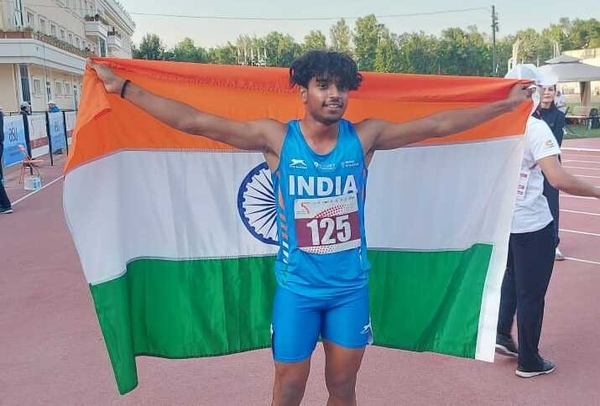
Across the men’s and women’s 100m events, the meet witnessed record-breaking runs, rapid progression, and a clear indication that the next generation is ready to push benchmarks higher. Abhay Singh’s performance in the men’s U-20 100m stood out not just for the time, but for its context. Clocking 10.41 seconds to win the final, he not only secured the gold medal but also broke an eight-year-old meet record previously held by Gurindervir Singh, who had run 10.47 seconds. The margin may appear small, but in sprinting, such improvements carry significant weight, especially at the junior level.
What makes Abhay’s run particularly notable is the composure with which it was executed. Sprint races at this level are often defined by variability starts, transitions, and race management can fluctuate. Abhay, however, delivered a controlled performance, maintaining speed through the latter stages and ensuring that his execution matched his potential.
Despite this breakthrough, his immediate international pathway remains limited. He is not eligible for the upcoming Asian U-20 Championships, which means his focus will shift towards transitioning into the senior circuit. In many ways, this positions him differently from his peers. While others prepare for junior continental exposure, Abhay’s trajectory now aligns more closely with senior-level competition, where the margins are tighter and the demands significantly higher.
His performance in Tumkur, therefore, carries a dual significance. It confirms his standing as one of the best U-20 sprinters in the country, while also raising expectations for how he adapts to the next phase of his career. The shift from junior dominance to senior competitiveness is rarely straightforward, but runs like 10.41 seconds indicate that the foundation is in place. If Abhay’s performance defined the men’s sprint narrative, Nipam’s progression across rounds shaped the women’s 100m story. Her campaign was built on incremental improvement, culminating in a national record-breaking run that highlighted both consistency and acceleration under pressure.
Nipam began her campaign in the heats with a time of 11.66 seconds, already a significant improvement over her previous personal best of 11.86 seconds set at last year’s Junior Federation Cup. That performance alone positioned her as a leading contender, while also ensuring she crossed the Asian U-20 qualification mark of 11.79 seconds. However, what followed was a demonstration of sustained progression. In the semifinals, she improved further, clocking 11.60 seconds to finish first. At that stage, the trend was clear each round was producing a faster time, indicating both physical readiness and effective race execution.
The final provided the defining moment. Nipam clocked 11.53 seconds, breaking the existing U-20 national record of 11.54 seconds held by Abhinaya Rajarajan. The improvement, though marginal in numerical terms, is significant in competitive context, as it reflects the ability to deliver peak performance at the most critical stage. Her run also secured the meet record, completing a sequence of achievements across the event personal best, qualification standard, meet record, and national record. Such a progression across rounds is rarely seen, particularly in sprint events where maintaining peak output over multiple races is challenging.
Beyond the numbers, Nipam’s performance reflects a broader shift in Indian women’s sprinting. The ability to consistently run in the low 11.5 range at the junior level indicates an upward movement in standards, with implications for future senior-level competitiveness. The semifinal also highlighted the competitive depth in the field. Aarti, who finished second with 11.81 seconds, narrowly missed the Asian U-20 qualification mark, underlining how tight the margins have become. This depth is critical for sustained development, as it ensures that top performances are not isolated but part of a competitive ecosystem.
The Junior Federation Cup itself continues to play a crucial role in this ecosystem. As a platform, it not only identifies emerging talent but also provides conditions where athletes can push their limits under competitive pressure. With over a thousand participants across events, the meet reflects the scale at which junior athletics is growing in India. For sprinters like Abhay Singh and Nipam, performances in such competitions serve as stepping stones. They offer validation of training, exposure to competitive scenarios, and a benchmark for future progression.
While Abhay’s immediate challenge lies in transitioning to the senior level, Nipam’s focus will shift towards the Asian U-20 Championships, where she will look to translate her national success into international results. Both athletes, however, represent different aspects of the same narrative—the emergence of a new generation capable of redefining standards. The results in Tumkur are not just about medals or records. They are indicators of trajectory. In sprinting, where progress is measured in hundredths of a second, the ability to consistently improve and deliver under pressure is what defines long-term success.
Abhay Singh’s record-breaking run and Nipam’s sequence of personal and national milestones together mark a significant moment for Indian junior athletics. The performances suggest that the gap between potential and execution is narrowing, and the next phase will be about sustaining this momentum on bigger stages.
As the season progresses, the focus will remain on continuity. For now, Tumkur has provided a clear signal India’s sprinting future is accelerating.
Comments (0)
to post comments, replies, and votes.
Loading comments…