Dharanidharan Headlines Fierce Javelin Field as Junior Federation Cup Sets Up High-Stakes Final
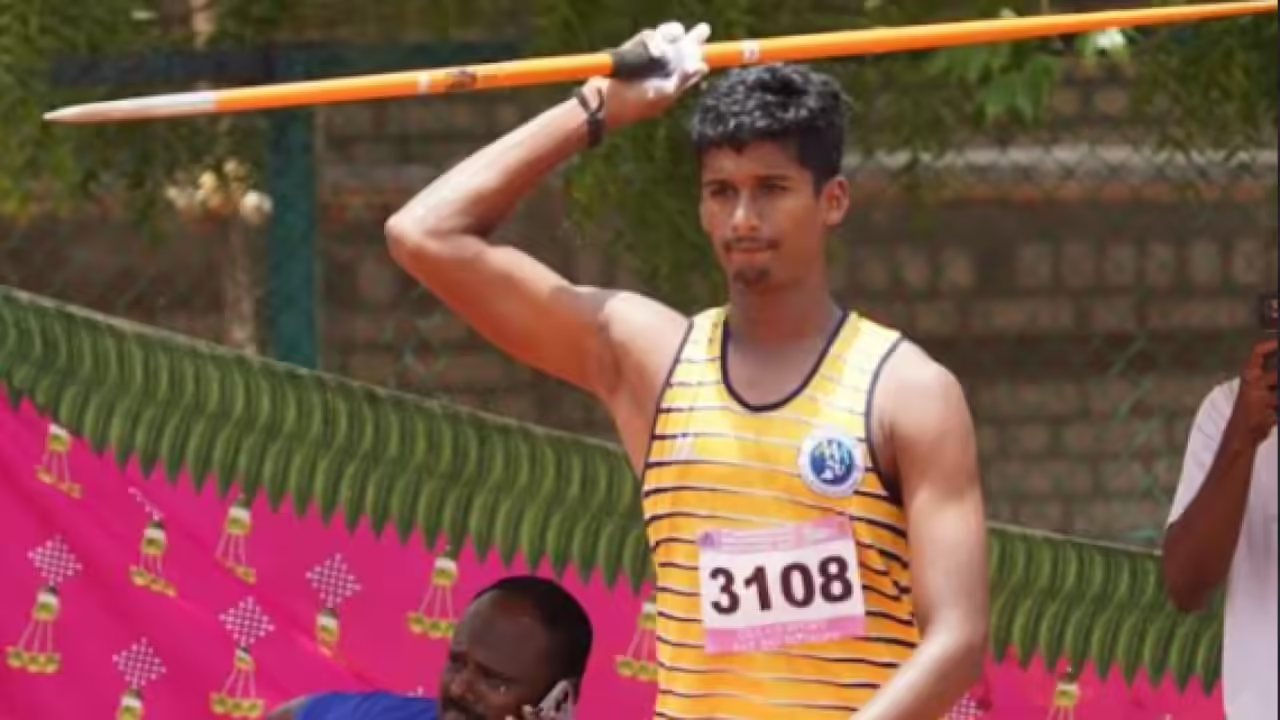
The men’s U-20 javelin throw qualification at the Junior Federation Cup in Tumkur has set the stage for one of the most competitive finals in recent Indian junior athletics.
At the centre of it stands Tamil Nadu’s T. Dharanidharan, whose throw of 70.65m not only secured qualification but also reinforced his position as one of the most consistent performers in the age group. While the mark itself is significant, the larger narrative is what lies ahead. The final on April 26 is not just about medals—it carries implications for selection to the Asian U-20 Championships, making every throw in the final potentially career-defining.
Dharanidharan’s performance in qualification reflects a trajectory built over the last three years. He has steadily progressed through state and national circuits, combining consistency with gradual improvements in distance. His 70.65m effort places him among the top contenders, but more importantly, it demonstrates his ability to deliver under competitive conditions. However, the qualification round also revealed a deeper and more competitive field than usual. A total of 11 Indian throwers breached the Asian U-20 qualification mark of 65.32m, turning what is typically a straightforward progression into a tightly contested battle for limited international spots.
Leading the field was Rishabh Giri, who recorded the best throw of qualification at 72.10m. His performance sets the benchmark heading into the final and positions him as a primary contender for gold. Alongside him, Dharanidharan’s 70.65m ensures that the gap at the top remains narrow. Rajat Kumar (69.83m) also entered the 70m range, reinforcing the quality at the upper end of the field. Ashish Yadav (67.43m), Himanshu (66.74m), and Mangal Singh (66.51m) further add depth, each capable of pushing beyond their qualification marks in a high-pressure final.
Kallolepa Bandiv (65.75m) and Chetan Jat (65.34m) completed the list of eligible throwers who crossed the qualification standard. With multiple athletes clustered around similar distances, the final is likely to be decided by marginal improvements rather than a single dominant performance. Adding another layer to the competition are Rohan Yadav (69.07m) and Pankaj Gavale (68.11m), both of whom also crossed the qualification mark but are not eligible for the Asian U-20 Championships. While they remain contenders for medals, their presence does not directly influence the allocation of international spots, creating a unique dynamic in the final.
From a competitive standpoint, this depth changes the nature of the event. In previous editions, a single throw above the qualification mark often secured both a podium finish and international selection. This time, however, the standard has shifted. Athletes will likely need to push beyond 70m and possibly closer to 72–73m to secure both medals and selection. For Dharanidharan, this represents both an opportunity and a challenge. His consistency gives him a strong foundation, but the final will demand more than stability. It will require a peak performance at the right moment, particularly against competitors who have already demonstrated similar or greater distances.
The technical demands of the javelin throw add further complexity. Factors such as run-up rhythm, release angle, and wind conditions can significantly influence outcomes. In a field where multiple athletes are closely matched, execution on the day becomes the defining factor. Beyond the men’s javelin event, the Junior Federation Cup has also produced significant results in other disciplines. In the women’s U-20 discus throw, national junior champion Amanat Kamboj delivered a standout performance, recording 52.27m on her fifth attempt. This throw comfortably surpassed the Asian U-20 qualification mark of 50.13m, securing her place for the continental event.
Kamboj’s performance highlights a parallel narrative within Indian junior athletics the emergence of athletes capable of meeting international standards across multiple events. Her ability to deliver the qualifying mark within a competitive setting reflects both technical development and competitive readiness. Returning to the javelin event, the final now carries heightened significance. With so many athletes in contention, the margins for error are minimal. A single foul throw, a slight misjudgment in approach, or a missed opportunity in early attempts could determine the outcome.
At the same time, the depth of the field signals a positive trend for Indian athletics. The presence of multiple athletes crossing the qualification mark indicates a broader base of talent, which is essential for sustained success at the international level. For Dharanidharan, the upcoming final represents a defining moment. His qualification performance has placed him firmly among the contenders, but the real test lies ahead. Delivering under pressure, against a field of similar calibre, will determine whether he converts consistency into a breakthrough result.
As the final approaches, the narrative is clear. This is not a one-athlete contest but a multi-layered battle where several throwers have the ability to claim top honours. With Asian U-20 berths on the line, the stakes extend beyond medals, making this one of the most anticipated events of the meet.
In Tumkur, the javelin runway is set. What follows will not just decide winners, but also shape the next wave of Indian throwers heading to the international stage.
Comments (0)
to post comments, replies, and votes.
Loading comments…