Asian Games 2026: Gonsalves-Baig Pair Eliminated After Two Teqball Defeats
 Follow
India’s men’s doubles campaign in Teqball at the 2026 Asian Games came to an early end as Declan Marshall Gonsalves and Mohamed Anas Baig suffered defeats in both their Group B matches, missing out on a place in the medal rounds.
The Indian pair, who entered the competition with a proven record on the international stage, lost their opening match to Vietnam before going down to South Korea in their second and final group fixture. The two defeats left Gonsalves and Baig at the bottom of Group B and ended their hopes of winning a medal in the sport’s Asian Games debut.
The Indian duo began their Group B campaign against Vietnam’s Truong Giang Ba and Anh Khoa Le at the Nagoya City Higashi Sports Center. Gonsalves and Baig were beaten 0-2, with Vietnam winning both sets by relatively narrow margins of 12-10 and 12-8.
The first set was particularly close, with India staying within touching distance of their opponents before Vietnam reached the 12-point mark. The second set saw the Vietnamese pair establish a more decisive advantage as they completed the straight-games victory. For India, the defeat meant that the second group match became crucial. With the Teqball competition using a group-stage format to determine progression, the pair needed a win against South Korea to remain in contention for the medal rounds.
That result, however, did not go their way.
In their second Group B encounter, Gonsalves and Baig faced South Korea, knowing that another defeat would bring their Asian Games campaign to an end. The Korean pair produced a strong performance, winning 2-0. The sets finished 12-4 and 12-7, giving South Korea a second consecutive victory and leaving India without a win from their two group matches. With two losses, Gonsalves and Baig finished last in Group B and were eliminated from the medal race.
Their final record at the Asian Games was therefore:
Vietnam 2-0 India — 12-10, 12-8
South Korea 2-0 India — 12-4, 12-7
India: 0 wins, 2 losses
The result brought a disappointing conclusion to the campaign for a pair that had already demonstrated its ability to compete successfully at the international level.
From World Championship Bronze to Asian Games Debut
The Indian duo had entered the Asian Games with an established pedigree. Gonsalves and Baig were part of the pair that won India’s first Teqball World bronze medal in 2024, making them among the country's leading representatives in the emerging sport. That background raised expectations around their Asian Games campaign, particularly with Teqball making its debut at the continental multi-sport event.
However, the competition provided a different challenge, and the Indian pair were unable to convert their previous international success into victories in Nagoya. Their early exit also illustrates the competitive nature of a sport that remains relatively new to the Asian Games programme.
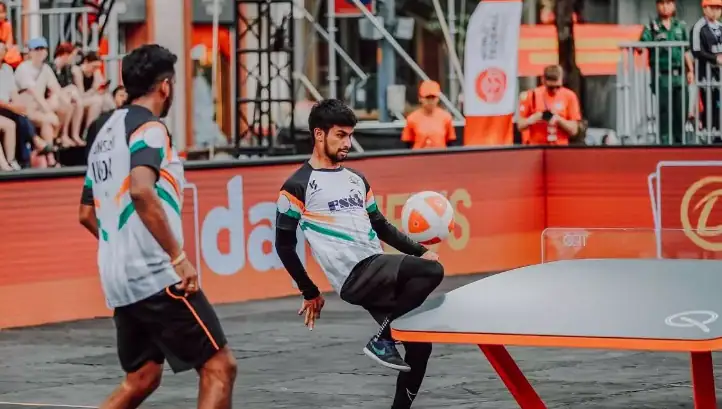
Teqball combines elements of football and table tennis, with players competing around a specially designed curved table. Rather than using their hands, athletes use their feet, heads and other permitted parts of the body to return the ball over the net. The format requires players to combine football skills with precise control, timing, movement and tactical awareness. The curved playing surface creates unusual trajectories, making anticipation and positioning important components of the game.
The Asian Games debut provides Teqball with a major international platform and introduces the sport to a much wider audience across Asia. For India, Gonsalves and Baig were among the athletes carrying the country's hopes in the men's doubles event.
Narrow Margins Against Vietnam
While the final result was a straight-games defeat, India's opening match against Vietnam showed that the contest was not entirely one-sided. The 10-12 opening set was decided by just two points, indicating that India were able to stay competitive against their Vietnamese opponents for significant periods. The second set ended 8-12, giving Vietnam the required two-set victory.
Against South Korea, however, the Indian pair faced a larger deficit. They managed seven points in the second set but were unable to prevent another straight-games loss. The contrasting scorelines demonstrate how quickly momentum can shift in Teqball, particularly in a format where sets are played to 12 points.
The Asian Games exit will undoubtedly be disappointing for Gonsalves and Baig, especially given their World Championship medal-winning credentials. At the same time, their participation provides valuable experience for Indian Teqball at a major continental event. As the sport continues to develop internationally, regular participation in high-level competitions will be important for India to build depth and establish more athletes capable of competing at the top level.
For Gonsalves and Baig, the campaign ended after just two matches, but their previous international achievements remain an important part of India's growing Teqball story. The Asian Games debut has also provided a wider stage for the sport itself, showcasing its unique combination of football technique, table control and athletic movement. For India, however, the immediate result is clear: two defeats, no wins and elimination from the men's doubles medal race.
The focus now will shift towards learning from the experience and using the exposure to strengthen India's presence in Teqball at future international competitions.
Comments (0)
to post comments, replies, and votes.
Loading comments…