Can India Better Its Historic Athletics Performance at Commonwealth Games 2026?
After winning eight athletics medals at Birmingham 2022, India heads to the Commonwealth Games 2026 with Neeraj Chopra leading a strong 43-member athletics and para athletics squad.
Athletics has traditionally been one of India's toughest sports at the Commonwealth Games. Competing against global powerhouses such as Australia, England, Jamaica, Kenya and South Africa has often meant that medals are difficult to come by. Yet, over the last decade, Indian athletics has undergone a remarkable transformation.
The 2022 Commonwealth Games in Birmingham marked India's finest athletics campaign in recent history. The contingent returned with eight medals—one gold, four silver and three bronze its best haul in track and field since Delhi 2010. The performances reflected India's growing strength not only in throws but also in jumps, race walking and middle-distance events.
Four years later, India heads to Glasgow 2026 with perhaps its strongest-ever athletics contingent. Led by Olympic champion Neeraj Chopra, the 43-member team, comprising 32 able-bodied athletes and 11 para athletes, carries genuine medal hopes across multiple disciplines.
Birmingham 2022: India's Best Athletics Performance in Years
India's athletics campaign in Birmingham produced memorable performances across track and field. The biggest breakthrough came in the men's triple jump, where India dominated the podium. Eldhose Paul scripted history by becoming the first Indian to win Commonwealth Games gold in the men's triple jump, producing a winning leap of 17.03m.
Remarkably, teammate Abdulla Aboobacker secured silver with 17.02m, completing a historic Indian one-two in the event. It was one of the defining moments of the Games and highlighted India's emergence as a global force in horizontal jumps.
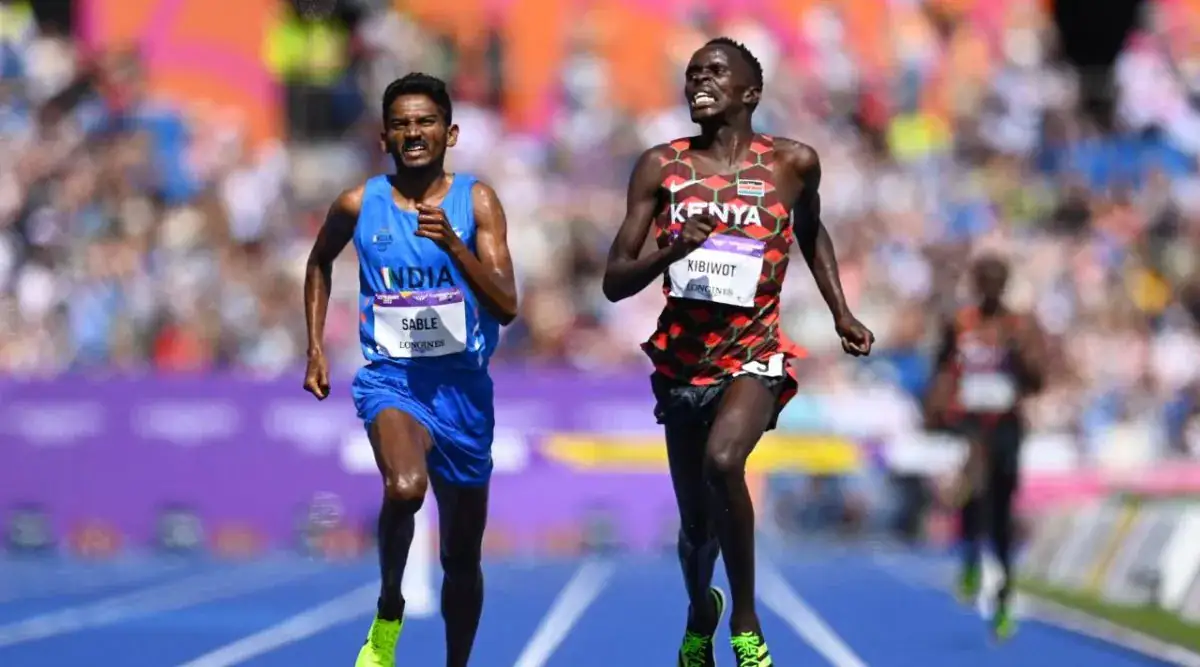
Another landmark performance came from Avinash Sable. Competing in the 3000m steeplechase, Sable broke his own national record by clocking 8:11.20, finishing second behind Kenya's Abraham Kibiwott. The silver medal was India's first-ever Commonwealth medal in the men's steeplechase and reinforced Sable's status as one of the world's leading distance runners.
Although he was forced to retire from the 5000m final due to injury, his steeplechase performance became one of India's standout moments in Birmingham.
India's jumpers enjoyed one of their finest Commonwealth Games campaigns. Sreeshankar produced an outstanding performance in the long jump, winning silver with a leap of 8.08m after qualifying comfortably for the final. Meanwhile, Tejaswin Shankar overcame significant challenges in qualifying for the Games before delivering India's first-ever Commonwealth Games medal in men's high jump, claiming bronze with a clearance of 2.22m.
The performances underlined India's growing competitiveness beyond its traditional throwing events.
Race walking once again emerged as a reliable medal discipline. Priyanka Goswami continued her impressive international form by winning silver in the 10,000m race walk, clocking a personal best of 43:38.83. On the men's side, Sandeep Kumar claimed bronze with another personal best, adding another valuable medal to India's tally.
The consistent performances demonstrated India's increasing strength in endurance events, traditionally dominated by Australia and Canada.
India's women also celebrated success in the throws. Experienced javelin thrower Annu Rani secured bronze with a best effort of 60.00m, adding another major international medal to her impressive career. Although several other Indian throwers reached finals, Annu ensured India maintained its strong record in the event.
The women's 4x100m relay team also impressed by finishing fifth, while athletes like Hima Das, Jyothi Yarraji and Dutee Chand gained valuable championship experience despite narrowly missing individual finals.
The biggest difference between Birmingham and Glasgow is one name. Neeraj Chopra missed the 2022 Commonwealth Games due to injury. This time, the Olympic and world champion leads India's challenge after enjoying another good season in 2025 that has included a 90-metre throw.
His presence instantly makes India a favourite for a medal in the men's javelin. Alongside Neeraj is Rohit Yadav, giving India two strong medal contenders in the event.
India's sprint programme has made remarkable progress since Birmingham. National record holder Animesh Kujur arrives in Glasgow after becoming the first Indian man to run 100m in under 10.20 seconds and setting a new national record in the 200m. He will be joined by Gurindervir Singh, another sub-10.30 sprinter, as India looks to challenge in sprint events that were once considered out of reach.
The men's 400m squad featuring Vishal TK, Rajesh Ramesh, Yashas Palaksha and Santhosh Kumar Tamilarasan also enters Glasgow with genuine relay ambitions following consistent improvements over the past two years.
India's field-event squad remains among its biggest strengths. Sreeshankar returns as one of the favourites in the long jump, while Tejaswin Shankar competes in the high jump after enjoying an outstanding collegiate career in the United States.
Triple jump medal hopes rest with Praveen Chithravel, while Selva Prabhu will represent India in the triple jump after steadily improving on the international circuit.
The throws department is equally formidable. Shot put veteran Tajinderpal Singh Toor returns alongside Samardeep Singh Gill, while Lokesh Sathyanathan strengthens the hammer throw contingent. The women's squad combines experience with emerging talent.
Parul Chaudhary headlines the middle-distance events after an outstanding run at the Asian level, while Priyanka Goswami once again leads India's race-walking challenge.
The throws unit includes Manpreet Kaur, Seema Kaliramna, Nidhi Rani, Rashdeep Kaur and Pooja Singh, giving India multiple medal opportunities.
Young athletes such as Ansa Babu, Neeru Pathak and Ravina Gaikwad will also gain valuable experience on the Commonwealth stage.
India's para athletics squad features 11 athletes, continuing the country's rise in international para sport. Experienced names such as Devender Kumar, Sharmila Dhankar, Shilpa K Shyla and Dilip Mahadu Gavit will lead the campaign, while several emerging athletes make their Commonwealth Games debut.
With para athletics becoming an increasingly important component of the Games, India will hope to add to its growing reputation in disability sport.
Can Glasgow Be Even Better?
Birmingham 2022 proved that Indian athletics has moved beyond relying on isolated stars. Success came across jumps, race walking, middle-distance running and throws, reflecting the sport's growing depth. Glasgow 2026 presents an opportunity to take the next step.
With Neeraj Chopra back in the squad, Sreeshankar and Tejaswin Shankar among the world's elite, Animesh Kujur spearheading India's sprint revolution, and a strong para athletics contingent adding further medal prospects, India enters the Games with unprecedented confidence.
Surpassing Birmingham's tally of eight athletics medals will not be easy, especially against traditional Commonwealth powerhouses. However, the quality and depth of this Indian squad suggest that another historic campaign is well within reach. If the country's leading stars perform to their potential and the next generation rises to the occasion, Glasgow could become the Commonwealth Games where Indian athletics reaches an entirely new level.
Comments (0)
to post comments, replies, and votes.
Loading comments…