From Empire to Commonwealth: How the Games Reinvented Themselves for Nearly a Century
From its origins in the British Empire to Glasgow 2026, here's the remarkable story of how the Commonwealth Games survived wars, politics and financial crises.
Every major sporting event leaves behind statistics, records and unforgettable moments. The Commonwealth Games have done all of that, but their greatest legacy is something less tangible. It is the story of survival.
Few sporting events have undergone as much transformation while retaining their identity. Born during the height of the British Empire, the Games have outlived the empire that created them, adapted to a changing political landscape, overcome financial uncertainty and remained relevant for nearly a century. As Glasgow prepares to host the 2026 Commonwealth Games, the event stands not merely as another multi-sport competition but as one of international sport's most remarkable stories of reinvention.
The origins of the Commonwealth Games can be traced back to 1891, when Reverend John Astley Cooper proposed a sporting festival that would unite nations of the British Empire through friendly competition. It was an ambitious vision, but the world was not ready.
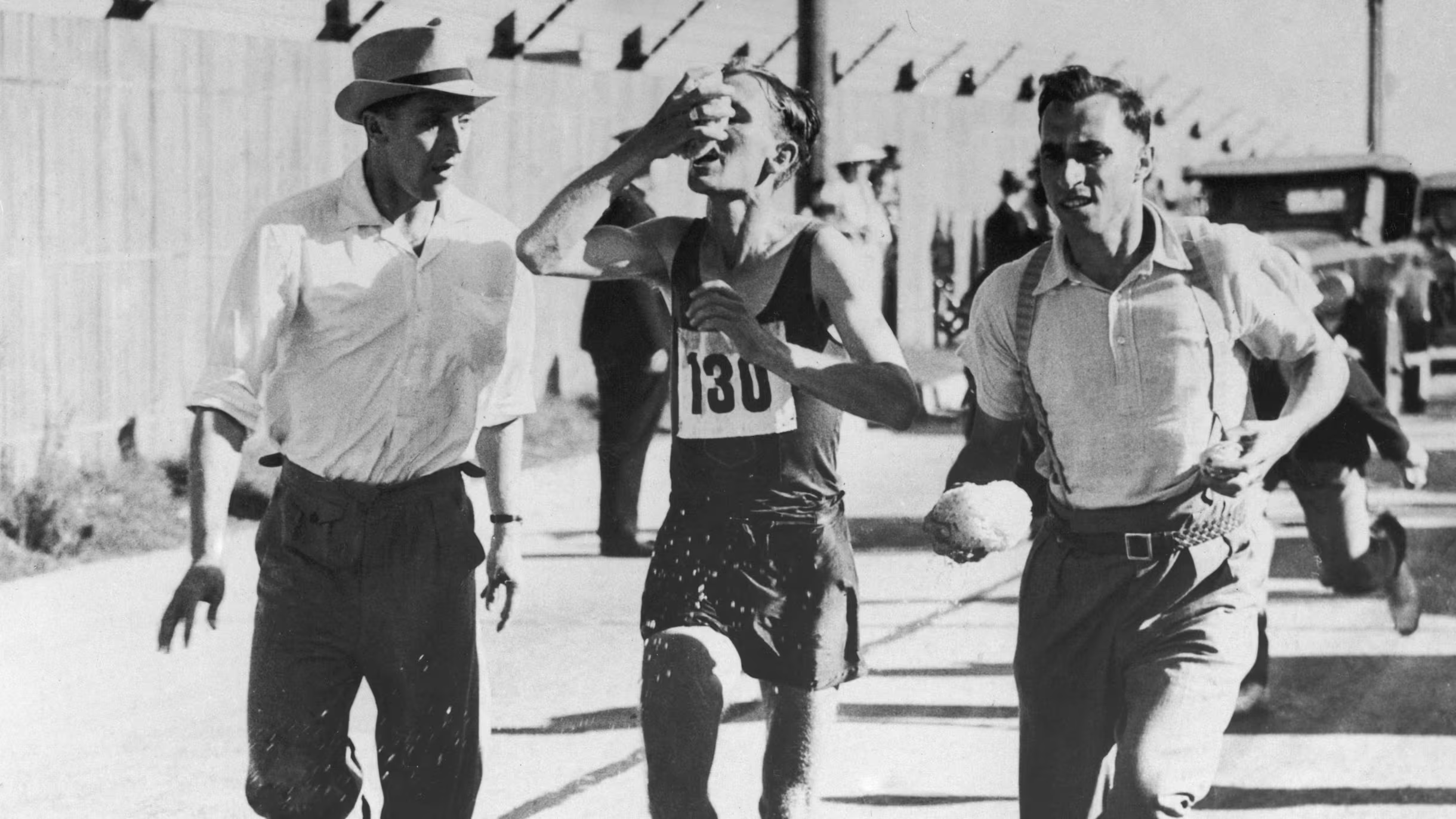
Political upheaval, economic instability and global conflict delayed its realisation for almost four decades. It was only in 1930 that the idea finally became reality when Hamilton, Canada, hosted the inaugural British Empire Games. Around 400 athletes representing 11 nations competed in six sports: athletics, swimming, rowing, boxing, lawn bowls and wrestling.
There were no extravagant opening ceremonies, no television audiences numbering in the millions and no commercial spectacle. The focus rested entirely on competition and camaraderie. Few could have predicted that the event would still exist nearly a century later.
The decades that followed transformed global politics. The British Empire gradually dissolved as countries gained independence and established their own identities. With each passing decade, the event had to redefine itself to remain relevant.
Its changing name reflected that evolution. From the British Empire Games, it became the British Empire and Commonwealth Games, then the British Commonwealth Games, before finally adopting the title Commonwealth Games in 1978.
These were more than cosmetic changes. They represented the transition from an event rooted in imperial history to one celebrating an association of independent nations connected by shared sporting traditions rather than colonial rule.
The Games evolved because they had little choice.
Unlike the Olympic Games, which enjoy unparalleled global prestige and financial stability, the Commonwealth Games have repeatedly faced questions about their future. Political boycotts disrupted editions during the Cold War era. Economic pressures made hosting increasingly expensive. Changing priorities within international sport forced organisers to constantly justify the event's place in an increasingly crowded calendar.
Each crisis prompted speculation that the Games might disappear. Yet every time, they found a way forward.
Their ability to adapt has become their defining characteristic. Rather than competing directly with the Olympics, the Commonwealth Games carved out a unique role by providing opportunities for athletes from developing sporting nations to compete on a major international stage.
India's Journey Mirrors the Games
India's own Commonwealth Games story reflects the broader evolution of the event. Competing initially as British India at the 1934 London Games, the country's sporting identity changed dramatically after independence. One of the defining moments arrived in 1958, when Milkha Singh won the 440 yards title in Cardiff.
His victory was historic. The Flying Sikh became the first Indian man to win an individual athletics gold medal at the Commonwealth Games, inspiring generations of athletes to believe they could succeed on the international stage.
Over the decades, India's medal-winning base steadily expanded. Initially driven by athletics, success soon spread to wrestling, weightlifting, shooting, badminton, boxing and table tennis. Rather than relying on isolated champions, India gradually developed a broader sporting ecosystem capable of producing consistent international performers.
No edition has had a greater impact on Indian sport than the 2010 Commonwealth Games in Delhi. Although the event faced criticism over infrastructure delays and organisational issues before competition began, the performances on the field told a different story. India produced its finest Commonwealth Games campaign, finishing second in the medal standings with 101 medals.
The success demonstrated that India was no longer merely participating; it had become one of the Games' leading sporting nations. More importantly, Delhi accelerated investment in coaching, infrastructure and athlete development, benefits that continue to influence Indian sport today.
Critics often compare the Commonwealth Games with the Olympics and question whether they remain relevant. The comparison misses the point.
The Commonwealth Games occupy a different space within international sport. For many athletes, they provide the first opportunity to compete at a major multi-sport championship. For emerging sporting nations, they offer realistic medal opportunities that can transform funding, public interest and athlete confidence.
Many Olympic champions first announced themselves on the Commonwealth stage. Not every Commonwealth medallist becomes an Olympic champion. But countless Olympic champions first discovered they belonged among the world's best at the Commonwealth Games.
That developmental role remains one of the event's greatest strengths.
Glasgow 2026: A New Model for Survival
The most significant challenge arrived in recent years. Escalating costs forced several potential hosts to withdraw, raising serious concerns about whether the Commonwealth Games could continue in their existing format. Once again, adaptation became the solution. Glasgow agreed to host the 2026 Games, but with a radically different approach.
The programme was reduced, existing venues were prioritised and unnecessary expenditure was eliminated. Rather than pursuing grandeur, organisers focused on sustainability. The result is a compact games centred on athletes rather than infrastructure.
In many ways, Glasgow represents a return to the principles that defined the first edition in Hamilton nearly a century ago.
As athletes march into Glasgow this July, they will become part of a sporting tradition that has survived challenges few international events have ever faced. Empires disappeared. Wars interrupted competition.
Political divisions tested unity. Financial pressures threatened the event's existence.
Yet the Commonwealth Games endured. Their greatest achievement is not measured in medal tables or world records.
It is measured in resilience. From a modest gathering of 400 athletes in 1930 to a modern multi-sport event spanning continents and cultures, the Commonwealth Games have repeatedly proved that relevance is earned through adaptation, not tradition alone.
The medals of Glasgow 2026 have yet to be won, but the Games have already accomplished something extraordinary.
Against the odds, they lived.
Follow more on Devasheesh's Substack
Comments (0)
to post comments, replies, and votes.
Loading comments…