From Gujarat To Centre Court: The Indian Link Behind Wimbledon's Iconic Towels
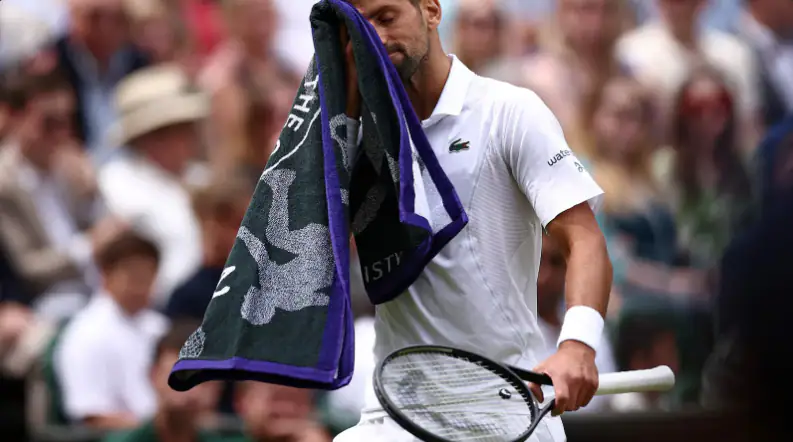
How a manufacturing hub in Gujarat became the secret powerhouse behind the All England Club’s most iconic souvenir.
How a manufacturing hub in Gujarat became the secret powerhouse behind the All England Club’s most iconic souvenir.
As the world’s finest tennis players battle for glory under the shifting skies of SW19, millions of spectators track the trajectory of furious volleys and precise baselines. Yet, during the crucial, breathless pauses between games, another fixture of the All England Club takes centre stage. Strikingly vibrant and instantly recognisable, the official Championships towels are slung over the shoulders of icons and tossed into courtside chairs. While the grass courts are intrinsically British, the physical fabric that absorbs the sweat of Grand Slam history traces its modern lineage to an industrial powerhouse thousands of miles away in Western India.
The journey of these highly coveted pieces of sporting memorabilia begins far from the manicured lawns of London. Since 2010, the entirety of Wimbledon’s official towel production has taken place in the manufacturing hub of Vapi, located in the Indian state of Gujarat. Through a cross-continental narrative of corporate acquisition and precision engineering, Indian textile weavers have quietly become the ultimate custodians of one of tennis’s most enduring visual traditions.
To understand how a factory in Gujarat came to supply the world's most prestigious tennis tournament, one has to look back at the shifting dynamics of global manufacturing. The story officially belongs to Christy, an upscale British home textiles heritage brand that dates its origins back to 1850 when its Manchester cotton mill created the very first looped terry towel for Queen Victoria. In 1988, Christy stepped onto the lawns of SW19 as the official towel manufacturer and supplier to the tournament, creating a brand partnership that would define the aesthetic of the competition for decades.
However, the dawn of the new millennium brought structural changes to the traditional British textile sector. In 2006, the Indian multinational textile giant Welspun acquired a controlling stake in Christy. Recognising the immense manufacturing capacity and technical prowess available in its home operations, the company eventually shifted the entire production machinery from the fading industrial landscapes of Greater Manchester to its state-of-the-art facility in Vapi. The transition was meticulous, ensuring that while the geography of the looms had fundamentally changed, the uncompromising luxury and stringently monitored standards required by the All England Club remained entirely intact.
Manufacturing merchandise for an event watched by hundreds of millions requires an extraordinary level of foresight. The production timeline for a single tournament does not span a few hectic weeks; rather, it is a continuous, eighteen-month cycle of planning, testing, and execution. Long before a single ball is struck on Centre Court, designers and factory managers in Gujarat are already analysing global fashion trends, testing dye vulnerabilities, and configuring complex loom patterns to prepare for the upcoming edition of the Championships.
The sheer volume and speed of production required as the tournament approaches is a testament to the industrial scale of the Vapi facility. During peak production phases, the factory floor can effortlessly churn out thousands of these premium towels within a single week. This process demands perfect synchronisation between automated high-speed weaving machines and skilled quality control technicians who inspect every square inch of fabric for structural anomalies, ensuring that no subpar product ever makes it to the hallowed grounds of London.
On the surface, a towel appears to be a straightforward utilitarian object, but the reality of top-tier athletic performance demands rigorous material science. A standard towel can easily fail under the intense friction and sudden moisture saturation of a five-set Grand Slam match. To prevent this, the engineers in Gujarat utilise a specialised short-loop terry weave. This unique structural framework maximises the surface area of the cotton yarn, allowing the fabric to achieve rapid moisture absorption while maintaining an extraordinarily quick drying time.
The raw material itself undergoes strict selection processes. The facility relies on premium long-staple cotton yarn, which provides the inherent strength necessary to prevent shedding and fraying under immense duress. This structural integrity ensures that the towels retain their distinct, plush softness and depth of pile, even after undergoing the aggressive, high-temperature industrial washing cycles that occur daily throughout the fortnight of the tournament.
The visual identity of Wimbledon is fiercely protected, and the towels must adhere to a strict colour psychology that works both on the ground and across digital broadcasts. The design philosophy bifurcates into two distinct stylistic paths every year. The men's tournament towels rigidly adhere to tradition, consistently featuring the classic, deeply institutional club palette of dark championship green, royal purple, and gold. These colours have remained virtually unchanged for years, acting as a direct visual anchor to the history of the tournament.
Conversely, the women's tournament towels serve as a canvas for contemporary experimentation, with the All England Club selecting a brand-new colour scheme annually. The creative process requires the Vapi team to formulate dyes that are brilliant to the naked eye but do not cause visual distortion or bleeding on high-definition television broadcasts. The tones must look perfectly saturated under natural sunlight, heavy overcast grey clouds, and the powerful artificial glare of the Centre Court roof lighting system.
Evolution of Court Souvenirs
Over the years, the relationship between the tennis elite and these vibrant pieces of fabric has evolved from simple utility into a legendary courtside ritual. It is an open secret within the tennis community that players routinely hoard their allocated on-court towels, packing them away into their gear bags after every single match. Superstars have openly admitted to filling entire suitcases with their tournament allocations, using them as prized gifts for family members or storing them away as personal milestones of their grand slam campaigns.
This widespread player habit has transformed the manufactured output from mere athletic equipment into highly sought-after consumer luxury items. Fans travelling from every corner of the globe line up outside the stadium souvenir shops, eager to purchase the exact same pieces of Indian-woven craftsmanship used by their sporting heroes. The immense global demand turns these towels into the single most successful merchandise item of the entire tournament, creating a direct economic bridge between the consumers in London and the weavers in Gujarat.
In the current landscape of global manufacturing, high quality cannot exist without an equally rigorous commitment to environmental ethics. The facility in Gujarat has pioneered several sustainability initiatives to ensure that the production of these high-profile souvenirs does not come at a devastating cost to the local environment. Textile manufacturing is historically notorious for its heavy water consumption, a factor that required a complete reengineering of the Vapi plant’s resource infrastructure to align with modern ecological mandates.
To mitigate this footprint, the production site operates with advanced wastewater recycling loops and sustainable energy systems, drastically minimising its reliance on local freshwater bodies. Furthermore, the final products comply with strict international ecological certifications, guaranteeing that no hazardous chemicals or toxic dye fixatives are utilised during the manufacturing cycle. This alignment of traditional Indian textile expertise with forward-thinking sustainable practices ensures that as long as players sweat on the lawns of Wimbledon, the threads connecting Gujarat to Centre Court will remain unbreakable.
Comments (0)
to post comments, replies, and votes.
Loading comments…