From Losing to Indian Women to Making FIFA World Cup History: Malawi’s Remarkable Rise
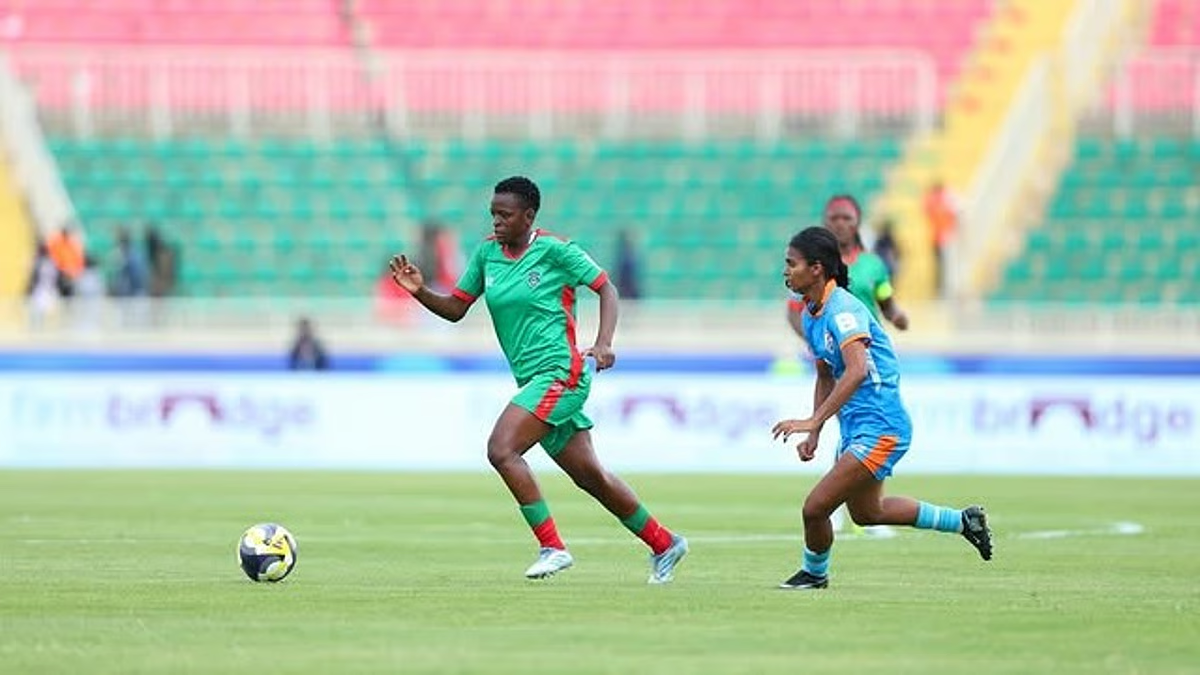
Malawi have qualified for their first-ever FIFA Women’s World Cup after beating Ghana, just months after India defeated the Scorchers 3-2 in the FIFA Series in Kenya
There is an interesting Indian connection to one of the biggest stories of the 2026 Women’s Africa Cup of Nations.
Just four months ago, Malawi were on the losing side against India. On April 15, the Blue Tigresses defeated the Scorchers 3-2 in Nairobi to finish third at the FIFA Series 2026 in Kenya. (AIFF)
At the time, it was a useful competitive victory for India. Four months later, the context looks dramatically different. Malawi have now qualified for their first-ever FIFA Women’s World Cup, completing a remarkable rise with a 2-1 comeback victory over Ghana in the WAFCON quarter-finals. The Scorchers have gone from losing to India in a third-place play-off to earning a place at the biggest stage in women's football.
It is a reminder of how quickly the fortunes of developing football nations can change.
The meeting between India and Malawi in Kenya was far from straightforward. India took the lead through Astam Oraon in the 18th minute before Malawi responded through Ireen Khumalo. Aveka Singh restored India's advantage just before half-time, but Malawi again fought back after the break through Henry Deborah.
With the match heading towards a 2-2 finish, India found the decisive moment through substitute Priyadharshini Selladurai, who scored in the 84th minute to give the Blue Tigresses a 3-2 victory. Malawi had shown resilience even in defeat. They came from behind twice, refused to allow India to control the contest and remained within touching distance until the final stages. Their performance suggested that the Scorchers were capable of competing despite being the lower-ranked side.
What happened afterwards has given that match an entirely different perspective.
From Nairobi to a World Cup
Malawi's WAFCON campaign has transformed the narrative around the team. The 2026 tournament is their first appearance at the Women's Africa Cup of Nations, and the Scorchers have used the opportunity to produce one of the most remarkable runs in the competition.
Their biggest prize came on Sunday. Ghana took the lead through Chantelle Boye-Hlorkah in the seventh minute, but Malawi responded quickly. Temwa Chawinga equalised in the 12th minute before Rose Kadzere scored the decisive goal in the 79th minute.
The 2-1 victory sent Malawi into the semi-finals and, more importantly, guaranteed them a place at the 2027 FIFA Women's World Cup in Brazil. The four WAFCON quarter-final winners receive automatic World Cup qualification, putting Malawi alongside Algeria, Cameroon and hosts Morocco as Africa's confirmed representatives. (The Guardian)
For a nation making its WAFCON debut, the achievement is enormous.
One of the biggest reasons behind Malawi's rise has been the presence of Temwa Chawinga. The forward has become one of the most recognisable players in women's football and has given Malawi an attacking reference point capable of changing matches. Her equaliser against Ghana was another example. After conceding inside the opening seven minutes, Malawi needed an immediate response. Chawinga delivered it just five minutes later.
That ability to recover from setbacks has become one of the defining characteristics of this Malawi side. It was also visible against India in April. Although the Scorchers eventually lost 3-2, they twice fought back from behind.
The same resilience has now taken them to the World Cup.
From an Indian perspective, Malawi's qualification offers an interesting lesson. India defeated a team that has subsequently reached the WAFCON semi-finals and secured a place at the Women's World Cup. That does not automatically mean India is at Malawi's level, because international football tournaments are shaped by context, squads, preparation, injuries and the importance of individual matches.
But it does underline the value of India's 3-2 result. The Blue Tigresses were able to compete with and defeat a team that has since eliminated Ghana in a high-stakes continental quarter-final. It also highlights the unpredictable nature of women's football development. India's victory came in a four-team FIFA Series tournament designed to provide international exposure through inter-confederation competition. Malawi went on from that experience to compete in their first WAFCON and now have a World Cup ticket.
For India, these are precisely the kinds of international matches that can help the national team measure its progress.
The April result now reads differently.
India won 3-2. Malawi finished fourth in the FIFA Series.
But four months later, Malawi have achieved something India is still chasing: qualification for the FIFA Women's World Cup.
The contrast is not necessarily a criticism of either team. Instead, it demonstrates how qualification pathways, continental competitions and tournament opportunities can shape a team's trajectory. Malawi's WAFCON journey has given them the opportunity to convert potential into history. They have already beaten Ghana, reached the semi-finals and secured their place at their first Women's World Cup.
Their story is no longer about being a debutant. It is about becoming a World Cup nation. And for Indian football fans, there is an intriguing footnote to that story. The last time India met Malawi, the Blue Tigresses walked away with a 3-2 victory. Today, Malawi are celebrating a World Cup qualification.
That is football's ability to change the meaning of a result and perhaps the clearest reminder that India's own journey must continue.
Comments (0)
to post comments, replies, and votes.
Loading comments…