India Eye Strong Showing In Men’s 4x400m Relay At World…
India’s men’s 4x400m relay team will head into the World Athletics Relays 2026 in Gaborone, Botswana, carrying growing expectations as the country looks to strengthen its position among the emerging relay nations in world athletics.
Scheduled for May 2-3 at the National Stadium in Gaborone, the World Relays will not only decide medals and prize money but also serve as a direct qualification pathway for the World Athletics Championships Beijing 2027. For India, the immediate target will be securing one of the 12 qualification spots available for Beijing.
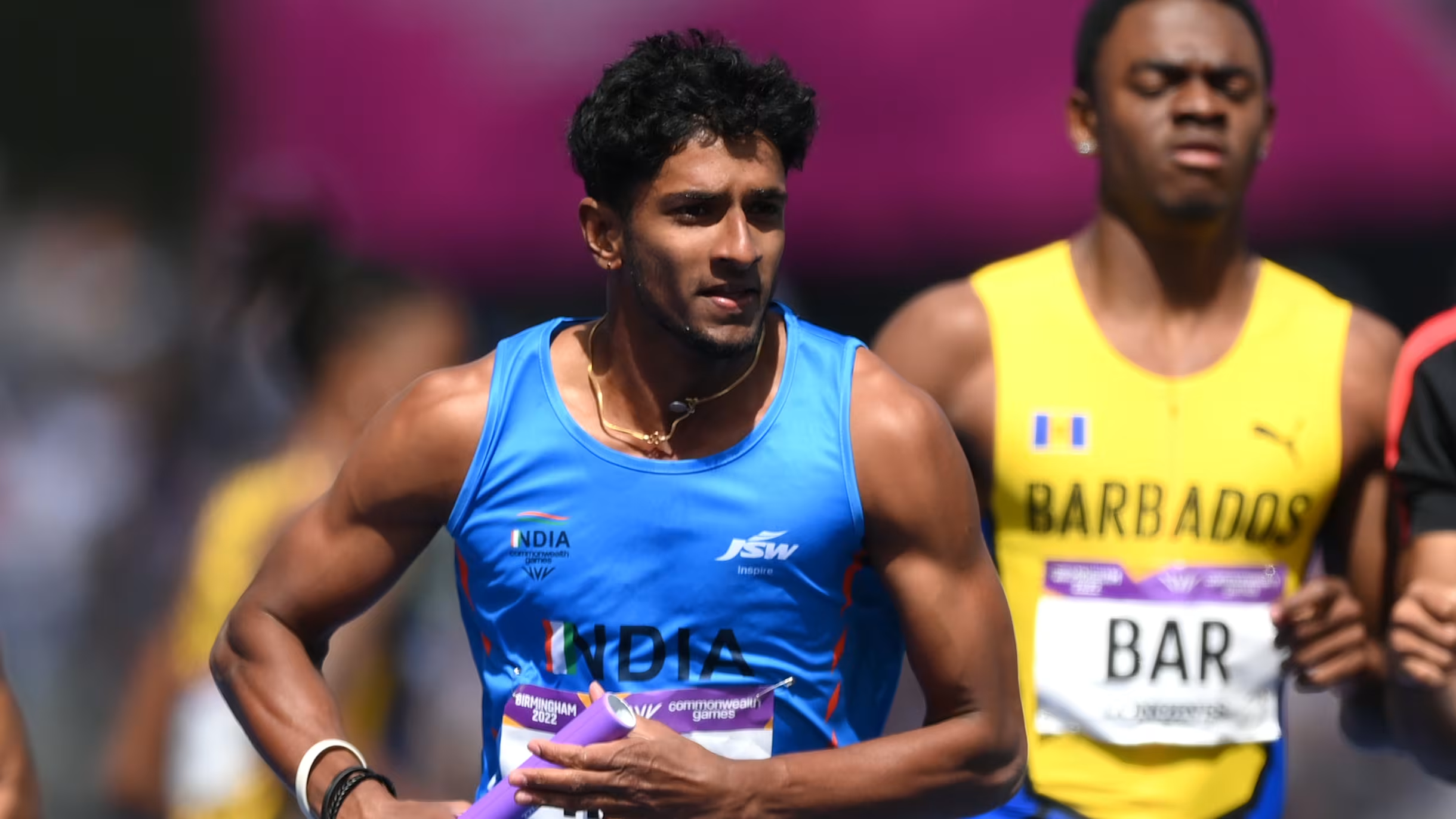
India has selected an eight-member pool for the men’s and mixed relay events, with the men’s 4x400m squad reflecting perhaps the strongest overall depth the country has produced in recent years. Leading the Indian contingent is Rajesh Ramesh, who enters the competition with a season-best timing of 45.26 seconds. Rajesh has steadily established himself as India’s fastest and most reliable quarter-miler over the past two seasons and will likely play a key role in India’s relay setup.
Joining him is Vishal TK, who has clocked an impressive 45.44s this season and emerged as one of India’s most improved 400m runners. The squad also includes experienced relay runners such as Amoj Jacob, Manu TS, and Dharamveer Choudhary all of whom have dipped below the 46-second mark this year. Further depth comes through Theerthesh Shetty, Jay Kumar, and Nihal Joel. Importantly for India, the relay pool now contains multiple athletes running within competitive margins of each other. That depth gives selectors flexibility in choosing combinations depending on heats, recovery, and tactical requirements.
At the World Relays, 12 federations will automatically qualify for the World Championships in Beijing. On day one, the top two teams from each of the four heats will directly secure qualification and advance to the final. Teams that miss out will get another chance during the repechage rounds on day two, where four additional qualification spots will be available. India enters the competition ranked inside the top-24 qualification zone, meaning a disciplined and clean performance could realistically place the team in contention for qualification.
For India, execution will be everything. At this level, relay races are often decided not by outright speed alone but by baton exchanges, lane positioning, composure, and race rhythm. India has shown over the last few years that it possesses the raw speed to compete respectably internationally. The next step is consistently delivering smooth relay execution under pressure.
The competition in Gaborone will be fierce. Host nation Botswana men's national athletics team enters as one of the favourites after becoming world champions in the men’s 4x400m relay last year. Botswana’s quartet of Lee Bhekempilo Eppie, Letsile Tebogo, Bayapo Ndori, and Collen Kebinatshipi stunned the world with their victory in Tokyo. Tebogo, already an Olympic 200m champion, gives Botswana enormous firepower, while Ndori and Kebinatshipi remain among the world’s elite 400m runners.
With the United States not fielding a men’s 4x400m relay team this year, Botswana will start as one of the strongest teams in the field especially with home support behind them.
South Africa and Belgium Remain Major Threats
South Africa men's national athletics team will also enter with strong momentum after winning the previous World Relays title in Guangzhou. Their lineup once again includes Zakithi Nene, Udeme Okon, Leendert Koekemoer, and Gardeo Isaacs, along with world U20 champion Lythe Pillay. South Africa’s relay structure has become increasingly stable over recent seasons, making them one of the most dangerous relay nations globally.
Belgium, meanwhile, continues to demonstrate remarkable relay consistency. The European nation has medalled repeatedly at global championships and arrives in Gaborone after winning silver at the World Indoor Championships earlier this year. Their squad features experienced relay specialists including Alexander Doom and Jonathan Sacoor.
While medal contention may still remain difficult for India against such elite competition, qualification for Beijing 2027 is a very realistic objective. India’s relay programme has grown steadily since the Tokyo Olympic cycle. The emergence of multiple sub-46 runners and improved domestic 400m standards have strengthened the overall relay structure significantly. The team also carries valuable championship experience from previous Asian and global events.
However, Gaborone will test India at a different level altogether.
Nations like Great Britain, Jamaica, Netherlands, Japan, Kenya, and Qatar all bring established relay systems and international experience. That means India cannot afford technical mistakes or inconsistent race management. Still, there is genuine optimism surrounding Indian quarter-mile running right now.
Rajesh Ramesh’s consistency, Vishal TK’s rise, and the experience of runners like Amoj Jacob give India a competitive core capable of challenging for qualification.
If the baton exchanges remain clean and the team delivers near its season-best level, India could leave Gaborone with far more than just experience it could secure another important step forward in its growing relay journey on the world stage.
Comments (0)
to post comments, replies, and votes.
Loading comments…