India’s Badminton Teams Face Early Tests at Asian Games 2026, Japan Awaits in Quarterfinal Path
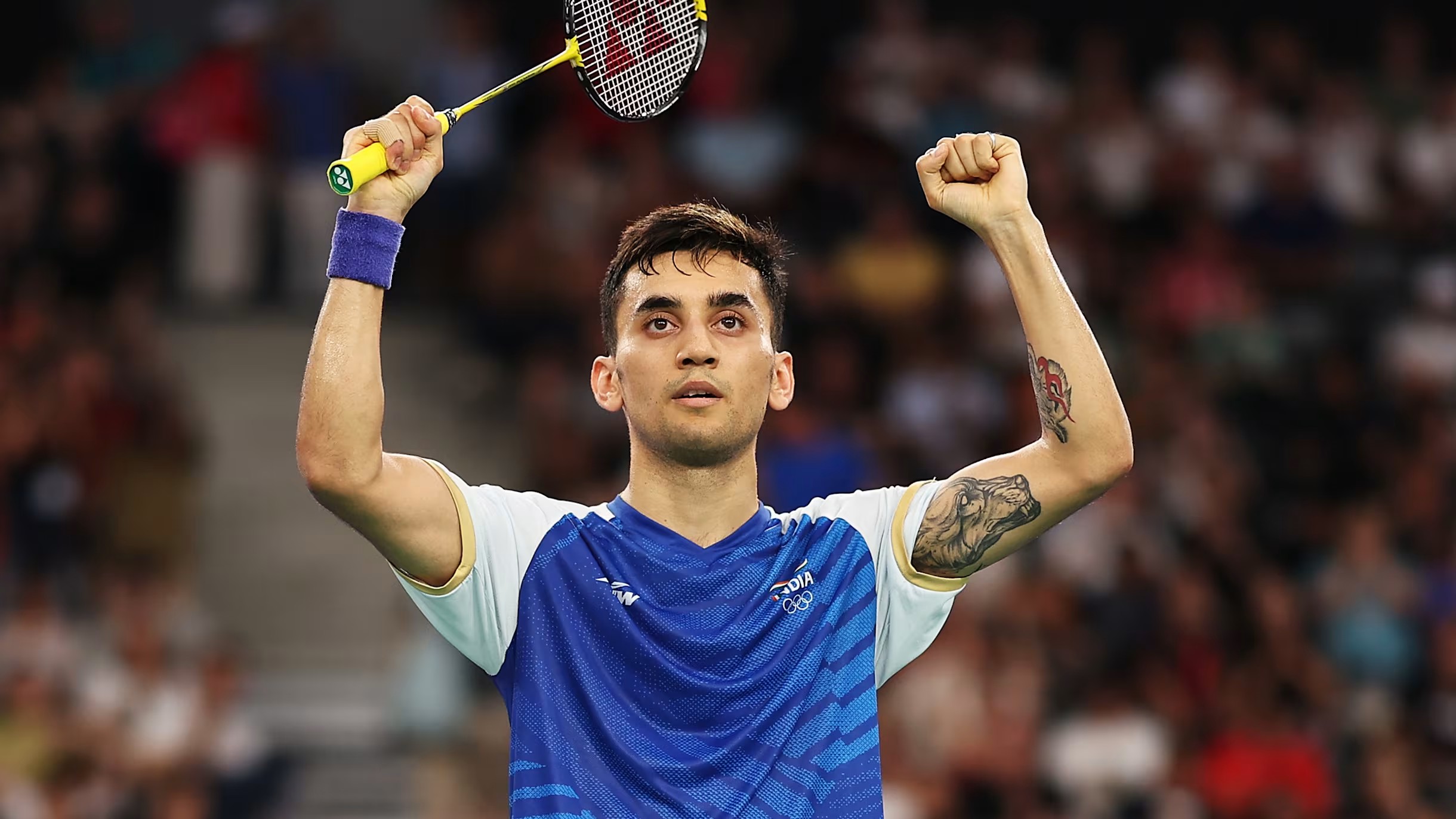
India’s badminton campaign at the Aichi-Nagoya Asian Games 2026 begins with both the men’s and women’s teams facing Round of 16 challenges, but the draw has ensured that the path to the medals could become difficult almost immediately.
The Indian women’s team will open its campaign against Kazakhstan on Sunday, September 20, while the reigning men’s team silver medallists will face Bangladesh on Monday, September 21. Both team competitions will be played in a straight knockout format, meaning every tie carries immediate consequences. The badminton competition is being held at the Ichinomiya City Municipal Gymnasium, with the team events preceding the individual competitions.
India’s women will be the first of the two teams in action when they take on Kazakhstan in the Round of 16. A victory would set up a potentially demanding quarterfinal against hosts Japan, who have received a bye into the Round of 16. The Japanese side is seeded second in the draw and would provide a major test for India on home soil. The potential match-ups underline the challenge. PV Sindhu could face Akane Yamaguchi, while Unnati Hooda could come up against Tomoka Miyazaki. In doubles, Treesa Jolly and Gayatri Gopichand could face Japan’s leading combination.
For India, progressing against Kazakhstan would therefore only be the first step. A quarterfinal against Japan would immediately test the depth and singles strength of the Indian squad.
The other half of the women’s draw features China and Thailand, meaning the top-seeded Chinese team and India cannot meet before the final if both progress according to the draw.
Men Begin Against Bangladesh
India’s men enter the tournament as the reigning Asian Games silver medallists, having reached the final in Hangzhou before losing 3-2 to China.
Their 2026 campaign begins against Bangladesh on Monday. On paper, the Round of 16 is only the beginning of a considerably more demanding route. A victory would potentially send India into a quarterfinal against Japan, setting up a contest involving several high-quality singles and doubles players. (The Indian Express)
Among the potential match-ups, Lakshya Sen could face Kodai Naraoka, while Ayush Shetty could be drawn against Yushi Tanaka. In doubles, Satwiksairaj Rankireddy and Chirag Shetty could face Japan’s Takuro Hoki and Yugo Kobayashi. Those match-ups could make the quarterfinal particularly significant. Japan will have home-court support, while Naraoka’s ability to operate effectively in slower conditions adds another dimension to the contest.
The men’s draw becomes even tougher beyond a potential Japanese quarterfinal. India, Japan, China and Korea are all positioned in the same half of the draw. Consequently, if India reaches the semifinals, it could encounter either China or South Korea. That creates a demanding projected route: Bangladesh in the Round of 16, potentially Japan in the quarterfinal and China or Korea in the semifinal.
The other half contains Malaysia, Indonesia, Hong Kong and Chinese Taipei, with top seed Indonesia positioned away from India. As a result, India cannot meet Indonesia before the final.
India arrives in Japan with strong memories from Hangzhou. At the previous Asian Games, the country won three badminton medals. Satwiksairaj Rankireddy and Chirag Shetty created history by winning India’s first-ever Asian Games gold medal in badminton in men’s doubles. The Indian men’s team subsequently won silver, while HS Prannoy claimed bronze in men’s singles.
The team silver was particularly significant because India had previously established itself as a strong force in individual badminton, but the men's team had not managed to convert that strength into an Asian Games title. Now, the objective is to build on that performance.
India’s women’s team has a smaller Asian Games medal history. The country’s only previous medal in the women’s team event came at the 2014 Incheon Asian Games, when India reached the podium with a team featuring Saina Nehwal, PV Sindhu and the doubles combination of Ashwini Ponnappa and Sikki Reddy. India defeated Thailand 3-2 in a closely fought quarterfinal before losing 1-3 to South Korea in the semifinals.
More than a decade later, Sindhu remains part of India’s Asian Games challenge, but the team also has a new generation represented by players such as Unnati Hooda and the Treesa Jolly-Gayatri Gopichand combination.
A 20-Member Squad Across Seven Disciplines
India’s badminton contingent comprises 20 players competing across seven disciplines, with the team competitions scheduled before the individual events. The team events begin on September 20, while the individual competitions follow later in the Games. For both Indian teams, the opening ties may appear to be the first hurdle, but the draw ensures that the real examination could arrive immediately afterwards.
With Japan potentially waiting in the quarterfinals for both teams, India’s route to the medals at Aichi-Nagoya is unlikely to offer much room for error.
After three medals in Hangzhou, including a historic men’s doubles gold and men’s team silver, India’s shuttlers now begin another Asian Games campaign with the opportunity to add another chapter to the country’s badminton legacy.
Comments (0)
to post comments, replies, and votes.
Loading comments…