India’s Long Jump Legacy Continues as Shahnavaz Khan Follows Shaili Singh onto World U20 Podium
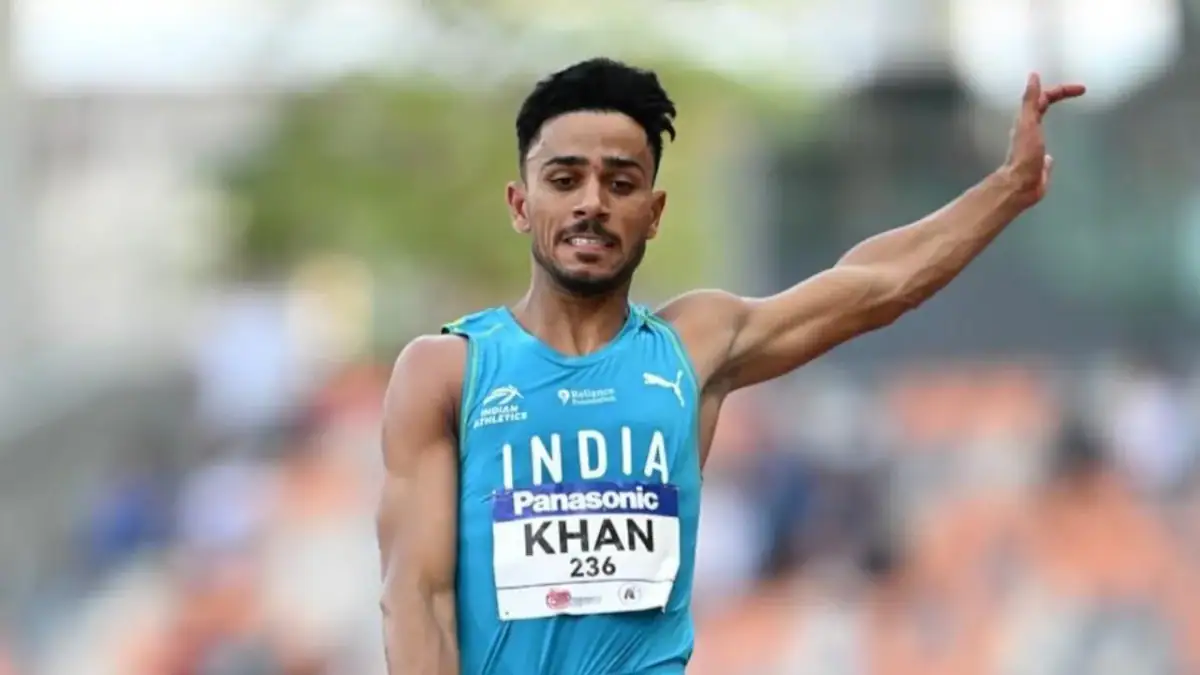
Shahnavaz Khan won bronze in the men’s long jump at the World U20 Championships, five years after Shaili Singh’s historic silver in Nairobi.
India’s long jump story at the World U20 Championships has entered a new chapter.
Five years after Shaili Singh won a historic silver medal in the women’s long jump at the 2021 World U20 Championships in Nairobi, Shahnavaz Khan added another global junior podium finish for India by winning bronze in the men’s event at the 2026 World U20 Championships in Eugene, Oregon.
The two performances, separated by five years and achieved in different events, point towards an increasingly strong pipeline in Indian horizontal jumps. Singh produced a 6.59m effort in Nairobi to secure silver, while Khan reached 7.84m in Eugene to claim bronze. Their medals are not isolated performances; they represent the progress of a generation of Indian jumpers increasingly capable of competing for podium places at global junior championships.
At just 17, Shaili Singh announced herself on the global stage at the 2021 World U20 Championships in Nairobi. She entered the final after topping qualification with a 6.40m jump and maintained her challenge throughout a high-quality competition. Her best effort came in the third round when she produced a 6.59m leap.
That jump briefly moved Singh into the gold-medal position. Although Sweden’s Maja Askag eventually surpassed her with 6.60m, Singh held on for silver, with Ukraine’s Mariia Horielova taking bronze at 6.50m.
Singh’s 6.59m was particularly significant because it exceeded her pre-championship personal best of 6.48m. Although the jump was assisted by a +2.2m/s tailwind and therefore just above the legal limit for record ratification, it was enough to secure India’s first global U20 medal in a horizontal jump.
Her performance established a new benchmark for Indian junior long jumpers and demonstrated that Indian athletes could compete directly with the strongest international prospects. Five years later, Khan has reinforced that belief.
At the 2026 World U20 Championships in Eugene, 18-year-old Shahnavaz Khan produced a composed performance to win bronze in the men's long jump. Khan entered the final after qualifying with a 7.73m effort. He then improved progressively during the medal competition, opening with 7.67m before recording 7.72m in his second attempt.
His decisive jump came in the third round. Khan landed at 7.84m to move into third position, a mark he maintained through the remainder of the competition. His subsequent attempts measured 7.52m and 7.83m before his final jump produced 5.37m.
The 7.84m effort was enough to secure bronze behind Italy’s Daniele Inzoli, who won gold with 7.97m, and Australia’s Mason McGroder, who claimed silver with 7.96m. Khan's achievement was historic in its own right. He became the first Indian male long jumper to win a medal at the World U20 Championships.
The significance of Singh and Khan's achievements lies in the consistency between the two performances. India now has World U20 long jump medals in both the women's and men's events, achieved by different athletes and five years apart. That progression suggests that horizontal jumps are increasingly benefiting from structured talent identification, specialist coaching and access to high-performance facilities.
The development pathway begins at the grassroots level through school competitions, state meets and the National Junior Federation Cup. Promising athletes can then move into regional high-performance centres and specialised training environments. Facilities operated by the Sports Authority of India, alongside private institutions such as the Anju Bobby George Foundation, have contributed to creating more specialised coaching systems for horizontal jumps.
The focus is increasingly on technical elements such as runway speed, take-off efficiency and landing mechanics rather than simply relying on natural athletic ability.
Khan's development also illustrates how early specialisation can influence elite performance. Despite possessing the physical attributes required for multiple events, including a strong javelin background, he chose to focus exclusively on horizontal jumps rather than move towards the decathlon.
That decision allowed his training to concentrate on the specific explosive qualities required for long jump. The results followed quickly. Khan recorded 8.04m in 2025 before producing an 8.23m leap at the 24th National Junior Athletics Federation Cup in Tumkur in May 2026. That performance surpassed Murali Sreeshankar's previous U20 national record of 8.10m.
His World U20 bronze therefore came as part of a broader progression rather than an isolated breakthrough.
The most difficult part of the journey now begins. Success at the U20 level establishes potential, but the transition to senior athletics requires athletes to become more consistent against stronger and more experienced opposition. For the Indian men's long jump, Khan now has established senior benchmarks to chase, including the performances of Murali Sreeshankar and Jeswin Aldrin.
The senior national record stands significantly higher than Khan's current championship performance, meaning continued improvements in approach speed, take-off efficiency and competition consistency will be essential.
The same applies to Singh, whose progression from her 6.59m U20 medal-winning performance to a senior personal best of 6.76m demonstrates that the transition is possible. She is now within reach of the Indian women's senior national record of 6.83m held by Anju Bobby George.
Shaili Singh's silver in 2021 and Shahnavaz Khan's bronze in 2026 provide two important markers in India's long jump development. Singh showed that an Indian woman could challenge for a global junior title. Khan followed by becoming the first Indian male long jumper to stand on the World U20 podium. The next objective is clear: ensure these medals become stepping stones rather than isolated achievements.
Greater access to biomechanical analysis, specialist coaching, international competition and appropriate athlete support can help India's junior jumpers make the difficult transition to senior athletics. The existing development structure, including SAI centres and TOPS support, provides a foundation for that progression.
For now, however, the significance of the two medals deserves recognition.
Shaili Singh — 6.59m, silver in 2021.
Shahnavaz Khan — 7.84m, bronze in 2026.
Different athletes. Different events. Five years apart. But the same message: India's next generation of long jumpers is continuing to fly.
Comments (0)
to post comments, replies, and votes.
Loading comments…