India vs Australia: Tokyo 2020 Rivals Meet Again, But Everything Has Changed
There is one match India will be watching at the FIH Women’s Hockey World Cup 2026 before they step onto the pitch against Australia: Netherlands vs China.
The equation for India is simple, even if the road to the semi-final isn’t. India must beat Australia, while the Netherlands must avoid defeat against China. If the Dutch win, they retain the top spot in women’s pool E, and India moves into second with a victory over Australia. If the two teams draw, China moves to three points, and India, with a win, would move to four enough to finish second and secure a semi-final berth.
But if China beat the Netherlands, they move to five points, and India’s semi-final hopes end, even with a win against Australia.
So, first, India needs the Netherlands to do them a favour. Then they need to do the rest themselves. And there is reason to believe they can. Because the Australia India are about to face is not the Australia India stunned at the Tokyo 2020 Olympics. That 1-0 quarter-final win in Tokyo in 2021 remains one of the defining results in Indian women’s hockey history. It sent India into their first-ever Olympic semi-final and eventually to a historic fourth-place finish.
But five years is a long time in international sport. The Hockeyroos have changed. Their leadership core has changed. Their coach has changed. Their identity is evolving.
And that makes Sunday’s game far more open than the Australia name might suggest. Australia currently sit eighth in the world, just one place above India, and their World Cup campaign has been anything but dominant. They began with a 2-0 win over Japan, but both goals came from penalty corners through Claire Colwill. It was a disciplined win, but hardly an attacking masterclass.
Then came the Netherlands. A 4-2 defeat to the world’s No. 1 team is hardly alarming on its own. The Dutch have been the benchmark in women’s hockey for years, and Australia actually showed enough in that game to suggest they can trouble the best. They created significant pressure and, importantly, demonstrated that they can go toe-to-toe with an elite side for long periods.
But the next game exposed something else. Chile.
Australia were leading 3-2 with just over eight minutes remaining. Within minutes, Chile had turned the game around, scoring twice to take a 4-3 lead. Australia eventually had to pull goalkeeper Jocelyn Bartram, throw another outfielder into the mix and find an equaliser with just 30 seconds left through Mariah Williams.
Australia escaped with a point. But it was also the sort of result that exposes the cracks in a team still trying to find its identity.
And then came China. Australia’s best performance of this second phase so far.
China took the lead from a penalty corner, but Australia kept pushing, earned three consecutive penalty corners before winning a penalty stroke, and Abi Wilson converted in the 48th minute to make it 1-1. They pushed for a winner right until the final minute but could not find it.
The result kept Australia’s own semi-final hopes alive but it also meant they now have to beat India. That is the Australia India will face. Not a weak Australia. Not an Australia that can be taken lightly. But certainly an Australia that can be beaten. This isn’t the Australia of Tokyo 2020. The Australia of Tokyo had an enormous amount of experience running through its squad. The current Hockeyroos are a different generation.
Some of the players who made that Australian side so formidable in Tokyo have moved on. What remains is a smaller senior core led by players such as Kaitlin Nobbs, Steph Kershaw, Amy Lawton, Grace Stewart, Karri Somerville and Mariah Williams, alongside a younger generation that has increasingly taken responsibility within the team.
Nobbs, who was still an emerging player at Tokyo, is now one of Australia’s senior leaders and was named Hockeyroo of the Year in 2025. Lawton was only 19 at Tokyo. She is now an established part of Australia’s midfield. Kershaw, another Tokyo Olympian, has evolved into one of Australia’s most important attacking players. And the team itself is under a new coach Katrina Powell’s four-and-a-half-year tenure ended after the 2025 Oceania Cup, with former South African international Rhett Halkett taking over in September 2025.
So when India walk out against Australia on Sunday, they aren’t facing the same team that once had India chasing the game in Tokyo. They are facing a Hockeyroos side still searching for consistency.
And that should matter. India’s graph, meanwhile, has gone the other way. India did not arrive at this World Cup as favourites. Far from it. The lead-up to the tournament had been turbulent, and the team had to rebuild its confidence and consistency.
But since Sjoerd Marijne returned as chief coach in January, there has been a noticeable shift.
Marijne, the coach who took India to that historic fourth-place finish in Tokyo, returned to the national team after four-and-a-half years, bringing back not only familiarity but also members of the support structure from that Olympic campaign. His first major task was not to recreate Tokyo. It was to rebuild India. And this World Cup has shown signs of that rebuilding process working.
India began with a 2-2 draw against China, the Paris Olympic silver medallists. They then put six goals past South Africa before holding England to a goalless draw in a match where their defence had to withstand enormous pressure. They then faced the Netherlands. And lost 2-0. But even that defeat came with a sense that India belonged in the contest.
The Netherlands eventually won through two penalty corners, but India stayed within touching distance of the world’s No.1 team and produced another disciplined defensive performance. That is perhaps the biggest reason why India should not enter Sunday’s game with fear.
They have already shown that they can absorb pressure. Now they need to turn that resilience into a result.
There is no point pretending India’s penalty corners have been their biggest strength at this World Cup. They haven’t.
India has created opportunities but has not converted enough of them. Even Marijne acknowledged that this remains an area the team needs to improve. He has also stressed that against the biggest teams, India need to convert the limited chances they get.
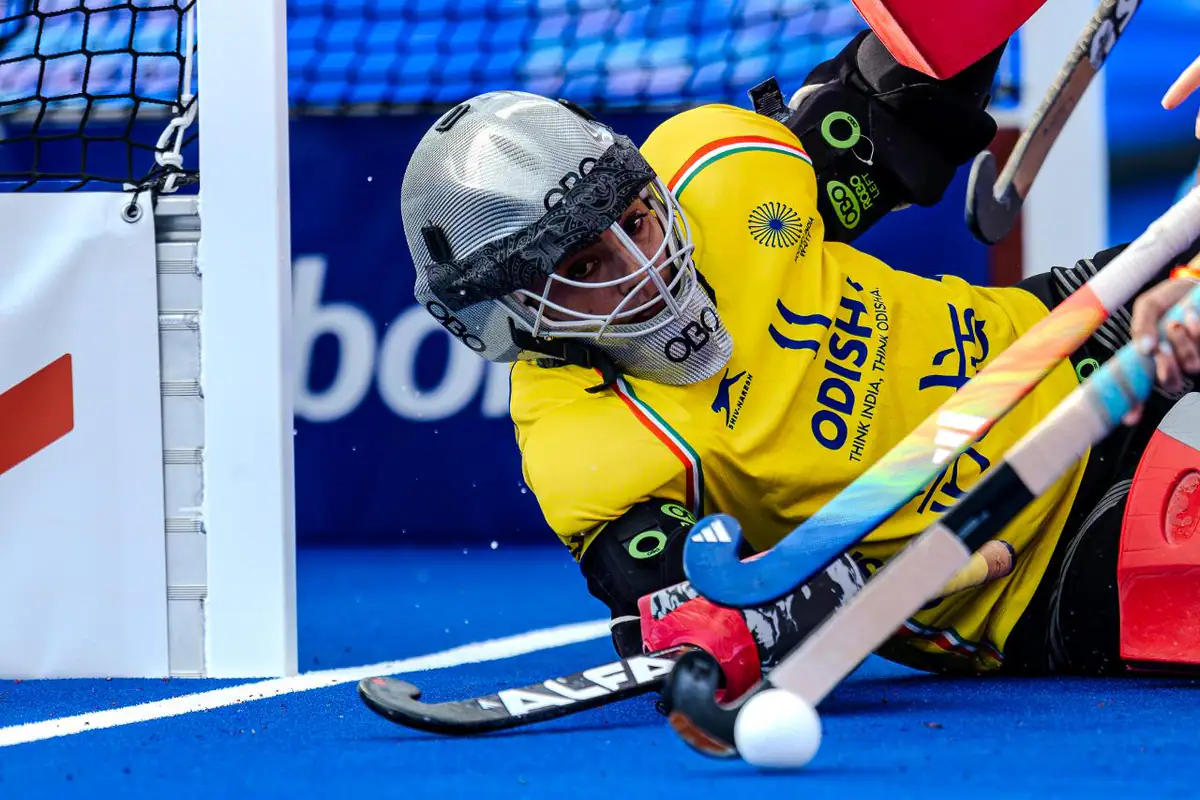
But if the penalty corner hasn’t been India’s biggest weapon, something else has their goalkeeping. Savita Punia and Bichu Devi have repeatedly given India the kind of security that allows the team to remain in games even when the opposition is on top.
And that could become crucial against Australia. Because Australia will attack. They will look to create turnovers, move the ball quickly and get into India’s circle. They have players capable of making something happen from very little. But India have goalkeepers capable of making sure that one chance does not automatically become one goal. That is a significant advantage in a match where the margins are likely to be extremely small.
And then there is the field play.
India have looked increasingly comfortable in transition, have shown that they can move the ball with purpose and have players capable of hurting Australia when the Hockeyroos leave space behind. Navneet Kaur, in particular, could have an important role to play.
India doesn't necessarily need to dominate Australia for 60 minutes.
They need to be clinical when the opportunities arrive. Salima has already said what this match means. India’s captain Salima Tete said, “We will give our all in today’s match against Australia. We will have to play like it’s our final match.”
This is no longer about what India were expected to do before the World Cup. It is about what they have done since arriving here:
- They have drawn with China.
- They have beaten South Africa.
- They have held England.
- They have competed against the Netherlands.
Now they have one final hurdle in Australia.
And this is where the Tokyo comparison becomes important. India have already beaten Australia in one of the biggest matches they have ever played. But this Australia is different. India is different too.
The question isn’t whether India can repeat Tokyo.
It is whether this version of India can write its own story. And right now, there is enough evidence to believe they can. And for all the talk about Australia’s history, their reputation and the pressure of the occasion, India should walk into this game knowing one thing: they have no reason to be scared of Australia. They have every reason to believe they belong in the semi-finals.
Comments (0)
to post comments, replies, and votes.
Loading comments…