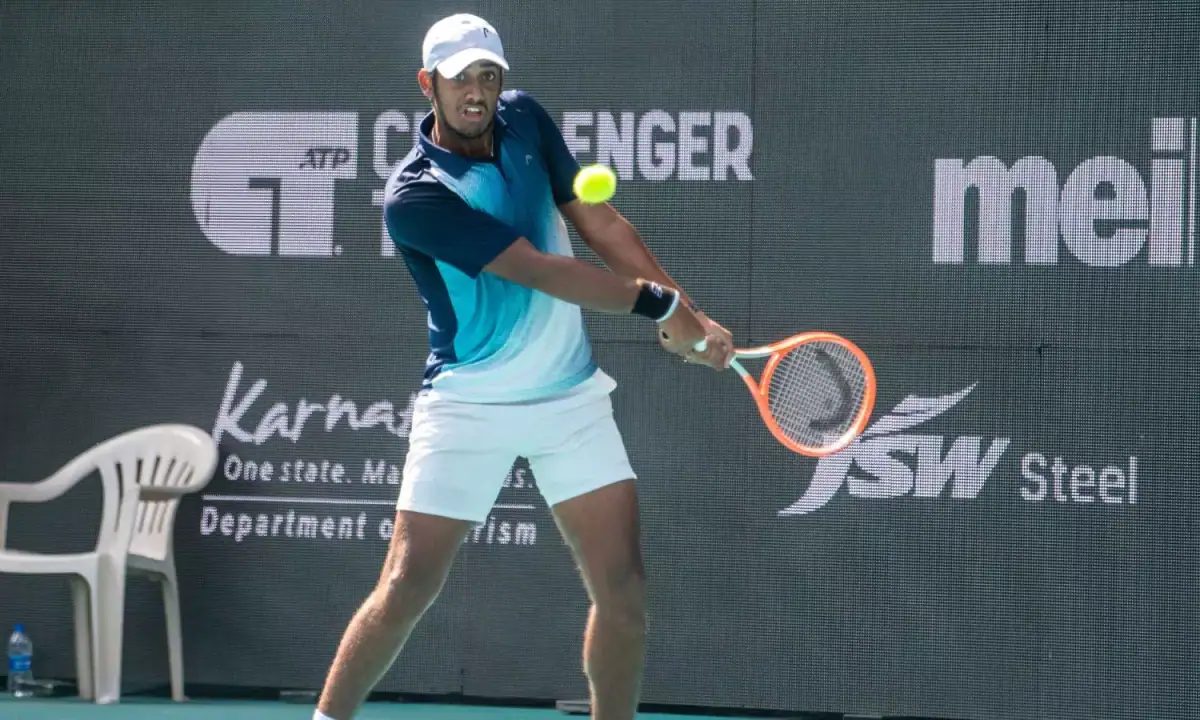
Manas Dhamne Continues Challenger Breakthrough With Gritty Comeback Win in Italy

Indian teenager Manas Dhamne defeated Frederico Ferreira Silva at the Vicenza Challenger to reach the Round of 16 after a marathon three-set battle.
Eighteen-year-old Manas Dhamne continues to quietly build momentum on the ATP Challenger circuit after producing one of the most impressive wins of his young professional career at the Vicenza Challenger in Italy.
The Indian teenager battled back from a set down to defeat Portugal’s Frederico Ferreira Silva 4-6, 7-5, 6-3 in a physically demanding contest lasting two hours and 51 minutes. Ranked 391 in the world entering the match, Manas overcame the world No. 237 to secure what is statistically his best clay-court win by opponent ranking and the third-best victory of his career overall.
More importantly, the performance once again highlighted why many within Indian tennis view him as one of the country’s most exciting long-term prospects.
The ATP Challenger circuit represents one of the most difficult transition levels in professional tennis. Young players moving from junior tennis into the professional system often struggle initially against experienced opponents who possess greater physicality, tactical maturity and consistency over long matches.
That context makes Manas’ victory particularly important. Frederico Ferreira Silva entered the match with far greater experience at Challenger level and a significantly higher ranking. The Portuguese player has spent years competing on the professional circuit and is especially comfortable on clay courts.
For an 18-year-old still adapting to senior-level tennis, overcoming that challenge after losing the opening set demonstrated both resilience and growing competitive maturity.
The match itself reflected Manas’ improving ability to problem-solve during long contests. After dropping the first set 4-6, the Indian teenager gradually began finding greater rhythm on serve and increasing the aggression on his forehand side. His ability to absorb long baseline rallies while selectively attacking shorter balls became increasingly effective as the match progressed.
The second set proved crucial.
Both players remained tightly matched deep into the set before Manas managed the decisive break late on to edge it 7-5 and force a decider. That momentum shift changed the complexion of the match entirely.
One of the most encouraging aspects of the performance was the improvement in Manas’ serve. He finished the match with seven aces, including two particularly important ones while serving for the contest under pressure. For young players transitioning into higher professional levels, serve development often becomes one of the biggest indicators of long-term ceiling. Challenger-level tennis is physically intense, and players unable to consistently earn free points on serve often struggle to sustain success.
Manas’ serving numbers therefore stand out positively.
Alongside the serve, his forehand power also appeared noticeably improved throughout the match. Observers following his progression have increasingly pointed to the growth in his offensive baseline game over recent months.
At the same time, there remain clear areas for development which is entirely normal for an 18-year-old competing at this level. One tactical area where Manas could still evolve further is variation. While his baseline power continues improving, incorporating more drop shots, transition play and net approaches could make his game significantly more unpredictable on clay courts. Against experienced professional players, rhythm disruption often becomes as important as pure ball-striking.
Encouragingly, Manas already appears willing to construct points patiently rather than relying solely on aggressive hitting, an important trait for long-term development on slower surfaces.
Indian men’s singles tennis has spent several years searching for the next breakthrough talent capable of consistently competing internationally. While India has historically produced strong doubles players, sustained singles success at ATP level has remained rare. That is why Manas’ gradual rise through Futures and Challenger tournaments is drawing increasing attention.
What separates him from many previous junior prospects is the environment in which he is developing.
Rather than relying heavily on domestic circuits, Manas has spent significant time competing internationally on European clay one of the toughest developmental pathways in professional tennis. Those conditions force players to improve physically, tactically and mentally far earlier in their careers.
The benefits of that exposure are now beginning to show.
The next challenge at the Vicenza Challenger could become even tougher. Manas is scheduled to face the winner between Tunisia’s Moez Echargui (ATP 139) and Switzerland’s Remy Bertola (ATP 208) in the Round of 16. Both players possess considerably more experience at Challenger level, particularly Echargui, who has been operating close to ATP Tour qualification levels this season.
But regardless of the next result, Manas has already reinforced an important point in Vicenza he is becoming increasingly competitive against established professional players.
Perhaps the most important takeaway from this victory is that Manas’ development is beginning to move beyond rankings alone. Young tennis careers are rarely linear. Breakthroughs usually arrive through gradual improvements in physicality, match tolerance and tactical adaptability rather than sudden ranking jumps. In Italy, Manas Dhamne showed signs of progress in all three areas.
And for Indian tennis, that may ultimately matter far more than one individual result.
Comments (0)
to post comments, replies, and votes.
Loading comments…