Can India End Their World Cup Drought? Looking Back at the Last Five FIH Men's Hockey World Cups
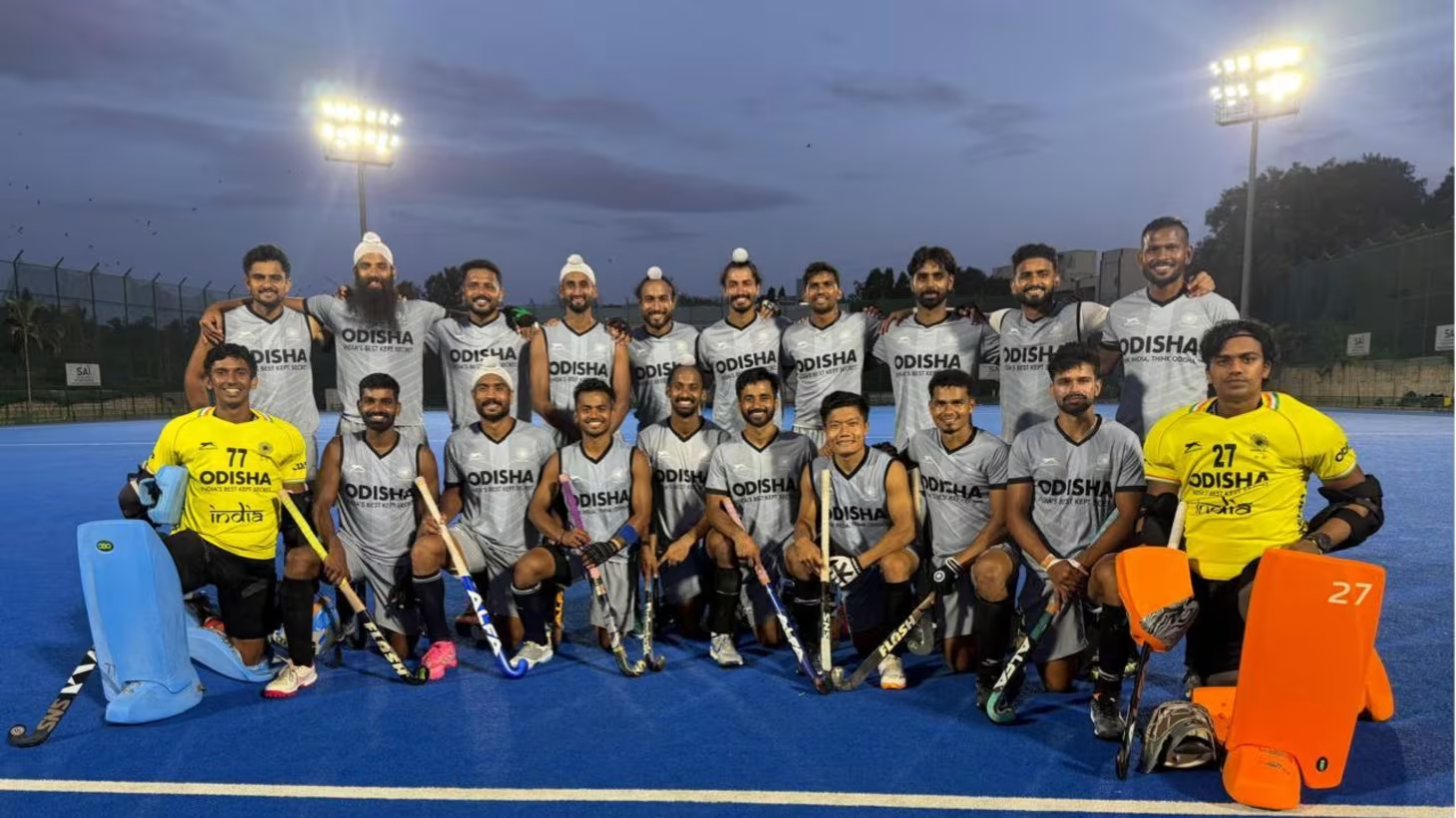
The countdown to the FIH Men's Hockey World Cup 2026 has begun, with Belgium and the Netherlands preparing to host the world's biggest hockey tournament.
For India, the upcoming edition represents another opportunity to reclaim its place among the sport's elite and end a World Cup drought that has now stretched for more than five decades. The 2026 tournament will mark India's 16th consecutive appearance at the Hockey World Cup, making them one of only three nations alongside Germany and the Netherlands to have featured in every edition since the tournament began in 1971.
Despite being one of hockey's most successful nations historically, India's World Cup record has remained underwhelming in recent decades. The country's only title came in 1975, when Ajit Pal Singh's side lifted the trophy in Kuala Lumpur. Since then, India has not reached the semi-finals, despite several promising campaigns.
As the Men in Blue prepare for another shot at global glory, here's a look back at India's performances in the last five Hockey World Cups.
2006: A Tournament to Forget
The 2006 World Cup in Germany proved to be one of India's most difficult campaigns.
Placed in a challenging Pool B alongside hosts Germany, the Netherlands, England, South Korea and South Africa, India struggled to compete against the world's strongest teams. The team failed to win a single group-stage match, managing only a draw against South Africa while losing the remaining four encounters. Although three defeats came by just one goal, a heavy 6-1 loss to the Netherlands exposed the gap between India and the tournament's leading sides.
India eventually defeated South Africa in the classification match after losing to Argentina, finishing 11th overall.
Across seven matches, India scored 10 goals while conceding 18, highlighting defensive vulnerabilities that affected the entire campaign.
Hosting the World Cup for the first time in nearly three decades, India entered the 2010 edition hoping home support would inspire a deep run. Drawn alongside Australia, England, Spain, Pakistan and South Africa, India once again faced a demanding group. One of the highlights of the tournament came in the emphatic 4-1 victory over Pakistan, a memorable result that delighted home fans. India also played out an entertaining 3-3 draw against South Africa.
However, defeats against Australia, England and Spain prevented India from progressing to the semi-finals. The tournament also marked the first Hockey World Cup appearance for legendary goalkeeper P.R. Sreejesh, who would go on to become one of India's greatest players. India eventually lost the classification match against Argentina to finish eighth, scoring 15 goals but conceding 21 across six matches.
2014: Signs of Progress
Four years later in the Netherlands, India showed encouraging improvement. Competing against Australia, Belgium, England, Spain and Malaysia, India collected four points during the group stage. A victory over Malaysia and an impressive draw against Spain demonstrated growing consistency, although defeats against the stronger European teams meant India again missed out on the semi-finals.
Unlike previous editions, India responded strongly in the classification round, defeating South Korea convincingly to secure ninth place. The tournament reflected gradual progress, particularly in terms of defensive organisation and competitiveness against higher-ranked opponents.
The 2018 World Cup, hosted in Bhubaneswar, offered perhaps India's best opportunity in recent history. The tournament introduced a new format featuring crossover matches, creating additional qualification pathways for teams finishing outside the top two. India enjoyed an outstanding group stage.
Placed alongside Belgium, Canada and South Africa, the hosts remained unbeaten. Comfortable victories over Canada and South Africa, coupled with a 2-2 draw against eventual champions Belgium, saw India top Pool C. The team scored 13 goals while conceding only five, showcasing both attacking quality and defensive solidity.
However, hopes of ending the semi-final drought were dashed in the quarter-finals. Facing the Netherlands, India suffered a narrow 2-1 defeat, ending another promising campaign in front of disappointed home supporters. Despite the heartbreaking exit, the 2018 performance remains one of India's strongest World Cup campaigns in recent times.
Expectations were even higher when India hosted the 2023 World Cup alongside Rourkela. Drawn in Pool D with England, Spain and Wales, India started confidently.
Victories over Spain and Wales, combined with a goalless draw against England, earned the hosts seven points. Yet England's superior goal difference meant India finished second in the group and was forced into the newly introduced crossover stage. That proved to be India's undoing. In one of the most dramatic matches of the tournament, India lost to New Zealand in a penalty shootout after the teams could not be separated.
The defeat ended India's World Cup campaign before the quarter-finals, leaving players and fans devastated after another missed opportunity on home soil.
India finished ninth, having scored nine goals while conceding only five, a statistic that reflected the team's defensive discipline but also highlighted missed opportunities in crucial moments.
The last five World Cups tell a story of gradual improvement but recurring disappointment.
India has consistently been competitive, reaching the knockout stages and producing strong group-stage performances. However, the inability to cross the quarter-final barrier has remained the defining challenge. The current generation possesses significantly greater experience than previous squads, with players regularly competing against the world's top teams in the FIH Pro League, Asian competitions and Olympic tournaments.
As Belgium and the Netherlands prepare to welcome the world's best hockey nations, India enters the 2026 World Cup carrying both history and expectation.
More than fifty years have passed since India's only World Cup triumph in 1975. The team now has another opportunity to end one of international hockey's longest waits and prove that it belongs once again among the sport's global elite. A place in the semi-finals would already represent India's best performance in over five decades—but with the talent currently available, the Men in Blue will undoubtedly believe they are capable of aiming much higher.
Comments (0)
to post comments, replies, and votes.
Loading comments…