Pooja’s Asian Games Gold Chances: India’s 19-Year-Old High Jump Star Enters as Season Leader
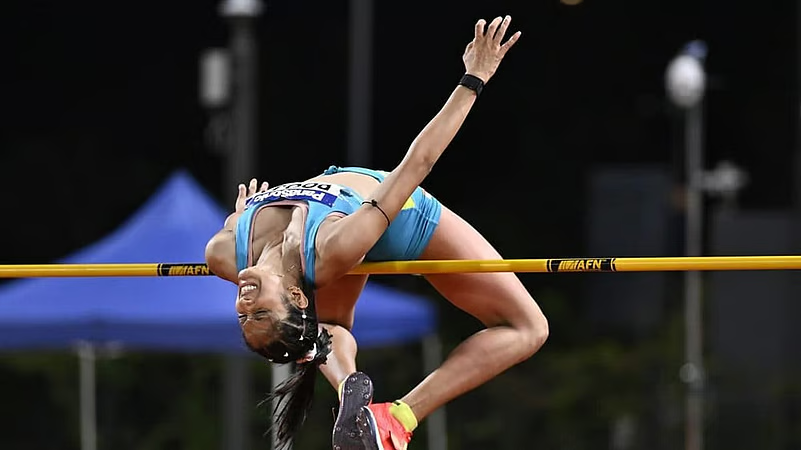
India’s Pooja enters the women’s high jump final at the Aichi-Nagoya Asian Games with the strongest clearance in the field this season, but the 19-year-old faces a final where the difference between winning gold and finishing outside the medals could come down to first-attempt efficiency and execution under pressure.
The final is scheduled for 3:35pm IST on Tuesday, September 29, at the Nagoya City Mizuho Park Athletic Stadium. Pooja arrives with a personal and season best of 1.93m, placing her at the top of the 15-athlete field. That 1.93m clearance is not merely the best mark on the start list. It represents a major progression in Pooja’s career. The Indian cleared 1.93m in Hong Kong earlier in the year, breaking Sahana Kumari’s 14-year-old Indian national record as well as the Asian Under-20 record. She also enters as the 2025 Asian champion, having won that title with 1.89m.
Why Pooja has a genuine gold-medal opportunity
On season-best numbers alone, Pooja has the highest ceiling in Nagoya. China’s Lu Jiawen is next at 1.92m, while compatriot Jin Ruoxuan has cleared 1.90m. Uzbekistan’s Barnokhon Sayfullaeva is at 1.89 m, while Kazakhstan’s Kristina Ovchinnikova and Nadezhda Dubovitskaya have 2026 season bests of 1.88 m and 1.87 m, respectively.
That puts Pooja at the front of the competitive hierarchy, but high jump finals are not decided by the highest season best. The event is particularly sensitive to attempt management because athletes tied at the same height are separated by the number of failures at that height and then by their total failures throughout the competition.
That makes every early jump relevant. Pooja’s biggest tactical challenge is that she is listed first in the jumping order. Lu Jiawen and Jin Ruoxuan follow immediately, meaning Pooja will repeatedly be among the first athletes setting the standard at each height. A clean first-attempt clearance can therefore become a significant advantage later in the competition.
The Lu Jiawen threat
The most obvious challenge to Pooja’s gold bid comes from Lu Jiawen. Lu has a 1.92 m personal and season best, only one centimeter below Pooja’s national-record clearance. More importantly, the Chinese jumper has considerable experience in major competitions and has developed a technically reliable Fosbury Flop. Her 2026 season included a first-attempt 1.88m clearance at the Jinan Indoors and a return to her 1.92m lifetime best outdoors.
This creates an interesting contrast. Pooja has the higher peak mark and greater recent upward momentum. Lu brings established championship experience and a strong record of technical repeatability. If the competition reaches 1.90m and beyond, the margin for error will become extremely small.
The competition could begin separating well before the bar reaches the 1.90 m range. The 1.87m mark is a key sorting height, with only seven athletes entering the final having a 2026 clearance at or above that mark. The next major filter comes at 1.90m, where the medal contenders should become much clearer.
For Pooja, the ideal scenario is therefore to move through the early heights without accumulating unnecessary failures. The proposed progression moves through 1.75m, 1.80m, 1.84m, 1.87m and 1.90m before potentially reaching 1.92m, 1.94m and 1.96m.
Pooja does not necessarily need to attack every height aggressively. Passing strategically can conserve energy, particularly once the field begins thinning.
One athlete who cannot be discounted purely on 2026 form is Nadezhda Dubovitskaya. The Kazakh owns the Asian record of 2.00m, a mark that remains comfortably above everyone else in the field. She also won bronze at the previous Asian Games. However, her 2026 season best is only 1.87 m, considerably below her career ceiling.
That creates two very different versions of Dubovitskaya: the athlete represented by her career record and the athlete represented by her current season. If she reproduces her best historical championship-level technique, she becomes a serious factor. If her current-season form continues, Pooja’s younger generation of challengers has a clear opportunity.
What Pooja needs to do
Pooja’s pathway to gold is relatively clear from the numbers: protect the early attempts, remain technically disciplined, and stay competitive once the bar reaches 1.90m. Her 1.93m season best means she has already demonstrated the physical ability to clear the heights required for the podium. The question is whether she can reproduce that level when the field is reduced and every missed attempt carries greater tactical consequences.
The final could ultimately become a duel around 1.90 m to 1.94 m. At those heights, Pooja’s explosive approach and elevation give her the physical platform to challenge for gold, while Lu’s consistency could make the Chinese jumper difficult to dislodge.
For India, the significance goes beyond a medal. Pooja is only 19 and has already progressed from a 1.80m sixth-place finish at the Hangzhou Asian Games to the senior Asian title and then to 1.93m. The final in Nagoya represents another step in that rapid progression.
She enters as the season leader. She has the highest clearance in the field. But the gold medal will depend on what happens after the bar goes up. At 1.90m, the numbers will begin to matter less than execution. At 1.92m and above, every attempt could define the podium.
Pooja has already cleared the biggest hurdle of the season: proving she belongs at the top of Asian high jump. In Nagoya, she gets the opportunity to turn that status into an Asian Games title.
Comments (0)
to post comments, replies, and votes.
Loading comments…