Can Gulveer Singh Complete a Three-Medal Asian Games Campaign? Gulveer’s 5000m Medal Equation
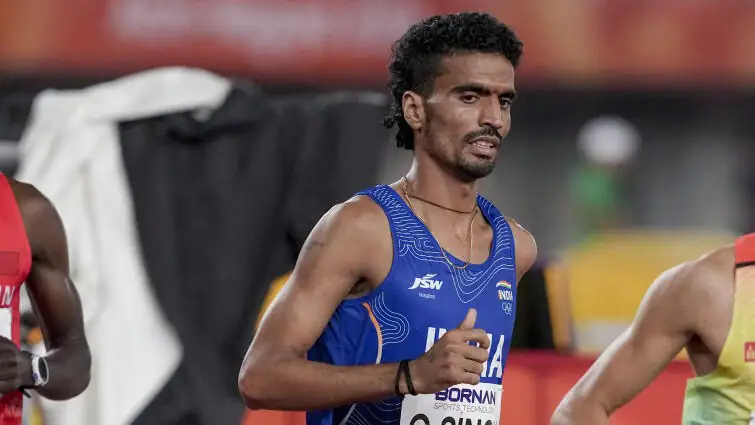
Gulveer Singh has already produced one of the most unusual distance-running campaigns in Asian Games history. On September 25, he won silver in the 10,000m. Three days later, he stepped down to the 1500m and again finished second, clocking a personal best of 3:36.72.
Now comes the third and final piece of the challenge.
Gulveer lines up in the men’s 5000m final at the Nagoya City Mizuho Park Athletic Stadium, with the opportunity to add another medal and complete a three-medal campaign across the 10,000m, 1500m and 5000m. The difficulty is obvious: the 5000m final comes less than 24 hours after his physically demanding 1500m final. The opportunity is equally clear: Gulveer possesses the strongest 5000m credentials in the field behind Bahrain’s Birhanu Balew and has already demonstrated that his speed is no longer a weakness.
Two medals, two very different races
Gulveer’s first medal came in the 10,000m, where he ran 28:29.38 for silver behind Balew, who won in 28:27.51. Gulveer then produced a completely different performance in the 1500m. His 3:36.72 was a personal best and earned another silver behind Japan’s Kazuto Iizawa, who set a Games record of 3:36.35. Crucially for the 5000m, Gulveer finished ahead of Nagiya Mori, who took bronze in 3:37.92.
That 1500m result changes the tactical equation for the 5000m. Previously, Gulveer's biggest question in a championship 5000m could have been his ability to respond to a late sprint from athletes with superior middle-distance speed. His performance on September 28 provided direct evidence that he can now compete at that pace.
The issue in Nagoya is therefore less about whether Gulveer has the speed to finish a tactical 5000m and more about how much of that speed remains after two demanding finals.
The Balew problem
The biggest obstacle is Birhanu Balew. The Bahrain runner enters with a 12:45.70 personal and season best, the fastest mark in the field and the Asian record. He has also won the Asian Games 5000m title in 2018 and 2023. His 2026 season includes a 7:29.60 3000m performance and a world-leading 12:45.70 in Brussels.
Balew also has a recovery advantage. He raced the 10,000m on September 25 and therefore enters the 5000m with three full days between finals. Gulveer, by contrast, has raced both the 10,000m and 1500m, with the latter coming only one day before the 5000m.
That scheduling difference could become decisive if the race turns into a sustained high-tempo contest.
Behind Balew, Gulveer's numbers are considerably stronger than most of the field. His 12:59.77 personal best makes him the only other athlete in the field to have broken 13 minutes. His 2026 season best is 13:03.93. Japan’s Nagiya Mori has a 13:14.18 personal best, while Tomonori Yamaguchi has run 13:16.38. That gives Gulveer a substantial established performance advantage over both Japanese contenders.
Mori is nevertheless a serious threat because he shares one important characteristic with Gulveer: he also raced the 1500m final on September 28. But Gulveer beat him directly in that race by 1.20 seconds. Yamaguchi presents a different challenge. He has not raced earlier rounds at these Games, meaning he enters the 5000m with fresh legs. His 13:16.38 personal best, however, remains significantly slower than Gulveer's established level.
The first scenario is a fast race. If Balew establishes a strong pace early, the field could quickly become an attritional contest. Gulveer's 13:03.93 season form gives him the aerobic capacity to remain with the lead group while forcing athletes such as Mori and Yamaguchi closer to their limits.
The second scenario is a tactical race. A slow opening 3000m would create a completely different contest, with positioning and the final 800m becoming critical. This is where Gulveer's new 1500m speed becomes particularly valuable. His 3:36.72 performance means he has demonstrated the ability to compete when a distance race turns into a sprint.
In either scenario, positioning will matter. Gulveer cannot afford to get boxed on the rail during the closing stages, particularly after the accumulated fatigue of the previous four days.
The one variable that cannot be measured purely through season-best statistics is recovery. Gulveer will have contested three championship finals across four days. The 10,000m demanded prolonged aerobic effort. The 1500m required a maximal finishing effort. The 5000m combines both demands. The source analysis identifies this accumulated workload as the central physiological risk in Gulveer's pursuit of a third medal. Balew's relative freshness and Yamaguchi's completely fresh legs create contrasting challenges.
Gulveer's advantage is the breadth of his training base. His development in Colorado Springs has transformed him from an endurance specialist into a more complete distance runner, with national records at 10,000m and the mile alongside his sub-60-minute half-marathon performance.
What would a third medal require?
Gulveer does not need to win the tactical battle at every stage. His best approach is likely to conserve energy early, stay close enough to the front to avoid traffic and use his improved speed only when the race reaches its decisive phase. The key moment could come inside the final kilometre. If Balew is able to sustain a world-class pace, Gulveer's primary challenge will be maintaining contact while protecting enough energy for the finish. If the race slows, his 3:36.72 1500m speed gives him another weapon.
The numbers establish Gulveer as the leading challenger behind Balew, but the 5000m is being contested under conditions that his season statistics cannot fully capture: an exceptionally compressed schedule and accumulated championship fatigue. That makes this final less about proving whether Gulveer belongs among Asia's best distance runners. He has already done that twice in Nagoya.
The question is whether his body can produce one more championship performance.
A medal would complete a remarkable three-event campaign across the 10,000m, 1500m and 5000m. Gold would require overcoming Balew's exceptional 2026 form and Gulveer's own recovery disadvantage. Silver or bronze would still extend a campaign that has already demonstrated extraordinary versatility.
At the start of the Games, the 5000m was simply another event on Gulveer Singh's schedule.
By the time he takes the line in Nagoya, it has become the race that could define his entire Asian Games campaign.
Comments (0)
to post comments, replies, and votes.
Loading comments…