Manav Thakkar vs Alexis Lebrun: Can India’s Rising Star Turn Familiarity into a China Smash Upset?
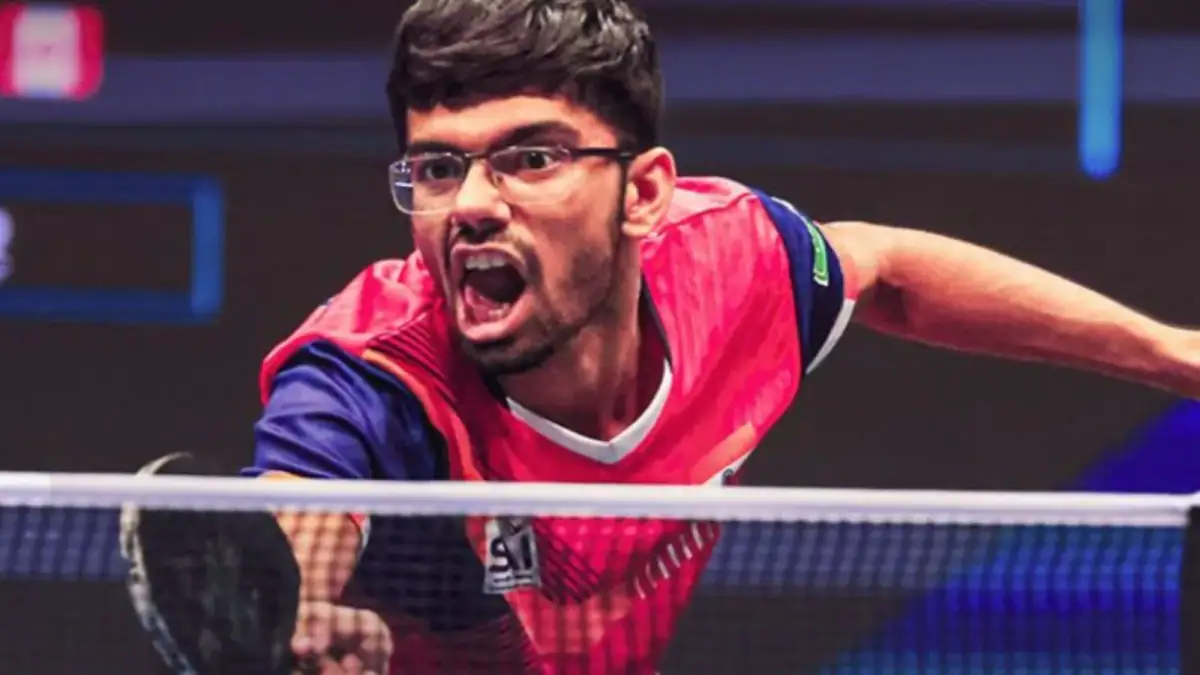
Manav Thakkar faces No. 7 seed Alexis Lebrun in the China Smash 2026 Round of 32. Can India’s rising paddler turn recent momentum and familiarity into a major upset?
Manav Thakkar faces one of the biggest singles tests of his senior career when he takes on France’s Alexis Lebrun in the Round of 32 at the WTT China Smash 2026 in Beijing.
The Indian is unseeded. Lebrun is the No. 7 seed and a top-10 player in the world.
On paper, the numbers point strongly towards the Frenchman. But this is not a conventional underdog-versus-favourite matchup. Thakkar and Lebrun know each other exceptionally well, having played alongside one another for Alliance Nîmes-Montpellier in France. They have trained in the same environment, shared tactical information and faced each other repeatedly across international competition. That familiarity could make this one of the more tactically intriguing matches of the China Smash.
The match is scheduled for Wednesday, October 7, at the Shougang Park Smash Arena in Beijing. China Smash is a WTT Grand Smash, the highest tier of the WTT calendar, with the champion collecting 2,000 ITTF ranking points from a total prize pool of $2.05 million.
Thakkar could hardly have asked for a more dramatic route into the Round of 32. The Indian fought back from 0-2 down against France's Simon Gauzy, winning 9-11, 9-11, 11-7, 11-5, 12-10. He even saved a match point at 9-10 in the deciding game before closing out one of the biggest victories of his China Smash campaign.
The result is officially recorded in the tournament results, with Thakkar listed as the winner over world No. 28 Gauzy. That comeback matters for more than the ranking points.
It demonstrated Thakkar's ability to alter his positioning and tactical approach during a match. After struggling to deal with Gauzy's variation early on, he moved closer to the table and began taking the ball earlier, disrupting the Frenchman's rhythm. But there is another consideration.
A five-game match is physically and mentally expensive. Thakkar had to recover from a 0-2 deficit, survive a match point and then play high-intensity rallies deep into the deciding game. Lebrun, by contrast, needed only four games to defeat Poland's Milosz Redzimski, winning 11-7, 11-8, 9-11, 11-2.
That difference in workload could become relevant if the match develops into a long contest.
Lebrun Brings a Completely Different Threat
Alexis Lebrun enters the match as the stronger-ranked player and one of the most aggressive attackers on the international circuit. Currently ranked No. 9, Lebrun is seeded seventh at China Smash. The official tournament player list confirms his top-10 status and No. 7 seeding. His biggest weapon is tempo.
Lebrun wants to make points short. His serve variations are designed to create a weak return, after which he can immediately attack with his forehand or explosive backhand. He is particularly effective when he can take the ball early and prevent his opponent from establishing a defensive rhythm. That creates the central tactical problem for Thakkar.
The Indian cannot afford to spend too much of the match reacting.
If Thakkar repeatedly gives Lebrun half-long or passive returns, the Frenchman will have opportunities to launch his first attack and dictate the point from the third ball.
The two players already met in the Round of 32 at WTT Champions Macao in September, and Lebrun won 3-1. The scoreline was 14-12, 11-4, 9-11, 11-3.
That match offers perhaps the clearest blueprint for what Thakkar needs to change. The contest was remarkably quick, with rallies frequently ending within the first few shots. Lebrun's ability to accelerate immediately after the serve prevented Thakkar from getting into his preferred counter-attacking rhythm. Thakkar's only game came when he succeeded in extending exchanges and finding more controlled placements.
The lesson is obvious: if the points remain short and explosive, the advantage belongs to Lebrun. If Thakkar can make the Frenchman play four, five or six shots consistently, the contest becomes much more interesting.
The unusual factor is that there are very few secrets between these players. Thakkar knows Lebrun's serve patterns, preferred attacking zones and movement habits from their time together at Alliance Nîmes-Montpellier.
Lebrun knows equally well what makes Thakkar uncomfortable. That eliminates the element of surprise.
Instead, the match could become a battle of execution. Who can impose the tactical pattern they want before the other player adjusts?
For Thakkar, the first priority should be the receive. A passive push could give Lebrun exactly the ball he wants. Short, low returns and aggressive flicks into the crossover area could force Lebrun to generate his own power rather than simply stepping into his preferred forehand attack.
Once rallies extend, Thakkar's compact counter-topspin game and lateral movement become more valuable.
There is considerable incentive for both players. A Round-of-32 victory at a Grand Smash means advancing to the last 16 and earning a larger ranking return. For Thakkar, an upset would represent a significant step towards establishing himself higher in the global rankings. For Lebrun, an early exit would be an expensive result at one of the biggest tournaments of the season.
The Frenchman therefore enters with the ranking advantage, but Thakkar enters with something equally important: confidence. He has already beaten a top-30 opponent in Beijing by recovering from a seemingly lost position.
Now he faces a top-10 opponent who knows his game almost as well as anyone.
Can Thakkar Turn Familiarity into an Upset?
This match is unlikely to be decided simply by who possesses the bigger forehand. It will come down to tempo. Lebrun will want short points, early contact and immediate pressure. Thakkar's route to victory is to disrupt that rhythm, vary the receive, stay close to the table and force the Frenchman into longer exchanges.
The Indian has already shown at China Smash that he can survive adversity. Against Gauzy, he was two games down and one point from defeat. Against Lebrun, he cannot afford to wait until the match reaches that stage.
He will need to start with the intensity and tactical clarity that carried him through the second half of his previous match. The rankings may favour Alexis Lebrun.
The recent head-to-head may favour Alexis Lebrun. But the conditions are not entirely against Manav Thakkar. He knows the opponent. He knows what went wrong in Macao. And after his comeback against Gauzy, he knows he can win a five-game battle when the pressure is at its highest.
For India, this is more than a Round-of-32 match. It is an opportunity for Thakkar to turn his growing reputation into one of the biggest singles wins of his career.
Comments (0)
to post comments, replies, and votes.
Loading comments…