Basant Creates History with Silver Medal in Men’s High Jump at World U20 Championships
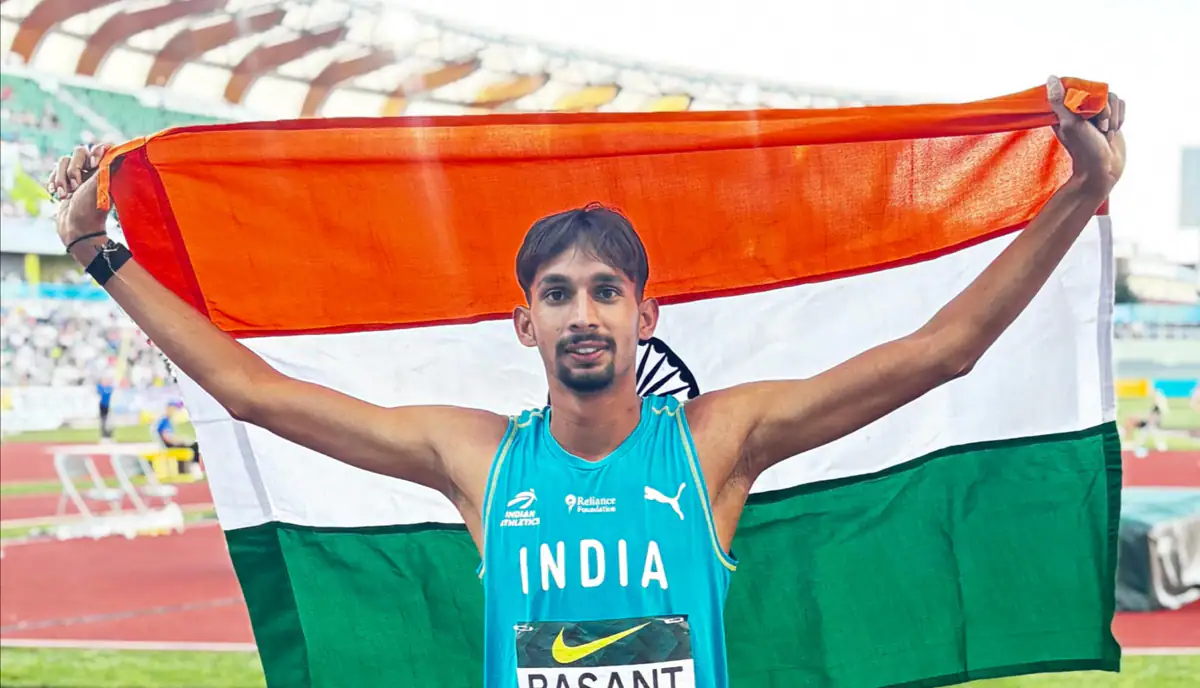
Basant created history at the World Athletics U20 Championships in Eugene, Oregon, becoming the first Indian high jumper to win a medal at a global championship after clearing 2.21m to secure silver in the men's high jump.
The 19-year-old from Ganganagar, Rajasthan, equalled his personal best in a dramatic competition where all three medal winners finished at the same height. Algeria's Younes Ayachi won gold, while Britain's Otis Poole took bronze, with the medals ultimately decided through the countback system.
For Indian athletics, however, the significance of Basant's performance extends well beyond the medal itself. His silver represents a landmark moment for India's high jump program and provides another indication of the country's growing strength among the next generation of field athletes.
Basant entered the competition with a clear objective but had to negotiate a demanding series of heights before reaching the medal-winning mark.
His progression through the final demonstrated both resilience and composure. He cleared 2.06m on his first attempt before needing two attempts to get over 2.12m. At 2.17m, he responded immediately, clearing the height on his first attempt.
The competition intensified at 2.21m.
Basant needed two attempts to clear the height, matching his lifetime best in the process. Once the bar stayed in place, he had secured a historic medal regardless of what happened next.
The achievement was particularly significant because 2.21m was also cleared by Ayachi and Poole.
That meant the gold, silver and bronze medals could not be separated simply by the highest height cleared.
With all three athletes clearing 2.21m, the competition went to countback.
In high jump, when athletes finish at the same height, the ranking can be determined by the number of unsuccessful attempts at previous heights. The athlete with the stronger progression and fewer failed attempts is placed higher.
Ayachi ultimately claimed the gold medal, while Basant finished second and Poole took bronze.
Basant's progression was:
2.06m: First attempt
2.12m: Second attempt
2.17m: First attempt
2.21m: Second attempt
The silver medal therefore came after a performance in which Basant consistently responded to the pressure of the competition and remained in contention through every stage of the final.
India has produced several notable high jumpers over the years, but Basant has now achieved something no Indian high jumper had managed before him at a global championship.
His silver medal makes him the first Indian athlete to win a high jump medal at a World Athletics global championship.
The achievement is particularly noteworthy because high jump is an event where international competition has traditionally demanded exceptional consistency and technical precision. Clearing 2.21m at a World U20 Championships is itself a significant accomplishment, but doing so under championship pressure and finishing on the podium makes Basant's performance even more important.
At just 19, he also has considerable room for progression. Perhaps one of the most encouraging aspects of Basant's performance is that he equalled his personal best when it mattered most.
The ability to reproduce one's best performance at a major championship is an important marker of competitive maturity. Basant had already demonstrated that he possessed the physical ability to clear 2.21m. In Eugene, he converted that ability into a global championship medal.
His performance also highlights the importance of consistency in high jump, where a single missed attempt can have a major impact on the final standings.
Basant's ability to recover after needing a second attempt at 2.12m and then clear 2.17m at the first time of asking showed that he could manage the changing demands of the competition.
Basant's silver medal could have significance beyond the immediate result.
Young Indian athletes entering high jump now have a new benchmark at the global junior level. A performance of 2.21m is no longer simply a personal target for one athlete; it represents the height at which an Indian athlete has reached a World U20 podium.
The achievement could also provide greater visibility to an event that has historically received less attention than some of India's more prominent athletics disciplines. For Basant, however, the focus will now shift from celebrating a historic junior medal to building on it.
At 19, his senior career is only beginning. The transition from junior to senior athletics will bring significantly stronger competition, but his performance in Eugene provides a strong foundation.
Basant's historic silver medal is more than a podium finish. It is a milestone for Indian high jump and another significant achievement for the country's emerging athletics generation.
Clearing 2.21m, equalling his personal best and finishing second in a global championship final required technical ability, consistency and composure. Basant delivered all three when the pressure was at its highest.
With Ayachi taking gold and Poole securing bronze at the same height, the final was ultimately decided by the smallest of margins. Basant's place in that three-way battle, however, will remain the defining achievement.
For Indian athletics, the significance is clear: Basant has become the first Indian high jumper to stand on a global championship podium. And at just 19, his historic leap could be the beginning of a much bigger journey.
Comments (0)
to post comments, replies, and votes.
Loading comments…