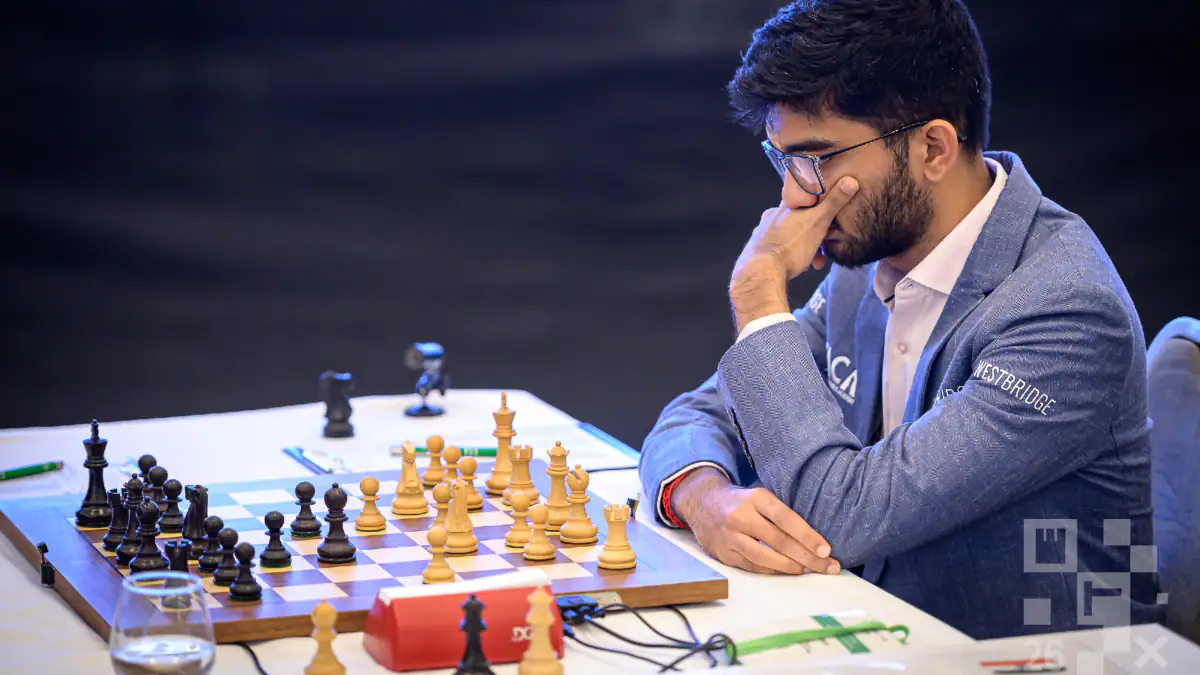
Gukesh and Sindarov Settle for Second Successive Draw as London System Produces Quiet Game in Geneva

The opening two games of the FIDE World Chess Championship match between D. Gukesh and Javokhir Sindarov have ended in draws, leaving the contest level at 1-1.
After a 38-move battle featuring the Berlin Defence on Tuesday, the second game in Geneva on Wednesday was a considerably quieter affair, with the players agreeing to a draw by threefold repetition after just 20 moves.
The encounter at the library of Fondation Martin Bodmer in Cologny saw Gukesh make his first appearance with the white pieces. The Indian world champion chose the London System, an opening that has featured in recent World Championship contests, but neither player managed to create a meaningful advantage.
The result extended the cautious start to the youngest World Championship match in history, with both 20-year-olds yet to establish an early lead.
Gukesh opened with 1.d4, pushing the pawn in front of his queen two squares. Sindarov responded with 1...d5, and the game developed into the London System after the Indian brought his dark-squared bishop to f4.
The choice was significant because the London System had also been used by Ding Liren against Gukesh in their previous World Championship match in Singapore. Ding employed the opening twice in that contest, with both games ending in draws.
Gukesh's decision to bring the same system into his match against Sindarov offered a familiar but strategically flexible starting point. The opening did not produce the sharp exchanges seen in the first game, and the players moved into a relatively balanced position.
Sindarov later indicated that he had not expected Gukesh to choose the London System, although he was familiar with the variation. Both players appeared well prepared, and the Uzbek challenger was able to meet the opening without allowing the world champion to build pressure.
Clock Pressure Without Board Drama
One of the talking points from the first game had been Gukesh's struggle with the clock. The Indian again spent considerable time on his moves in the second encounter, particularly before playing his 16th move, f3.
By then, he had fallen more than half an hour behind Sindarov on the clock. However, the situation was not as precarious as it had been in the opening game, when the time pressure had added another layer of tension to an already demanding contest.
On the board, neither player had established a clear advantage. Gukesh's decision to bring his dark-squared bishop towards the centre did not create an immediate threat, while Sindarov maintained a solid position.
The game reached a point where forcing complications would have required one of the players to accept additional risks. With no clear route to an advantage, the prospect of a draw became increasingly apparent.
The decisive sequence began after Gukesh played 16.f3. Sindarov responded with 16...Nf6, and the players then repeated a sequence involving their bishops and knights.
Gukesh moved his bishop between e5 and g3, while Sindarov repeatedly shifted his knight between d7 and f6. The position returned to the same configuration three times, allowing the players to claim a draw by threefold repetition.
The final sequence was:
16. f3 Nf6
17. Be5 Nd7
18. Bg3 Nf6
19. Be5 Nd7
20. Bg3 Nf6
This time, Sindarov ensured that the draw was claimed correctly. There had been a small procedural issue in the first game, when the arbiter had to point out that the Uzbek player's claim of a draw was premature.
The second encounter ended without a similar interruption. The players signed off on the draw with much of the material still on the board, underlining how little progress either had made towards a decisive result.
Match Remains Open as Game Three Approaches
The contrast between the first two games has been clear. Tuesday's 38-move Berlin Defence encounter offered sustained tension, with both players tested and Gukesh's clock situation adding to the drama. Wednesday's London System game was shorter and more controlled, with neither player finding a reason to depart from an equal position.
The 1-1 scoreline means the championship remains wide open. With 12 games still to be played in the 14-game match, neither player has gained an early psychological or scoreboard advantage.
For Gukesh, the London System provided an opportunity to test a different opening approach with White. For Sindarov, the result demonstrated that he could meet the world champion's choice without being forced into an uncomfortable position.
Attention now turns to Thursday's third game. With the opening two encounters producing draws through repetition, the next contest could offer another opportunity for either player to introduce a new preparation idea and alter the early rhythm of the match.
The first two games have shown that both competitors are prepared to prioritise positional security when a clear advantage is unavailable. Whether that balance continues or one of them chooses to take greater risks will be the central question as the championship moves into its next phase.
Comments (0)
to post comments, replies, and votes.
Loading comments…