India Fall to Jamaica in Unity Cup 2026 Semifinal Despite Spirited Defensive Display
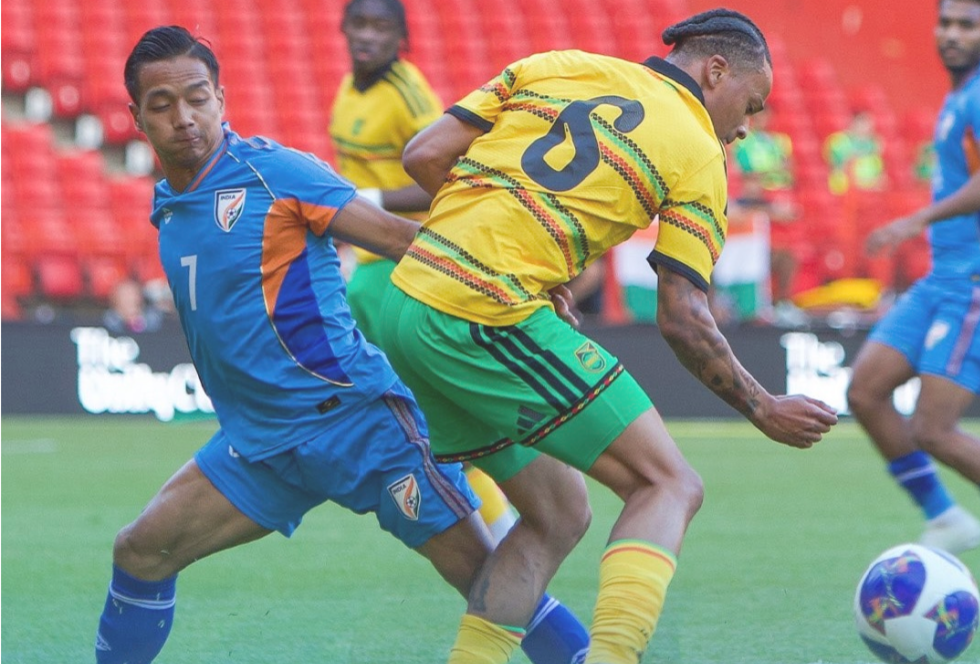
The Indian men’s football team suffered a 0-2 defeat against higher-ranked Jamaica men's national football team in the semifinal of the Unity Cup 2026 at The Valley in London on Wednesday night, ending the Blue Tigers’ hopes of reaching the final.
Goals from Courtney Clarke and Kaheim Dixon ensured Jamaica booked their place in the title clash against Nigeria, while India will now face Zimbabwe in the third-place playoff. Despite the scoreline, the match was not entirely one-sided. India showed moments of resilience, especially defensively, but once again struggled to consistently threaten stronger opposition in the final third.
From the opening whistle, Jamaica’s superior athleticism and technical sharpness were evident. India attempted to play with an aggressive defensive line initially, pressing high and trying to disrupt Jamaica’s buildup. But the Reggae Boyz quickly began exploiting spaces behind the midfield with direct running and fast transitions.
The breakthrough arrived in the eighth minute.
A quick Jamaican counterattack stretched India’s shape before Courtney Clarke received possession near the edge of the box. Using an Indian defender as a screen, Clarke curled a superb strike beyond Gurpreet Singh Sandhu into the top corner to make it 1-0. The early goal immediately put India under pressure against a side ranked 71st in the world 65 places above the Blue Tigers in the FIFA rankings.
Gurpreet and Jhingan Keep India Alive
Following the goal, Jamaica controlled large portions of possession and repeatedly tested India’s defensive structure. Kaheim Dixon, one of Jamaica’s biggest attacking threats throughout the night, consistently found dangerous pockets behind the Indian defence. Gurpreet Singh Sandhu was forced into several important interventions, including a strong save midway through the first half to deny Dixon from close range.
At the heart of India’s resistance stood Sandesh Jhingan. The centre-back produced a tireless performance, making multiple crucial recoveries, blocks and tackles throughout the contest. Even as Jamaica continued stretching India physically with quick movement, Jhingan remained heavily involved in nearly every defensive situation.
The first half ended with India trailing 0-1, but the damage could easily have been worse given Jamaica’s attacking dominance during long phases.
To India’s credit, the second half brought noticeable improvement. Khalid Jamil’s side pushed slightly higher up the pitch and began applying more pressure during Jamaica’s buildup phases. The midfield looked more compact, while Lallianzuala Chhangte and Ryan Williams finally started finding small pockets of space.
India even thought they had equalised in the 53rd minute. A defensive error from Jamaica allowed Ryan Williams to square the ball into the box before Chhangte smashed home from close range. However, the move was ruled out for offside, denying India what would have been a huge momentum shift.
That phase represented India’s best spell of the match.
The Blue Tigers began winning more second balls, earned dangerous set-piece opportunities and briefly looked capable of forcing Jamaica into discomfort.
Injury Concern For Ryan Williams
One major setback for India arrived just before the hour mark when Ryan Williams appeared to suffer an injury and had to be substituted. Williams had been one of India’s few bright attacking sparks during the second half, and his departure reduced India’s already limited attacking threat further. PN Noufal was introduced, while later substitutions included Vikram Partap Singh and Ricky Shabong. However, the changes never fully transformed the game offensively.
Interestingly, Noufal himself was later substituted after only around 20 minutes on the pitch, highlighting India’s tactical search for solutions during the closing stages.
As India pushed slightly higher in search of an equaliser, Jamaica eventually found the second goal that killed the contest. In the 78th minute, Kaheim Dixon finally got his reward after tormenting India throughout the evening. The winger drifted inside, skipped past defenders and fired a low shot through Akash Mishra’s legs into the far corner to make it 2-0.
The goal effectively ended India’s hopes of a comeback. Still, the Blue Tigers continued fighting until the end, with Jhingan coming closest late on through a header that drifted wide in stoppage time.
The result ultimately reflected the current gap between India and stronger international opposition. Jamaica rarely looked fully stretched despite not operating at maximum intensity for large periods. Their pace, physicality and technical quality in transitions repeatedly troubled India.
At the same time, India’s defensive discipline especially after conceding early deserves some credit. Against a much stronger side, the Blue Tigers remained organised for long phases and avoided a collapse despite sustained pressure. However, the attacking concerns remain obvious.
India created very few clear-cut opportunities across 90 minutes, and the lack of consistent attacking penetration against higher-ranked teams continues to be a major issue for Khalid Jamil moving forward.
India will now shift focus towards the third-place playoff against Zimbabwe, where the Blue Tigers will hope to finish the tournament on a more positive note.
Comments (0)
to post comments, replies, and votes.
Loading comments…