India Join Elite Company as Basant and Shahnawaz Deliver Historic Double at World U20 Championships
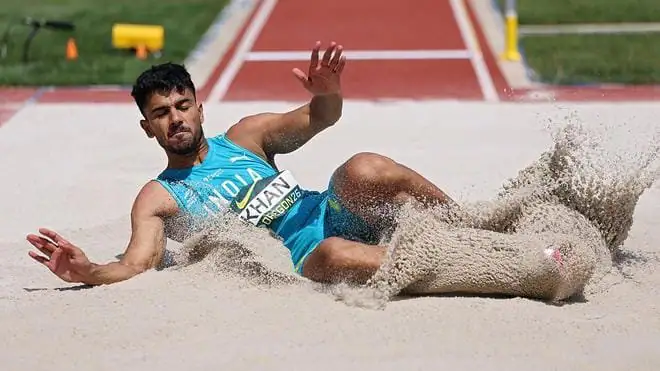
Basant Kumar Meghwal and Shahnawaz Khan won high jump and long jump medals at the World U20 Championships, putting India in an elite historical list.
India has entered a select chapter of World U20 Championships history after Basant Kumar Meghwal and Shahnawaz Khan secured medals in the men's high jump and long jump, respectively, at the 2026 edition in Eugene, Oregon.
Basant won silver in the high jump after clearing 2.21m, while Shahnawaz claimed bronze in the long jump. Their performances have made India only the seventh nation in the history of the World U20 Championships to win men's medals in both jumping disciplines at the same edition.
More significantly, India is the first nation to achieve the feat in a decade, since Cuba accomplished the double at the 2016 World U20 Championships. The achievement places India alongside a distinguished group comprising East Germany, Great Britain, the United States, China, Spain and Cuba.
For Indian athletics, the significance goes beyond two individual medals. It represents evidence of growing depth in technical field events and the emergence of a new generation capable of competing for global junior honours.
The World U20 Championships have traditionally been one of the most important platforms for identifying future senior athletics stars.
Winning a medal in one jumping discipline is already a significant achievement. Doing so in both high jump and long jump at the same championship requires a combination of talent, specialist coaching, athlete identification and development systems. The two events also demand substantially different physical and technical characteristics.
High jumpers need to maximise vertical lift from a curved approach while maintaining the body mechanics required to clear the bar. Long jumpers, meanwhile, must preserve maximum controllable horizontal speed before converting that velocity into an explosive take-off.
The fact that so few nations have managed to develop medal contenders in both disciplines during the same edition underlines the rarity of the achievement.
The Seven-Nation Club
India's achievement in Eugene places it alongside six previous nations that managed the same men's high jump and long jump medal double. The list begins with East Germany in 1986, when Thomas Müller won high jump bronze with 2.22m and Thomas Wolf took long jump bronze with 7.77m. Great Britain followed in 1996, with Ben Challenger winning high jump silver at 2.21m and Nathan Morgan claiming long jump bronze with 7.74m.
In 2002, the United States achieved the feat in Kingston. Andra Manson won high jump gold after clearing 2.31m, while Trevell Quinley earned long jump bronze with 7.71m. China achieved the double in 2006 on home soil in Beijing. Huang Haiqiang won high jump gold with 2.32m, while Zhang Xiaoyi took long jump bronze at 7.86m.
Spain followed in 2008, with Miguel Ángel Sancho taking high jump bronze at 2.21m and Eusebio Cáceres winning long jump bronze with 7.59m. The most recent nation before India was Cuba in 2016. Luis Zayas won high jump gold with 2.27m, while Maykel Massó also captured gold in the long jump with 8.00m.
India has now joined that exclusive group in 2026.
Basant Kumar Meghwal produced a particularly significant performance in the high jump final. The Indian cleared 2.06m on his first attempt before needing a second attempt to get over 2.12m. He responded strongly at 2.17m, clearing the height first time, before reaching 2.21m on his second attempt.
Three athletes finished with a best clearance of 2.21m. Algeria's Younes Ayachi won gold after clearing the height on his first attempt, while Basant took silver by clearing it on his second attempt. Great Britain's Otis Poole secured bronze after needing three attempts. Basant's medal made him the first Indian high jumper to win a medal at the World U20 Championships.
His silver was also an important marker because it came at his personal-best height, demonstrating his ability to reproduce his best performance under global championship pressure.
Shahnawaz Khan then added the second half of India's historic achievement in the men's long jump. The Indian jumper advanced to the final after producing 7.73m in qualification and subsequently delivered a podium performance in the final. His bronze ensured that India's campaign in Eugene would be remembered not simply for an individual field-event medal but for a rare double across two technically distinct jumping disciplines.
The performance also reflects Khan's rapid development. His progression into the global junior medal picture has been accompanied by increasingly strong domestic performances, indicating that the Eugene podium is part of a broader upward trajectory rather than an isolated result.
The achievement is particularly important because India's international athletics success has historically been concentrated in individual disciplines and exceptional athletes. The Eugene campaign suggests a broader shift. Alongside Basant and Shahnawaz's medals, India also secured silver in men's javelin through Ashish Yadav, while other athletes made progress across track and field events.
This growing diversity matters.
A successful athletics programme cannot depend indefinitely on individual exceptional talents. Sustained international competitiveness requires multiple athletes, coaches and event groups developing simultaneously.
India's emergence in both vertical and horizontal jumps at the same World U20 Championships is therefore a meaningful indicator of that broader development.
India's entry into the historic seven-nation list is a landmark achievement, but the bigger question now is whether the Eugene medals can become a foundation for senior success. The transition from U20 to senior athletics is notoriously demanding. Athletes must adapt to stronger competition, greater physical demands and increasingly sophisticated technical requirements.
For Basant and Shahnawaz, the next stage will be about converting junior success into sustained senior performances. For Indian athletics, their medals provide something equally valuable: a benchmark for the athletes coming behind them. From East Germany in 1986 to Great Britain, the USA, China, Spain and Cuba, the dual-jump achievement has historically belonged to nations with strong technical development systems.
In 2026, India has joined them.
Ten years after Cuba's achievement, Basant Kumar Meghwal and Shahnawaz Khan have put India on the same list giving Indian athletics a historic double and a powerful glimpse of what its next generation can achieve.
Credit Prithvi on X
Comments (0)
to post comments, replies, and votes.
Loading comments…