India’s relay squads set for biggest global test at World Relays in Gaborone
Indian athletics will enter an important phase this weekend as four relay teams prepare to compete at the World Athletics Relays 2026 in Gaborone, Botswana.
Beyond qualification spots for the World Athletics Championships in Beijing next year, the event also offers India a crucial opportunity to measure itself against some of the strongest relay nations in the world ahead of a packed international cycle that includes the Asian Games and the Los Angeles Olympics pathway. From sprint relays to the increasingly competitive 4x400m events, India will have representation across multiple disciplines, reflecting the growing depth within the country’s relay programme.
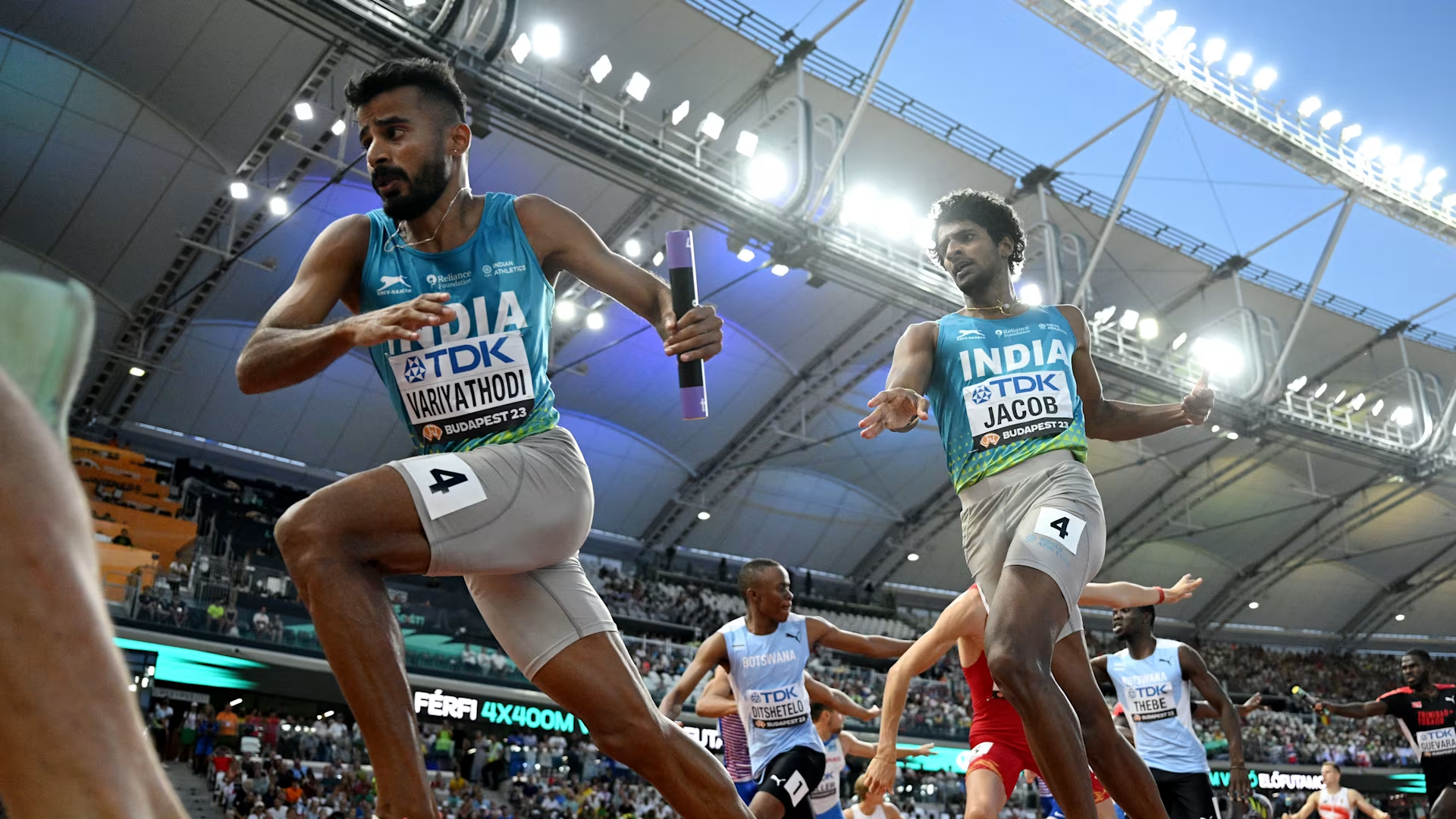
The biggest attention, naturally, will once again fall on the men’s 4x400m team. Over the past few seasons, India’s quarter-milers have steadily transformed themselves into a genuine global contender, regularly breaking national records and reaching finals at elite competitions. In Gaborone, however, the challenge becomes even steeper. India has been drawn into a loaded heat alongside Great Britain, Belgium, Japan, Qatar and Spain all nations with strong relay traditions and sub-three-minute capabilities. Japan, in particular, brings added intrigue as the current Asian record holders. With India’s own national record now standing at 2:59.05, the gap between the two Asian powers is shrinking rapidly.
The Indian squad heads into the competition with one major advantage: depth.
Rajesh Ramesh has emerged as one of the most consistent quarter-milers in Asia this season, while Vishal TK, Dharamveer, Manu TS and Amoj Jacob have all gone below 46 seconds. That gives India multiple combinations and tactical flexibility depending on the rounds. Unlike earlier generations where India often depended on one standout athlete, this relay pool now looks balanced across all four legs. That depth becomes especially important in championship relay racing, where recovery, baton exchanges and maintaining rhythm across rounds can decide qualification.
The heat itself is expected to be brutally fast. Great Britain and Belgium are likely to force an aggressive pace from the opening leg, while Japan’s relay discipline and efficiency remain among the best in the world. Qatar, meanwhile, continues to be a dangerous relay side despite fluctuating results in recent years. For India, a place in the top two would guarantee direct qualification for the World Championships and the World Relays final. Even if that proves difficult, fast timings could still secure progression through the time qualification route.
The race could also carry larger significance for Asian athletics. With India eyeing dipping below the three-minute barrier and Japan already holding the continental record, conversations around the Asian benchmark are beginning to intensify. Gaborone may offer another glimpse into how quickly India is closing that gap. While the men’s 4x400m squad enters with aspirations, the mixed 4x400m team faces a very different challenge.
India has been drawn alongside the United States the world record holders along with strong European teams such as Belgium, Ireland and Spain. On paper, it is one of the toughest heats in the competition.
Yet for India’s younger women athletes, the race could become an invaluable learning experience. Athletes like Rashdeep Kaur, Kumari Saloni and Ansa Babu have shown impressive progress domestically, all producing lifetime bests this season. Now they will get the rare opportunity to compete directly against some of the world’s best relay programmes.
The mixed relay has evolved rapidly over recent years, becoming one of the most tactical events in global athletics. The sequencing of athletes, timing of baton changes and ability to manage pressure often matter just as much as raw speed. India’s programme is still developing in comparison to established powers, but exposure at this level remains critical for long-term growth.
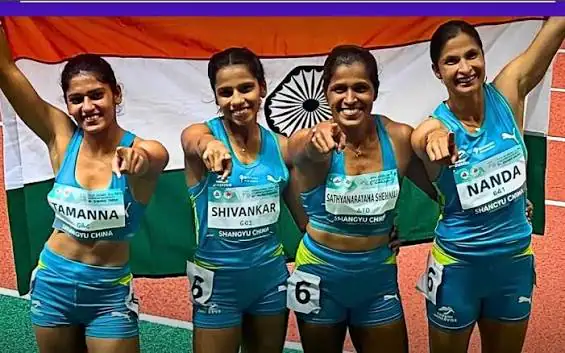
The women’s 4x100m relay team also enters a difficult field featuring sprint heavyweights such as the United States, Canada, Australia and Poland. Indian women’s sprinting has shown gradual progress in recent seasons, particularly in relay coordination and baton exchange work. Competing against elite sprint nations now offers a realistic benchmark of where India stands internationally.
The squad comprising Nithya Gandhe, Sneha S.S, Srabani Nanda, Sudeshna Shivankar and Tamanna may not enter as favourites for qualification, but races like these are important for building competitive experience under pressure. Sprint relays are often decided by execution rather than individual rankings alone, and India will hope to produce a clean, technically sharp race. Meanwhile, India’s men’s 4x100m team is preparing for a significant milestone of its own a World Relays debut. The sprint relay pool globally remains extraordinarily competitive, and India has landed in another unforgiving heat alongside Great Britain, South Africa, Nigeria, Brazil and China. The presence of China adds particular importance from an Asian perspective, especially with continental rivalries beginning to intensify ahead of the Asian Games.
India’s current national record of 38.69 seconds remains some distance away from the world’s top sprint relay nations, but participation itself marks progress for a programme that is still developing depth in the short sprints.
Perhaps the biggest positive for Indian athletics heading into Gaborone is the diversity of relay representation. Not long ago, India’s global relay ambitions revolved almost entirely around the men’s 4x400m event. Today, the country is competing across four relay disciplines at one of the sport’s biggest team competitions. That reflects broader improvements in athlete development, coaching systems and international exposure.
The results this weekend will matter. Qualification for Beijing 2027 remains the immediate objective. But beyond timings and finishing positions, Gaborone is also about establishing India’s relay programme as a consistent global presence rather than an occasional breakthrough story.
And increasingly, that shift is beginning to look real.
India’s Race Timings at World Athletics Relays 2026 (IST)
Event | Heat |
| Time (IST) |
|---|---|---|---|
Mixed 4x100m Relay | Heat 3 |
| 5:48 PM |
Mixed 4x400m Relay | Heat 1 |
| 6:00 PM |
Women’s 4x100m Relay | Heat 1 |
| 6:35 PM |
Men’s 4x100m Relay | Heat 3 |
| 7:14 PM |
Men’s 4x400m Relay | Heat 3 |
| 8:19 PM |
All above races will take place on Day 1 of the World Athletics Relays 2026 in Gaborone, Botswana.
Comments (0)
to post comments, replies, and votes.
Loading comments…