India’s Unbeaten Run Ends Against Kazakhstan, Bronze Medal Still Within Reach at CAVA Women’s Championship
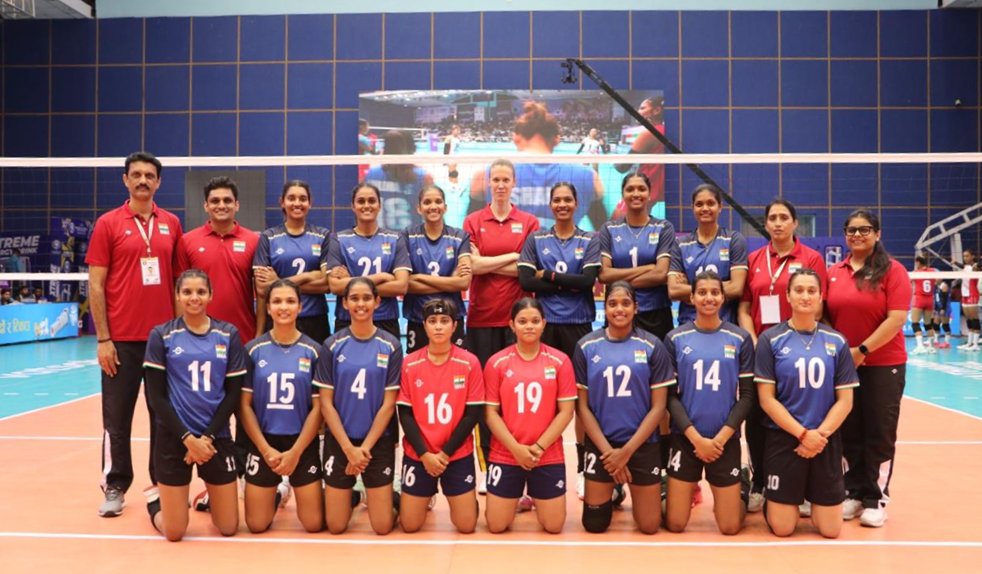
India’s impressive run at the CAVA Women’s Volleyball Championship 2026 came to an end in the semifinals as the team went down 0-3 to a higher-ranked Kazakhstan side in Kathmandu, Nepal, on Thursday.
The Indian women, who had entered the knockout stage unbeaten after three consecutive victories in the preliminary round, fought hard in patches but were ultimately outclassed by World No. 36 Kazakhstan, losing 21-25, 17-25, 14-25. While the defeat ended India’s hopes of reaching the final, the campaign is far from over. The team will now have another opportunity to return home with a medal as it prepares for the bronze-medal playoff, where host nation Nepal could be the likely opponent.
India knew the semifinal would present a completely different challenge from anything they had faced earlier in the tournament. The side coached by Jana Kulan had looked increasingly confident through the group stage, defeating Nepal, Maldives and Kyrgyzstan while topping the standings with a perfect record.
However, Kazakhstan represented a significant step up in quality. Ranked 36th in the world and possessing far greater international experience, the Central Asian side entered the match as favourites. Their physicality, blocking ability and attacking depth had made them one of the strongest teams in the tournament, and they showed exactly why in the semifinal.
Still, India did not look overwhelmed in the opening stages.
The first set provided plenty of encouragement for the Indian camp. India matched Kazakhstan point for point for long periods and displayed the defensive discipline that had been a hallmark of their group-stage performances. Several extended rallies went India's way, and the team remained within touching distance throughout most of the set.
However, when the decisive moments arrived, Kazakhstan's experience made the difference. A series of strong attacks and effective serving helped the higher-ranked side create a small cushion, which they maintained to close out the set 25-21. Although India found itself trailing, the performance suggested an upset might still be possible.
The second set saw Kazakhstan gradually impose its authority. The Indian side continued to battle hard, but the intensity and consistency of the Kazakh attack began to create problems. Kazakhstan's blockers became increasingly effective at shutting down India's offensive options, while their powerful spikes repeatedly forced the Indian defence into difficult situations.
India struggled to sustain momentum for long stretches, allowing Kazakhstan to open a comfortable lead.
The set eventually ended 25-17 in favour of the Central Asians, leaving India needing a remarkable comeback to reach the final.
The third set reflected the growing influence of Kazakhstan. With confidence building and a place in the final within reach, the World No. 36 side played with greater freedom and control. India continued to compete for every point, but fatigue and the physical demands of facing a stronger opponent began to show.
Kazakhstan dominated the net, controlled key rallies and limited India's opportunities to build scoring runs. The result was a 25-14 victory in the third set, completing a straight-sets win and booking Kazakhstan's place in the gold-medal match.
Despite the defeat, India's overall campaign remains encouraging. The team arrived at the semifinals unbeaten, having opened the tournament with a dramatic 3-2 victory over Nepal before recording comfortable straight-set wins against Maldives and Kyrgyzstan. Those performances demonstrated the progress made by the squad under Jana Kulan.
At the same time, the semifinal highlighted the gap that still exists between India and the stronger Asian volleyball nations.
India's victories in the group stage were impressive, but Kazakhstan exposed areas that require further development, particularly in attack efficiency and net defence against physically dominant opponents.
Such matches are valuable learning experiences, especially for a team seeking to establish itself more consistently at the continental level.
Importantly, the tournament is not over for India. The team remains in contention for a bronze medal and has an opportunity to finish the championship on a positive note. A meeting against host nation Nepal appears the most likely scenario in the third-place playoff, which would set up a fascinating rematch of the tournament opener. India defeated Nepal in a hard-fought five-set thriller earlier in the competition, coming back strongly after dropping the opening set.
That victory should provide confidence heading into another potential encounter.
A bronze medal would not only reward the team's efforts throughout the week but also underline the progress shown during the tournament.
While reaching the final would have been a major achievement, India's campaign has already produced several positives. The team topped its preliminary group, defeated multiple opponents convincingly and showed greater consistency than in several recent international competitions. The semifinal loss to Kazakhstan ultimately reflected the quality of the opposition rather than a failure on India's part.
World No. 36 Kazakhstan entered the match as favourites and justified that status with a composed and clinical performance.
For India, the focus now shifts to finishing strongly.
The dream of gold may be over, but a place on the podium remains within reach. If the team can rediscover the form that carried it through an unbeaten group stage, it still has the chance to conclude the CAVA Women’s Championship with a well-deserved medal.
Comments (0)
to post comments, replies, and votes.
Loading comments…