India U-17 Women Begin Asian Cup Qualifying Campaign Against Iraq
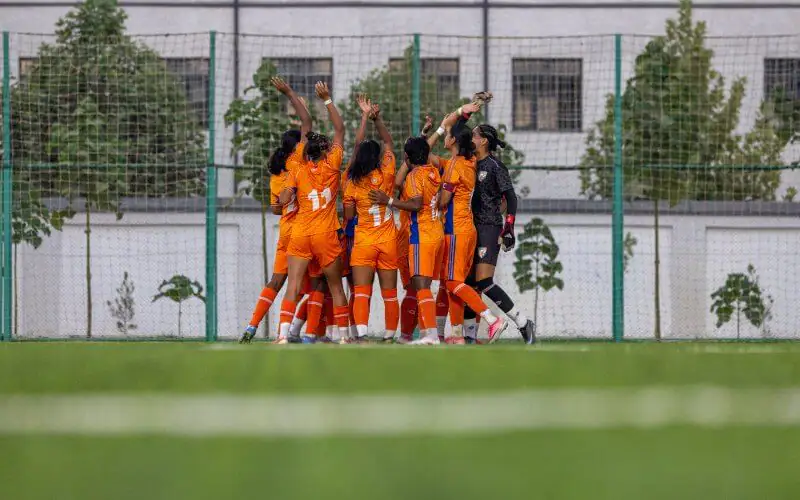
India U-17 women begin their AFC U-17 Women’s Asian Cup China 2027 qualifying campaign against Iraq as they target back-to-back Asian Cup appearances.
India’s U-17 women’s national team begins their latest continental challenge on Monday with a clear objective: qualify for back-to-back AFC U-17 Women’s Asian Cups for the first time.
The Young Tigresses face Iraq in their opening Group E fixture at the MP Selayang Stadium in Selayang, Malaysia, with kick-off scheduled for 1:30 PM IST. India then face Syria on October 8 before meeting hosts Malaysia on October 11. Only the group winner will qualify for the AFC U-17 Women’s Asian Cup China 2027. This is a different India side from the one that made history earlier this year, but the connection between the two campaigns is strong. Eleven players from the previous squad have returned, bringing with them experience of India's best-ever finish at the competition.
India reached the knockout stage of the AFC U-17 Women’s Asian Cup China 2026 for the first time. Their campaign eventually ended with a 0-3 quarter-final defeat against hosts China, but reaching the last eight represented a major step forward for Indian women's youth football. The challenge now is to make that achievement repeatable.
Qualification for China 2027 would give another generation of Indian players exposure to the strongest teams in Asia and potentially create another pathway towards the FIFA U-17 Women’s World Cup. The four semi-finalists at the Asian Cup will qualify for the 2027 FIFA U-17 Women’s World Cup in Morocco.
For India, however, everything begins with Group E.
The preparation for the qualifiers began back in July, giving head coach Joakim Alexandersson considerable time to develop the squad. India initially assembled in Bengaluru, where the coaching staff conducted trials and began putting together the group. The team subsequently travelled to Tashkent for two closed-door friendlies against Uzbekistan. Both matches ended 0-0.
The next phase took place in Goa, where India played two friendlies against the Philippines. The first ended in a 2-4 defeat, providing the coaching staff with a clear indication of areas requiring improvement. India responded in the second meeting with a 2-0 victory, with Anushka Kumari scoring both goals. That was the team's final friendly before travelling to Malaysia.
Across the four matches, the results were mixed, but the objective was preparation rather than building an unbeaten record. Alexanderson has used the extended camp to establish the team's playing principles, particularly in possession and defensive organization. The emphasis has been on technical quality, speed of play, communication, and collective responsibility.
That could prove important against Iraq, an opponent for whom India has limited recent footage.
Iraq Could Force India to Be Patient
Alexandersson has acknowledged that there is relatively little information available on the Iraqi side. That makes the opening fixture particularly interesting tactically. Rather than expecting Iraq to immediately engage India in an open contest, India's coaching staff anticipate a disciplined and compact opponent who could look to exploit spaces on the counter-attack. For India, that means the first challenge may not necessarily be breaking down an aggressive defense. It could be maintaining patience while avoiding the turnovers that allow Iraq to attack in transition.
The Young Tigresses will need to move the ball quickly enough to shift Iraq's defensive structure while maintaining sufficient protection behind the ball. That balance could determine the opening stages.
The return of 11 players from the previous Asian Cup campaign gives Alexandersson a valuable core of players who already understand the demands of international tournament football. But this remains a new qualification cycle. The squad includes a mix of returning players and younger faces, with Anushka Kumari, Abhista Basnett, Alva Devi Senjam, Nira Chanu Longjam, Silky Devi Sorokhaibam, Thandamoni Baskey and Redima Devi Chingkhamayum among the players selected for the 23-member squad.
That continuity could be particularly useful in a short qualification tournament where there is little time to recover from a poor start. India cannot afford to treat the Iraq fixture simply as an opportunity to settle into the competition. With only three group matches, every point carries significant weight.
The structure of the group makes India's final fixture potentially decisive. After Iraq, India face Syria on October 8 before taking on hosts Malaysia on October 11. Malaysia will have home support and will also be familiar with the conditions at MP Selayang Stadium. India's schedule is therefore compressed, with only a few days between matches.
The ideal scenario is to establish momentum against Iraq before facing increasingly demanding tests. But the primary objective remains qualification rather than a particular scoreline. For Alexandersson, the value of reaching another Asian Cup goes beyond this one group. The coach believes another continental campaign would allow these players to compete against the best teams in Asia and carry that experience into their senior careers. It would also strengthen India's chances of qualifying for future editions.
That is the larger significance of the campaign. India's previous appearance changed what was considered possible for the U-17 women's team. Now the Young Tigresses have an opportunity to turn that breakthrough into a pattern. The first step comes against Iraq.
India vs Iraq October 5, 1:30 PM IST.
The road to China 2027 begins in Selayang.
Comments (0)
to post comments, replies, and votes.
Loading comments…