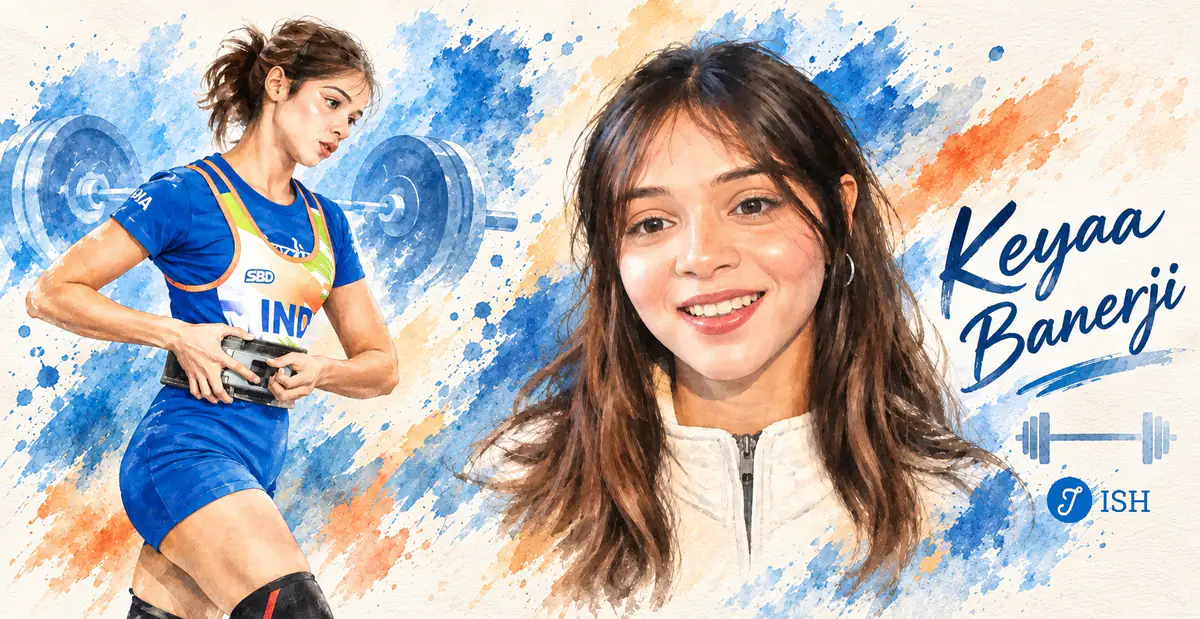
Why did Indian powerlifter Keyaa Banerji go viral after winning silver? Explore the 140kg deadlift, online looks debate, and her candid ANI interview.
The sudden explosion of public and media fascination surrounding Indian powerlifter Keyaa Kunal Banerji illuminates a complex collision between elite athletic performance, algorithmic visibility, and deeply entrenched gender biases. When video footage of Banerji locking out an extraordinary deadlift began circulating across digital channels, the response diverged sharply from traditional sports coverage. Rather than centering on technical mastery, powerlifting federation structures, or developmental training protocols, mainstream digital discourse fixated almost exclusively on her physical appearance.
This sudden viral fame rapidly turned volatile. The celebration of her silver medal highlighted uncomfortable disparities within Indian sports media, particularly when compared to the muted public recognition afforded to fellow competitors who achieved greater podium success at the very same event. An examination of the technical achievements, digital dynamics, ethical violations, and Banerji's own public responses provides a comprehensive account of why she became an internet sensation, the darker undercurrents of her fame, and how an investigative article can effectively structure this saga.
The Platform Reality: Athletic Execution at Sun City
The physical accomplishment that triggered the viral cycle occurred at the 2026 International Powerlifting Federation (IPF) World Sub-Junior and Junior Classic Powerlifting Championships held in Sun City, South Africa. Keyaa Banerji, competing in the Junior Women's 47-kilogram weight category, officially weighed in at 45.70 kilograms. Over the course of the full-power contest, she registered a 90-kilogram back squat, a 50-kilogram bench press, and a 140-kilogram deadlift, yielding a three-lift aggregate total of 280 kilograms. This overall score placed her fifth in the international junior standings.
Under IPF championship rules, individual medals are awarded for each separate lift alongside the overall total. Banerji earned her world junior silver medal specifically in the individual deadlift event. Ines Herbaux of France took the gold medal in the discipline with a lift of 165 kilograms, while Blathnaid O'Dwyer of Ireland matched Banerji's 140 kilograms, with Banerji securing the silver position by virtue of lighter bodyweight and attempt sequencing.
The primary athletic factor behind her viral appeal was her strength-to-bodyweight ratio. By successfully deadlifting 140 kilograms at a body weight of 45.70 kilograms, Banerji moved approximately 3.06 times her own mass. In strength sports, achieving a triple-bodyweight deadlift is an exceptional milestone that places any female lifter in elite international company. The sheer visual of a compact, 45.70-kilogram lifter lifting a barbell bent under heavy plates produced an immediate, visceral impact that resonated far beyond the specialized strength-training community.
The Anatomy of Sudden Virality: Visual Contrast and Pretty Privilege
While her physical feat provided the raw footage, the speed and scale of Banerji's digital prominence were driven by visual consumerism. On platforms such as Instagram, X, and Reddit, conversations surrounding the competition footage transitioned almost instantly from athletic achievement to aesthetics. Commentators openly marvelled at her facial symmetry, youthful appearance, and perceived conventional beauty while lifting heavy weights.
This phenomenon highlighted the potent role of pretty privilege within contemporary digital media. Social media algorithms heavily prioritize content that combines physical contrast with conventional beauty standards. In strength sports, an arena historically and erroneously stereotyped as incompatible with feminine aesthetic ideals, the emergence of an athlete conforming to conventional beauty standards produced an immediate algorithmic novelty. Users labeled her an overnight crush, with widespread remarks framing her as pageant-ready or comparing her to pop icons.
The public fascination quickly degenerated into invasive cultural scrutiny. Comment sections debated her regional identity, ethnic background, and caste lineages, dissecting her Bengali surname against her upbringing in Haryana. Forums engaged in cosmetic analyses, arguing over skin tone disparities between her competition appearance and casual photography, with users debating colorism, foundation shades, and tan lines. Through this intense visual lens, Banerji's athletic discipline was largely stripped of sporting legitimacy and converted into passive aesthetic entertainment.
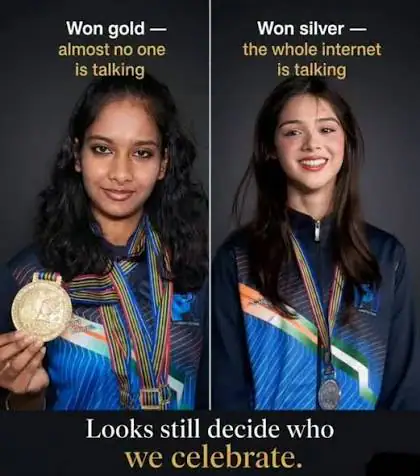
The superficial nature of the public's fascination becomes unmistakable when contrasted with the parallel accomplishments of other Indian athletes at the exact same championship. The most glaring example was the near-complete digital neglect of 17-year-old Madhura Kar, a high school lifter from Jalpaiguri, West Bengal.
Competing in the Sub-Junior Women's 52-kilogram category at a bodyweight of 49.35 kilograms, Kar delivered one of the most dominant performances in the history of Indian junior strength sports. Kar executed a clean sweep of the division, winning the gold medal in the squat with 107.5 kilograms, the gold medal in the bench press with 60 kilograms, the gold medal in the deadlift with 125 kilograms, and the world championship gold medal for the overall total with 292.5 kilograms.
Source: Google Images
Kar was not an accidental victor. She had captured the National Powerlifting Championship in 2024, defended her title in 2025, won the National Bench Press Championship in Faridabad, and claimed a silver medal for India at the Asian Powerlifting Championships in China earlier that same year. Yet, despite sweeping four world gold medals, Kar received only a fraction of the digital engagement, mainstream media interviews, and public adoration lavished upon Banerji.
A similar lack of coverage met Indian lifter Asma Taherali Zabuawala, who contested the Sub-Junior Women's 84-plus-kilogram heavyweight class and secured sixth place globally with a 132.5-kilogram squat, a 75-kilogram bench press, and a 165-kilogram deadlift for an aggregate total of 372.5 kilograms.
Online sports communities eventually began drawing direct comparisons between the public reception of both athletes. The stark contrast in visibility underscored how modern media consumerism routinely bypasses objective athletic dominance in favor of cosmetic marketability. While Madhura Kar stood as a four-time world gold medalist, her traditional athletic demeanor and lack of viral visual appeal resulted in widespread public indifference, exposing how lookism distorts sporting recognition.
The Darker Toll: Generative AI, Harassment, and Account Suspension
For Banerji, who had maintained a low digital footprint prior to the championships, sudden virality brought severe personal and psychological costs. Her original private Instagram account had roughly 300 followers and contained few personal photographs. The viral circulation of her lifting footage shattered this boundary, subjecting her to invasive online harassment and systemic digital exploitation.
Malicious online actors quickly weaponized generative artificial intelligence against her. Thousands of non-consensual synthetic images altering her face and body proliferated across digital platforms. Concurrently, multiple impersonation accounts emerged across social media, utilizing her likeness to siphon audience engagement and capitalize on her sudden notoriety.
The harassment culminated in Instagram suspending her original, private account, overwhelmed by coordinated bot reports and identity duplication. In response to being silenced, Banerji made the reluctant decision to establish a public profile. She explicitly articulated that the new account was not created to pursue social media influencer status, product endorsements, or follower numbers. Rather, it was an act of self-defense designed to preserve her authentic voice, refute defamatory deepfakes, and establish ownership over her athletic narrative.
The ANI Interview: Athlete Perspective and Systemic Critique
In her televised interview with Asian News International (ANI), Banerji moved decisively to regain control of the conversation, shifting focus away from cosmetic sensationalism toward technical athletic substance. The interview served as an intellectual counterweight to the superficial internet commentary.
Calling Out Institutional Sexism
Banerji directly addressed the commentary surrounding her victory, characterizing the overwhelming public fixation on her looks as sexism at its finest. She noted that male athletes who achieve international podiums are universally evaluated on their tactical execution, athletic grit, and physical training protocols. Female athletes, by contrast, find their sporting milestones subordinate to aesthetic evaluations. She expressed sharp disappointment that two years of rigorous, solitary athletic labor had been reduced in the public square to a conversation about facial beauty.
Educating the Public on Strength Disciplines
Banerji used the media opportunity to dismantle common public confusions between powerlifting and Olympic weightlifting. Mainstream Indian reporting frequently mislabeled her a weightlifter, conflating her discipline with the Olympic sport popularized by Karnam Malleswari and Mirabai Chanu. Banerji clarified the distinction: Olympic weightlifting comprises dynamic, explosive overhead lifts, namely the snatch and the clean and jerk, operating directly under the Olympic charter. Powerlifting, conversely, is an independent, non-Olympic strength sport governed by federations such as the IPF, measuring absolute force production across three static lifts: the squat, the bench press, and the deadlift. She stressed that competitive powerlifting is deeply technical, demanding absolute compliance with strict referee commands, locked positions, and platform regulations rather than undisciplined gym lifting.
Objective Performance Appraisal
Banerji refused to romanticize her silver-winning lift, providing a measured and critical assessment of her platform execution. She revealed that the 140-kilogram deadlift sat on the lower boundary of her tactical plan. In preparatory gym cycles, she had successfully pulled 147.5 kilograms and 150 kilograms multiple times. The existing Asian continental deadlift record stood at 147.5 kilograms, and her competitive objective had been to break that continental benchmark on the international platform.
She explained that the 140-kilogram lift was her second attempt rather than her final lift. Because the bar moved slower than expected off the floor, she and her coach opted for a modest jump to 142.5 kilograms for her third attempt. She failed to complete that final attempt. Despite the external fanfare surrounding her silver medal, she acknowledged feeling personal disappointment at not reaching her training ceiling or establishing a new continental record, demonstrating an elite competitor's mindset driven by performance metrics rather than public approval.
Keyaa Banerji instagram
Athletic Trajectory and Personal Background
Banerji's ascent within competitive powerlifting was swift and methodical. She entered the gym in June 2024 at age 19, initially seeking general fitness and personal wellness. Her transition to competitive lifting occurred through the guidance of a friend who was an active international coach and world-level gold medalist. Recognizing her exceptional leverage, neuromuscular recruitment, and rapid deadlift adaptation, her coach structured a specialized program to pursue national records and international qualification.
Her domestic progression demonstrates steady year-on-year physical development:
At the 2025 National Championships, she recorded an 82.5-kilogram squat, a 47.5-kilogram bench press, and a 127.5-kilogram deadlift, yielding a 257.5-kilogram total.
At the 2026 National Championships, she improved her marks to a 95-kilogram squat, a 52.5-kilogram bench press, and a 140-kilogram deadlift, elevating her total to 287.5 kilograms.
At the 2026 IPF World Championships, she recorded a 90-kilogram squat, a 50-kilogram bench press, and a 140-kilogram deadlift for a 280-kilogram total, capturing the individual deadlift silver medal.
Alongside her physical training, Banerji pursued higher education, graduating with a Bachelor of Science in Psychology from Ashoka University. While she has indicated plans to pursue a Master of Business Administration in the future, her immediate sporting commitments remain paramount. Her stated objectives include rehabilitating lingering joint issues that have limited her squat and bench press progression, challenging the Asian deadlift record, and eventually securing an overall world championship gold medal for India.
The Cultural Mirror of Digital Sports Fandom
The trajectory of Keyaa Banerji's sudden fame serves as a case study in how digital culture processes female athleticism. When an athletic milestone enters the viral stream, mainstream audiences frequently bypass technical rigor and performance equity, filtering achievements through an aesthetic lens that favors conventional beauty.
The public fixation on Banerji, set against the relative obscurity of Madhura Kar's historic four-gold performance, reflects an ongoing systemic failure within sports media consumption. However, Banerji's deliberate rejection of influencer culture, combined with her technical self-appraisal and defense of sporting integrity, provides a model of resistance. Her journey underscores a vital principle for modern sports journalism: an athlete's ultimate value must be measured by the iron on the platform rather than the metrics of algorithmic desire.
Enjoyed this story? A small contribution helps us cover more of Indian sport.₹200+ unlocks 1 year Premium · tap anywhere to paySupport · ₹501