Wimbledon 2026: India's Campaign Ends in First Round as Yuki Bhambri, Sriram Balaji and Anirudh Chandrasekar Exit
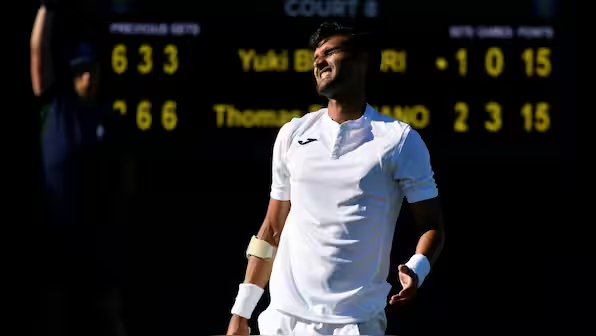
India's Wimbledon 2026 campaign ended in the opening round after Yuki Bhambri, N Sriram Balaji and Anirudh Chandrasekar lost their men's doubles matches, leaving no Indian representatives in the tournament.
India's campaign at Wimbledon 2026 came to an early end on Thursday as Yuki Bhambri, N Sriram Balaji and Anirudh Chandrasekar were all knocked out in the opening round of the men's doubles competition.
With no Indian players featuring in the singles draws or the mixed doubles event this year, the country's hopes rested solely on its three men's doubles representatives. However, all three partnerships bowed out on the opening day of their campaigns, bringing India's challenge at the grass-court Grand Slam to a swift conclusion.
While Bhambri suffered a straight-sets defeat, Balaji came agonisingly close before losing in three sets, and Wimbledon debutant Anirudh Chandrasekar also pushed his opponents to the limit in a hard-fought contest.
Yuki Bhambri partnered experienced New Zealander Michael Venus in the men's doubles draw but the pair were unable to overcome the challenge of Jean-Julien Rojer and Theodore Winegar. The Indo-New Zealand combination struggled to create opportunities on return as their opponents maintained control throughout the match.
The first breakthrough came in the sixth game of the opening set when Bhambri and Venus were broken, allowing Rojer and Winegar to establish the advantage. The experienced pair continued to serve confidently before adding another crucial break in the seventh game of the second set.
With few opportunities to recover, Bhambri and Venus eventually went down in straight sets, ending their Wimbledon campaign in the opening round.
For Bhambri, it was another disappointing exit at a tournament where he has often relied on doubles to extend his stay after recent years of injury setbacks.
India's best chance of progressing came through N Sriram Balaji and his Brazilian partner Marcelo Demoliner, who looked in complete control for much of their first-round clash against Sander Gille of Belgium and Dutchman Sem Verbeek.
Balaji and Demoliner made an impressive start, serving consistently throughout the opening set while applying pressure on their opponents' serve. Their persistence paid off in the eighth game when they secured the only break of the set before comfortably serving out a 6-3 advantage. The second set proved far more evenly contested, with neither team able to find a breakthrough as both pairs held serve throughout.
That forced a tie-break, where the momentum shifted dramatically.
Balaji and Demoliner struggled under pressure, winning just two points as Gille and Verbeek dominated the breaker 7-2 to level the match.
The loss of the second set appeared to affect the Indo-Brazilian pair's confidence. They conceded an early break in the opening game of the deciding set, immediately handing the initiative to their opponents. From there, Gille and Verbeek protected their serve with authority and never allowed Balaji and Demoliner a realistic opportunity to recover, completing a 3-6, 7-6(2), 6-4 comeback victory after two hours and two minutes. The defeat was particularly disappointing considering the strong position Balaji and Demoliner had established after winning the opening set.
There was also disappointment for Anirudh Chandrasekar, who made his Wimbledon main draw debut alongside Japan's Takeru Yuzuki. The Indo-Japanese pairing produced a spirited performance against Marco Trungelliti of Argentina and Ignacio Buse of Peru but ultimately fell just short after a closely fought three-set battle. Chandrasekar and Yuzuki started brightly by claiming the opening set 6-4, putting themselves in an excellent position to spring an upset.
However, their opponents responded strongly in the second set, which remained on serve throughout before being decided in a tie-break.
Trungelliti and Buse edged the breaker 7-3, forcing the contest into a deciding third set. The final set proved equally competitive, as neither pair was able to establish a decisive advantage. Eventually, the match was decided in another tie-break, where the South American duo held their nerve to secure a 10-7 victory and complete a hard-fought comeback. Despite the defeat, Chandrasekar's Wimbledon debut showcased his ability to compete at Grand Slam level and provided valuable experience for the 27-year-old doubles specialist.
India's complete first-round exit once again underlines the challenges facing Indian tennis at the Grand Slam level. For the second consecutive major, India's presence was limited exclusively to the men's doubles draw, with no representatives in the singles events. While the country continues to produce accomplished doubles players capable of competing on the ATP Tour, breakthroughs at the biggest tournaments have become increasingly difficult.
Bhambri, Balaji and Chandrasekar all entered Wimbledon with hopes of making deep runs, but crucial moments ultimately proved decisive. Balaji came closest to advancing, while Chandrasekar's encouraging debut demonstrated promise despite the result. Bhambri, meanwhile, will be hoping to regroup quickly as the hard-court season approaches.
With all three Indian pairs eliminated, India's campaign at Wimbledon 2026 comes to an end in the opening round, leaving fans to look ahead to the North American swing and the final Grand Slam of the season, the US Open, where Indian doubles specialists will once again aim to make their mark.
Comments (0)
to post comments, replies, and votes.
Loading comments…