Can India’s Sports Economy Really Reach $500 Billion? The Numbers Suggest a Longer Road Ahead
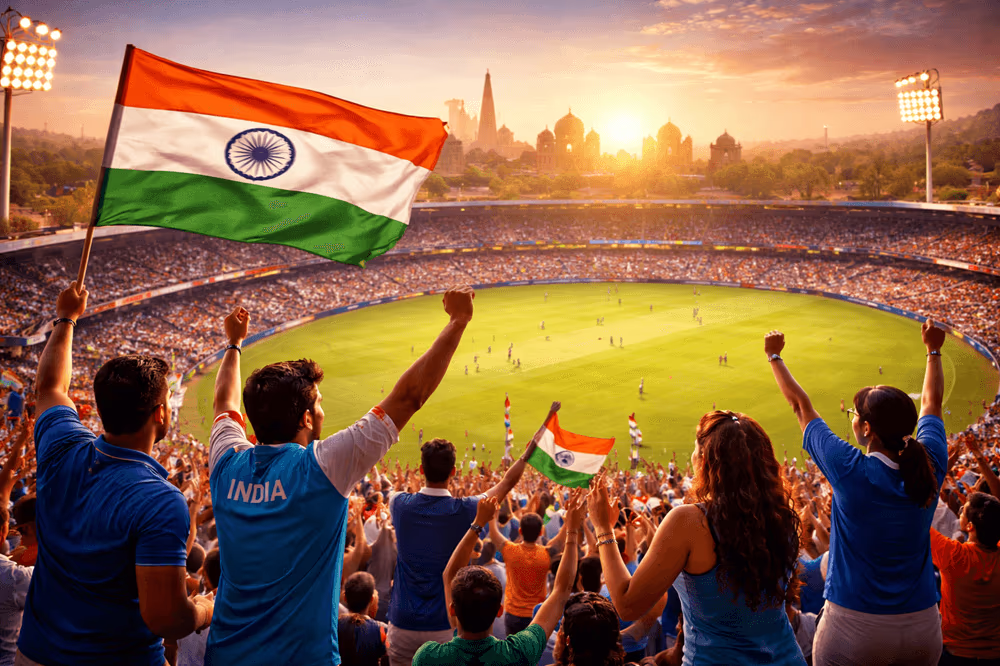
India’s sports economy is projected to reach $130 billion by 2030, but can it realistically grow to $500 billion? A closer look at the numbers reveals where future growth must come from.
The Indian sports industry has become one of the most discussed growth stories in the country's economy. Depending on which report one reads, the valuation of India's sports economy ranges from around $20 billion to as high as $130 billion. Meanwhile, estimates for the United States sports economy range between $500 billion and $1 trillion.
For the sake of optimism, let us assume the most favourable numbers are accurate. Let us accept that India's sports economy can reach $130 billion by 2030, as projected by the Deloitte-Google "Think Sports" report. Let us also use the conservative estimate of $500 billion for the United States.
Even then, a critical question remains: where will the next phase of growth come from?
The challenge becomes clearer when viewed mathematically. If India reaches a sports economy of $130 billion by 2030 and aims to grow to $500 billion shortly thereafter, the sector would need to expand nearly four times in size. Achieving that in just five years would require an annual growth rate of approximately 31%.
That is an extraordinary figure. In reality, very few large industries anywhere in the world have managed to sustain 30% annual growth over extended periods. The concern is not whether Indian sports can grow rapidly it already is but whether that growth can continue at such an aggressive pace once the easy gains have been exhausted.
Understanding the $130 Billion Projection
The often-quoted $130 billion figure originates from the Deloitte-Google report, which estimates that India's sports economy will grow from approximately $52 billion in 2023 to $130 billion by 2030. That projection itself implies a healthy 14% compound annual growth rate. Importantly, the report uses a broad definition of sports.
It includes not just professional leagues, sponsorships, media rights and ticket sales, but also sportswear, fitness products, nutrition, sports technology, gyms, sports tourism and related industries. This broader definition explains why the number appears significantly larger than traditional estimates of India's sports industry.
However, even under this optimistic framework, reaching $500 billion requires another leap altogether.
The biggest misconception in discussions about sports economies is that media rights and professional leagues drive everything. In reality, the American sports economy is built on three pillars: sports products, sports participation and fan engagement. Together they create a diversified ecosystem worth more than a trillion dollars.
India, by contrast, remains heavily dependent on fan engagement.
Cricket dominates the ecosystem, accounting for around 85% of sports industry revenues and more than three-quarters of sponsorship spending. That model has limitations.
There are only so many broadcast deals, sponsorship contracts and cricket tournaments that can be monetised. At some point, growth has to come from people spending money on sports themselves rather than merely watching sports.
That means buying equipment, joining gyms, participating in amateur leagues, purchasing sportswear, travelling for sporting events and engaging in recreational activities.
In short, India must become a nation of participants rather than spectators.
The strongest growth opportunities are not necessarily in stadiums or television studios. Sports apparel and equipment remain one of the largest opportunities. India's sportswear and athleisure market continues to expand rapidly, particularly in Tier-2 and Tier-3 cities where disposable incomes are rising. Per capita spending on sportswear remains significantly lower than major sporting nations, leaving substantial room for expansion.
Fitness and wellness also represent a major opportunity.
The post-pandemic boom in health consciousness has fuelled demand for gyms, fitness memberships, nutritional supplements and wearable technology. The nutraceutical sector alone is expected to witness substantial growth during the remainder of the decade.
Sports technology is another promising area.
Artificial intelligence, performance analytics, athlete monitoring systems and digital coaching platforms are creating entirely new business segments that barely existed a decade ago. As technology becomes more affordable, its adoption across grassroots and elite sport will continue to increase.
The mathematics becomes far more realistic when the timeline is extended. If India reaches $130 billion in 2030 and then targets $500 billion by 2040, the required growth rate drops to around 14.4% annually. That is almost identical to the growth rate already projected for the sector today.
Stretch the target further to 2045 or 2047, and the required annual growth falls below 10%. Those figures are not only realistic but achievable if policy reforms, infrastructure investments and participation rates continue improving.
This is why the conversation should not focus on whether India can become a $500 billion sports economy. The more important question is when.
India's sports economy undoubtedly possesses enormous growth potential. The country's young population, expanding middle class, increasing health awareness and rising interest in multiple sports provide strong foundations for future expansion. Non-cricket sports such as badminton, football, kabaddi and athletics are steadily attracting larger audiences and greater commercial investment.
However, expecting the industry to quadruple immediately after reaching the $130 billion milestone risks creating unrealistic expectations.
The next phase of growth will not come solely from cricket, broadcasting or sponsorships. It will come from participation, fitness culture, sports manufacturing, technology, community sport and consumer spending.
If India successfully builds those pillars over the next two decades, a $500 billion sports economy is not an unrealistic dream. It is simply a long-term destination rather than an immediate milestone.
Comments (0)
to post comments, replies, and votes.
Loading comments…