FIFA-Zee Deal Ends World Cup Broadcast Uncertainty in India, Signals Long-Term Football Ambition
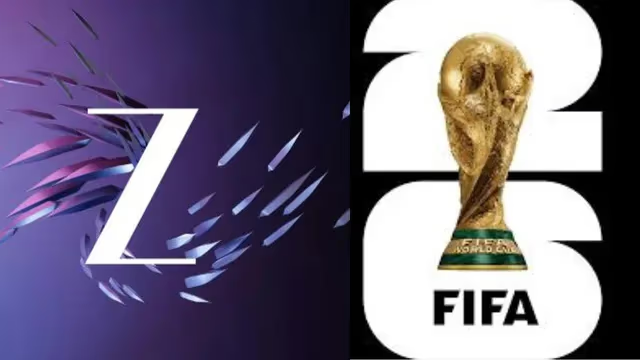
Zee Entertainment has secured FIFA rights through 2034, including the 2026 and 2030 FIFA World Cups, marking a major step in India's football broadcasting landscape.
After months of uncertainty surrounding the availability of the FIFA World Cup in one of the world's largest media markets, FIFA has finally secured a broadcasting partner in India.
Zee Entertainment has acquired the rights to broadcast and stream FIFA tournaments in the country through 2034, ending a prolonged standoff over rights negotiations and ensuring Indian football fans will have access to the 2026 FIFA World Cup.
The agreement, signed just days before the World Cup kicks off across the United States, Canada and Mexico on June 11, represents one of the most significant developments in India's sports broadcasting industry in recent years. More importantly, it marks Zee's ambitious return to the sports business after nearly a decade away from the sector.
While financial details have not been officially disclosed, reports suggest FIFA initially sought close to $100 million for the India package covering the 2026 and 2030 FIFA World Cups before eventually reducing its asking price to approximately $60 million. Other industry estimates place the eventual value of the deal in the $30-35 million range.
Regardless of the exact figure, the agreement is a major statement of intent from Zee.
The deal covers 39 FIFA events over an eight-year period through 2034, including the FIFA World Cup 2026, FIFA World Cup 2030, FIFA Women's World Cup 2027 and numerous youth and age-group competitions. Rather than treating the World Cup as a standalone event, Zee has secured a long-term football portfolio that provides consistent premium content for nearly a decade.
The timing of the agreement is notable. The 2026 FIFA World Cup had remained unsold in India longer than expected, making the country one of the last major global markets without a broadcast partner. One of the primary challenges was the tournament's North American location.
Unlike the 2022 World Cup in Qatar, which benefited from favourable viewing times for Indian audiences, the majority of matches in 2026 will be played late at night or early in the morning due to the significant time difference. Only 14 of the tournament's 104 matches are expected to start before midnight Indian time.
The World Cup final, scheduled for New Jersey on July 19, will begin at 12:30 AM Indian time. By comparison, nearly all matches during the 2018 FIFA World Cup and a substantial majority during the 2022 edition were played in far more convenient viewing windows for Indian audiences.
These timing challenges contributed significantly to broadcaster hesitation.
Reports indicated that JioStar, which currently dominates India's sports broadcasting landscape through rights ownership of the IPL, Premier League and several other major properties, offered approximately $20 million for the package. FIFA rejected the bid, believing the rights were worth substantially more.
Sony, which previously held FIFA World Cup rights in India for the 2014 and 2018 editions, reportedly explored the opportunity but ultimately chose not to submit a formal bid.
That left the door open for Zee.
For the company, the agreement represents more than just World Cup broadcasting rights. It serves as the foundation for a broader sports strategy centred around its streaming platform Zee5 and its recently launched sports channels. The FIFA package provides premium content capable of attracting viewers, subscribers and advertisers over a prolonged period.
Industry experts believe the move is less about direct advertising revenue and more about long-term audience acquisition.
Football occupies a unique position in the Indian sports ecosystem. Cricket remains overwhelmingly dominant, but football has steadily built a substantial following, particularly among younger, urban and digitally engaged audiences. Estimates suggest India's football audience could range between 300 and 350 million consumers, with the 2022 FIFA World Cup reportedly reaching more than 110 million viewers across television and digital platforms.
While football cannot compete with cricket's scale, it offers something equally valuable to broadcasters—access to a premium audience.
The sport enjoys strong popularity in football-centric regions such as Kerala, West Bengal, Goa and the Northeast, while also attracting younger consumers in metropolitan areas. This demographic is particularly appealing to advertisers targeting affluent, digitally connected audiences. As a result, football's commercial value extends beyond raw viewership numbers.
The FIFA acquisition also gives Zee an opportunity to strengthen its position in an increasingly competitive media landscape. Premium sports rights have become one of the most effective tools for attracting subscribers, reducing churn and increasing engagement on streaming platforms.
For Zee5, FIFA tournaments can act as major acquisition events, drawing users into the ecosystem and potentially converting them into long-term subscribers. The agreement also helps establish Zee's newly launched sports channels as credible players in the market. Live sporting content remains essential for driving television subscriptions and maintaining audience engagement, and few sporting properties carry the global recognition of the FIFA World Cup.
The broader significance of the deal extends beyond broadcasting.
FIFA President Gianni Infantino has repeatedly identified India as a key strategic market for the future growth of football. Securing a long-term broadcast partner ensures that FIFA maintains visibility in a country with enormous population potential and a rapidly evolving sports media landscape.
For Indian football fans, the agreement removes any lingering uncertainty. The 2026 FIFA World Cup and several future FIFA events will now be available through Zee's television and digital platforms.
For Zee, the deal represents a calculated gamble on football's future in India. Whether it translates into significant commercial success remains to be seen, but the broadcaster has clearly signalled its ambition to become a serious player in the country's sports media market.
With 39 FIFA tournaments secured through 2034, Zee is not simply buying World Cup rights—it is investing in football's long-term growth story in India.
Comments (0)
to post comments, replies, and votes.
Loading comments…