India U17 Women Arrive in Suzhou for AFC Asian Cup Return After 21 Years
India’s U17 women’s national team has officially landed in Suzhou, China, marking the beginning of a significant chapter in the country’s youth football journey.
After a brief preparatory camp in Gurugram, the 23-member squad arrived on April 27 for the AFC U17 Women’s Asian Cup 2026, a tournament India has qualified for after a gap of more than two decades. The return to continental competition at this level is not just symbolic it reflects the gradual rebuilding of India’s women’s football pathway, with a new generation of players now stepping onto a stage that demands both tactical maturity and mental resilience.
India’s qualification for this tournament after 21 years underscores the progress made at the grassroots and youth levels. For many of the players in the current squad, this will be their first exposure to elite Asian competition, where the pace, physicality, and tactical discipline are significantly higher. Placed in Group B, India faces a challenging draw alongside Australia, Japan, and Lebanon. The campaign begins on May 2 against Australia, followed by a crucial fixture against Japan on May 5, before concluding the group stage against Lebanon on May 8.
All matches will be played at the Suzhou Taihu Football Sports Centre, with India aiming to navigate a group that features two of Asia’s strongest footballing nations.
Tournament Stakes and Qualification Pathway
The structure of the tournament adds further importance to every group-stage match. The top two teams from each group, along with the two best third-placed teams across all groups, will advance to the quarter-finals. Beyond that, the stakes rise significantly. The four semi-finalists will secure qualification for the FIFA U17 Women’s World Cup Morocco 2026, making this tournament a direct gateway to global competition.
For India, this creates a clear objective: remain competitive in every match and push for a top-three finish in the group to keep knockout hopes alive.
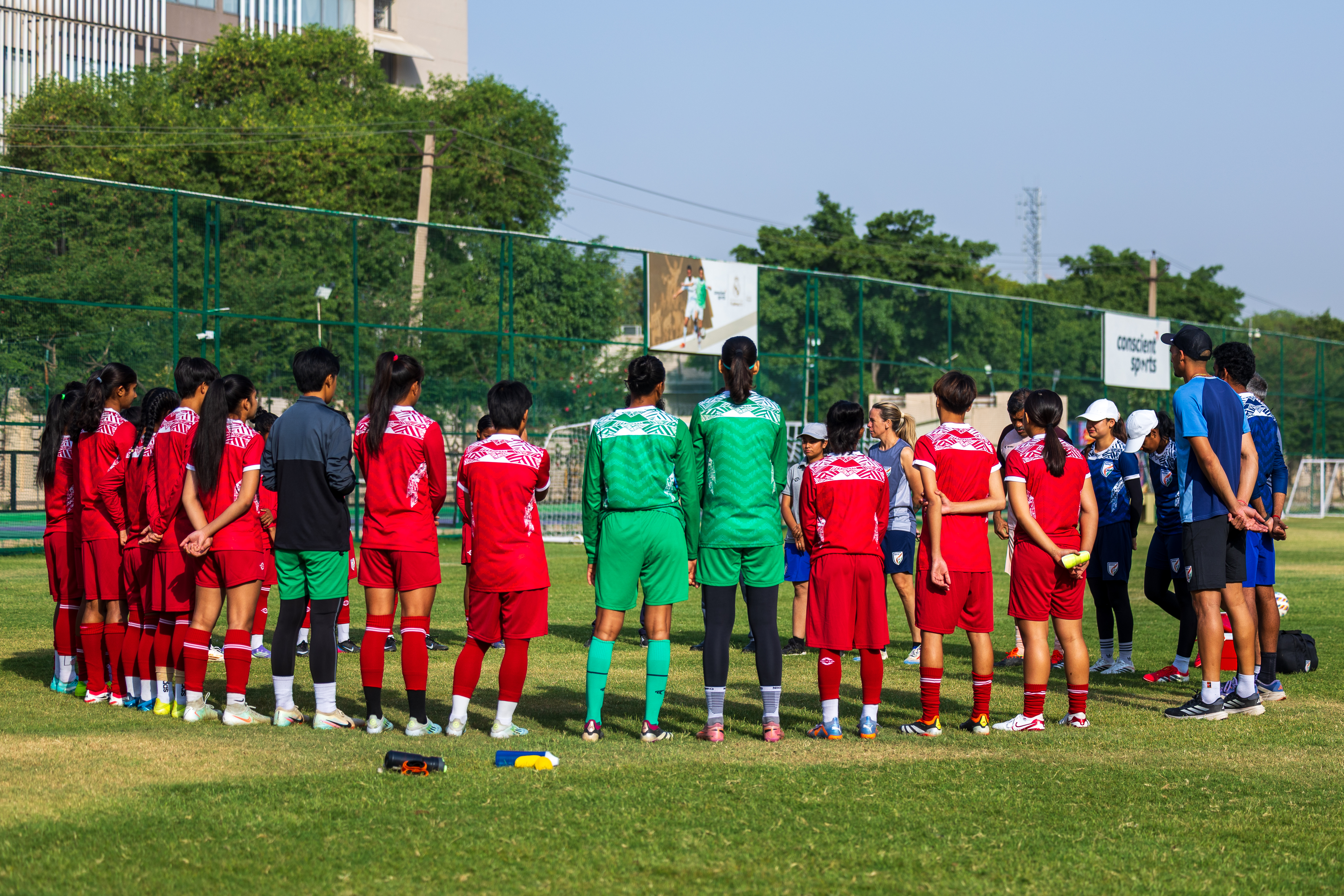
The team’s preparation has been extensive and structured under head coach Pamela Conti, who took charge in January. Over the past three months, the squad has undergone a continuous training programme, primarily based in Bengaluru. This long camp has allowed the coaching staff to build cohesion, refine tactical systems, and improve physical conditioning—key factors when transitioning from domestic to international competition.
The preparation phase also included competitive exposure. India won the SAFF U19 Women’s Championship in February, a result that provided both confidence and match practice. This was followed by two victories in friendly matches against Myanmar in Yangon, where the team demonstrated attacking intent and defensive organisation. A more challenging test came earlier this month in Sochi, where India faced Russia in a three-match friendly series. While the team did not register a win, the experience of playing against physically stronger and tactically disciplined opponents offered valuable lessons ahead of the Asian Cup.
The final phase of preparation took place in Gurugram from April 20 to 26, focusing on fine-tuning combinations and match readiness before departure.
https://www.indiasportshub.com/articles/three-key-takeaways-from-india-s-fifa-women-s-series-2026-campaign
The 23-member squad reflects a balanced mix of defensive stability, midfield control, and attacking potential.
In goal, Munni, Surajmuni Kumari, and Tamphasana Devi Konjengbam provide options, with the emphasis on shot-stopping and distribution—both critical in high-pressure matches. The defensive unit, featuring players like Abhista Basnett, Alisha Lyngdoh, and Ritu Badaik, will be tasked with maintaining structure against technically superior opponents. Organisation and discipline will be crucial, especially against teams like Japan, known for their quick passing and movement.
Midfield will play a central role in determining India’s competitiveness. Players such as Pritika Barman, Olivia Chanu Ningthoujam, and Thandamoni Baskey are expected to handle transitions, maintain possession, and support both defensive and attacking phases. In attack, the responsibility will fall on forwards like Pearl Fernandes, Joya, and Anushka Kumari to convert opportunities. Against stronger teams, chances may be limited, making efficiency in the final third essential.
Given the strength of the group, India is likely to adopt a pragmatic approach. Against Australia and Japan, defensive compactness and quick transitions could be key strategies, while the match against Lebanon may offer a more balanced contest. The ability to adapt within matches whether to defend deep or press higher will be critical. Set-pieces could also play a decisive role, especially in tightly contested games.
While qualification for the knockout stages remains the immediate target, the broader objective extends beyond results. This tournament serves as a platform for exposure, learning, and long-term development. For a young squad, competing against top Asian teams provides insights into the demands of international football decision-making under pressure, game management, and tactical awareness.
These experiences are essential in building a pipeline of players capable of transitioning to the senior national team.
India’s return to the AFC U17 Women’s Asian Cup comes at a time when women’s football in the country is gaining momentum. Increased investment, structured leagues, and improved grassroots programmes are gradually shaping a more competitive ecosystem. The Young Tigresses now have an opportunity to contribute to that momentum. A strong performance in Suzhou could inspire confidence, attract attention, and reinforce the belief that India can compete at higher levels.
As the team prepares for its opening match, the focus will be on execution, composure, and belief. The challenge is significant, but so is the opportunity.
India’s Group Stage Schedule
May 2, 17:00 IST – Australia vs India
May 5, 17:00 IST – India vs Japan
May 8, 13:00 IST – India vs Lebanon
All matches will be played at the Suzhou Taihu Football Sports Centre and streamed live on the AFC Asian Cup YouTube channel.
Comments (0)
to post comments, replies, and votes.
Loading comments…