Lakshya Sen’s 0-2, 1-3, 0-2 Records Against Next Gen Raise Serious Questions for India’s No. 1
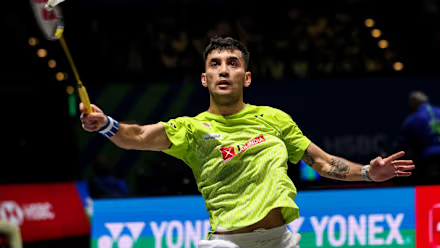
There is nothing particularly unusual about an established badminton player losing to the next generation. Every era eventually produces younger athletes who challenge, and then replace, the stars who came before them.
For Lakshya Sen, however, the concern is not simply that he is losing to younger opponents. It is the manner and frequency of those defeats.
India's No. 1 men's singles player has built a career around competing with the world's best, reaching the Olympic semi-finals and establishing himself as a consistent presence at the biggest tournaments. Yet his recent record against some of the leading names of the emerging generation makes uncomfortable reading.
Against Alex Lanier, Sen is 0-2. Against Victor Lai, he is 1-3. Against Alwi Farhan, he is 0-2. He is also 0-1 against Indonesia's Moh. Zaki Ubaidillah and 0-1 against China's Hu Zhe'an. When Garret Tan is included, the broader record against this emerging group becomes even more concerning.
The numbers alone are alarming. The way some of those matches have unfolded is even more so.
It is not about losing to the next generation.
It would be unfair to suggest that every defeat against these players is a failure. The emerging generation is exceptionally strong. Lanier has gone from being a promising young player to a world champion. Victor Lai has established himself among the world's leading players and has already won a Super 1000 title. Alwi Farhan is a former World Junior Champion who is increasingly making his presence felt at the senior level.
These are not opponents Sen should simply be expected to beat because he has more experience. The bigger issue is competitiveness.
Across the identified next-generation group, Sen has repeatedly struggled to sustain pressure once the match moves away from his preferred rhythm. Seven of the 11 matches in the broader dataset have ended in straight games, while several defeats have included extremely one-sided second games.
That is what makes the situation so concerning. A player can lose a three-game thriller and emerge having demonstrated that he belongs at that level. Losing in straight games after being competitive early, and then watching the contest disappear, points towards a different problem.
Victor Lai has become a particularly difficult opponent.
The 1-3 record against Victor Lai perhaps illustrates Sen's current problem better than any other matchup. Their meetings have produced different scenarios, but the pattern has increasingly favored the Canadian. At the 2026 Thomas Cup, Sen won the opening game 21-18 before Lai responded emphatically, taking the next two games 21-19 and 21-10.
At the China Open, Sen had a 15-9 advantage in the opening game but could not close it out, losing 19-21 before dropping the second game 11-21. And most recently at the China Masters, there was no comeback story at all. Lai won 21-14, 21-7. Three consecutive defeats against the same opponent are one thing. The increasingly one-sided nature of the results is the bigger warning sign.
The same problem appears against Lanier and Alwi.
Sen's record against Alex Lanier is 0-2, with both encounters ending in defeat. The Frenchman represents precisely the kind of player who can challenge Sen's traditional strengths: speed, physicality, and relentless movement.
If Sen's advantage is supposed to come from his ability to absorb pressure and turn defense into attack, it becomes considerably harder when an opponent can match his tempo. The same issue has appeared against Alwi Farhan.
Sen is 0-2 against the Indonesian, including a straight-games defeat at the 2026 Indonesia Open. Alwi's aggressive approach and willingness to take the shuttle early have made it difficult for Sen to establish the kind of controlled rallies from which he has traditionally built his game.
For much of Sen's rise, his athleticism was one of his defining weapons. His ability to cover the court, retrieve seemingly impossible shuttles, and turn defensive situations into attacking opportunities made him difficult to break down.
But the next generation is different. Players such as Lanier and Lai are not simply technically gifted; they are fast, physically capable, and comfortable in flat exchanges. Others, including Hu Zhe'an and Alwi, can apply pressure at the net and prevent Sen from settling into long, predictable rallies.
That means Sen increasingly needs to win through variation and anticipation rather than simply outlasting opponents. This is where the questions begin. His game can become reactive when an opponent takes control of the front and middle of the court. Defensive lifts can then give younger, aggressive players the opportunity to attack repeatedly.
Once that cycle begins, Sen can find himself chasing the match rather than controlling it.
There is evidence that Sen is still capable of beating dangerous younger players. His record against compatriot Ayush Shetty is 3-0. Shetty himself has established himself as one of the most dangerous young players on the men's circuit, including a major victory over Shi Yuqi at the 2026 World Championships.
So this is not a question of Sen suddenly lacking the physical or technical ability to compete with younger players. It is more specific.
When Sen understands an opponent's patterns and can impose his own rhythm, he remains extremely difficult to beat. Against unfamiliar, fearless young opponents who change pace quickly and attack without hesitation, he has struggled to find answers.
Calling the record "pathetic" may capture the frustration of Indian badminton fans, but it oversimplifies the problem. The next generation is genuinely exceptional.
What is difficult to ignore, however, is that Sen is supposed to be the established player in these matchups. He is India's No. 1 men's singles player and an Olympic semi-finalist. He should not necessarily win every meeting, but he should be making these young opponents work considerably harder for their victories.
That is where the current numbers become uncomfortable.
The solution is unlikely to be simply playing more tournaments or trying to hit harder. Sen needs greater tactical adaptability, stronger mid-court initiative and better match management when an opponent changes the momentum. His coaching setup also needs to ensure that these recurring patterns are being addressed rather than treated as isolated defeats.
Because the next generation is not going away.
Lanier, Lai, Alwi and the others are only getting better. And if Sen cannot find a way to make these matchups more competitive, the concern will eventually move beyond an unpleasant head-to-head record.
It will become a question of whether India's No. 1 men's singles player is being overtaken by the generation he was expected to lead.
Comments (0)
to post comments, replies, and votes.
Loading comments…