The FIFA World Cup India Never Played: Revisiting the Decision That Changed Indian Football Forever
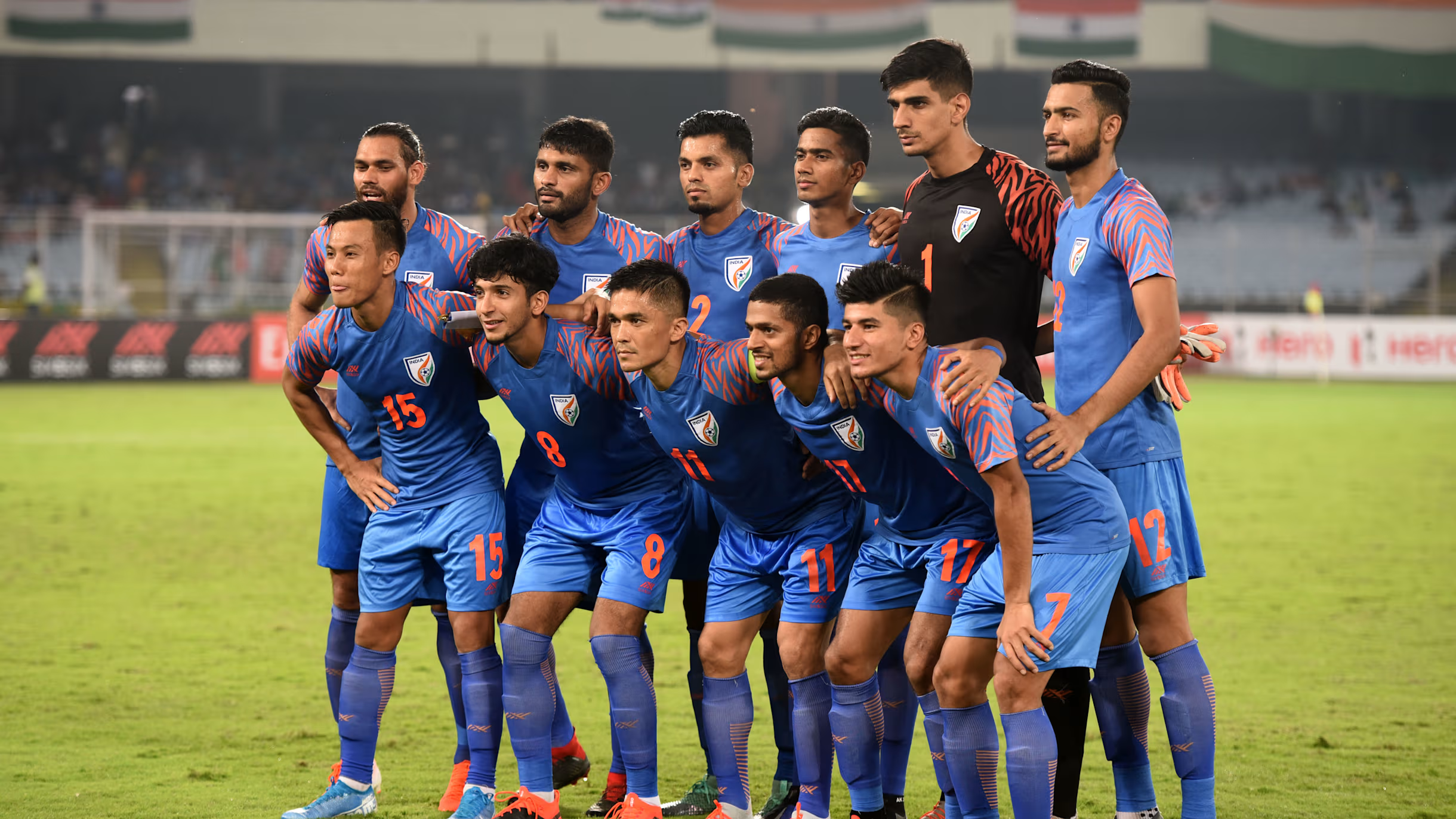
Indian football's history is filled with moments of promise, but perhaps none carries more intrigue than the events surrounding the 1950 FIFA World Cup. More than seven decades later, the story remains one of the sport's greatest "what if" moments in India.
The Indian football team qualified for the FIFA World Cup in Brazil but never took the field. Instead, the nation withdrew before the tournament began, leaving generations of football fans wondering how different Indian football's trajectory might have been had the team made the journey to South America.
A World Cup appearance in 1950, and perhaps even a respectable performance, could have transformed football in India much like the 1983 Cricket World Cup victory did for cricket. Instead, it became a missed opportunity that continues to haunt Indian football.
To understand India's qualification, it is important to understand the state of global football in 1950. The tournament in Brazil was only the fourth FIFA World Cup and the first to be held after World War II. The previous two editions had been cancelled due to the war. The world was still recovering from economic devastation, and international travel remained expensive and logistically difficult. Several countries either withdrew during qualification or declined participation altogether because of financial and travel-related concerns.
Unlike today's extensive qualification process, only 13 teams eventually participated in the 1950 FIFA World Cup. A total of 34 teams initially entered qualification to determine 16 places.
India, having gained independence just three years earlier, entered the qualification process for the first time. They were grouped with Burma (now Myanmar), Indonesia and the Philippines in the Asian qualifiers.
However, before a single qualifying match could be played, all three opponents withdrew from the competition. As a result, India secured qualification without kicking a ball.
India's place in the tournament was officially confirmed, and the team was even included in the final World Cup draw held in Rio de Janeiro on May 22, 1950. The Indians were placed in Group 3 alongside Sweden, Paraguay and defending champions Italy.
Yet despite qualifying and being assigned a group, India never arrived in Brazil for their opening match scheduled for June 28.
Over the years, several theories emerged regarding India's withdrawal from the tournament. The most famous and widely circulated claim suggested that FIFA refused to allow Indian players to compete barefoot. The myth gained popularity because of India's appearance at the 1948 London Olympics. During that tournament, several Indian players played without boots, using heavily bandaged feet instead.
The image of barefoot Indian footballers challenging European opponents became iconic and remains one of the most memorable visuals in Indian sporting history. As a result, many believed India withdrew from the World Cup because FIFA insisted on players wearing boots.
However, this explanation is incorrect.
FIFA had no mandatory rule requiring players to wear boots until 1953. India even continued playing barefoot during the 1952 Helsinki Olympics without facing any restrictions. The real reasons behind the withdrawal were far more complex.
The biggest obstacle facing India was financial. Travelling to Brazil in 1950 was a major undertaking, especially for countries outside Europe and South America. The cost of sending a squad across the world was enormous, particularly for a newly independent nation still dealing with economic challenges.
The All India Football Federation (AIFF), which was still in its formative years, struggled to secure adequate funding for the trip.
Although discussions were held and both FIFA and the Brazilian Football Confederation reportedly offered support, concerns about finances remained significant. Several state football associations also explored possible contributions, but uncertainty continued.
Eventually, following a meeting in Calcutta on May 23, 1950, the AIFF decided to withdraw.
The federation's official statement cited lack of preparation time and logistical difficulties. It stated that the late arrival of information meant the team would need to fly to Brazil, making selection and preparation difficult.
Yet financial limitations remained a key factor behind the decision.
Another important factor was the perception of the World Cup itself. Today, the FIFA World Cup is unquestionably football's biggest tournament. In 1950, however, the competition did not carry the same prestige it does now. For many countries, particularly outside Europe and South America, Olympic football was considered the premier international competition.
India's impressive performance at the 1948 London Olympics had generated optimism that the country could establish itself as a respected football nation. As a result, the AIFF prioritised preparations for the 1952 Helsinki Olympics over participation in the World Cup.
Former India captain Sailen Manna later admitted that players of that era viewed the Olympics as the ultimate dream. His teammate Sheoo Mewalal shared similar sentiments, explaining that the World Cup was still a relatively unfamiliar concept for Indian footballers at the time.
There were also concerns within the AIFF about how an amateur Indian side would fare against professional teams from Europe and South America. Some administrators feared heavy defeats could damage the reputation India had built through its Olympic performances.
Additionally, domestic football matches in India were often played over 70 minutes rather than the international standard of 90 minutes, raising questions about the team's physical readiness.
Ultimately, India chose not to travel to Brazil.
History records that India qualified for the FIFA World Cup in 1950 and never participated. What history cannot answer is how differently Indian football might have evolved had the team boarded a plane to Brazil and taken its place among the world's best.
More than 75 years later, it remains the most fascinating missed opportunity in Indian football history.
Comments (0)
to post comments, replies, and votes.
Loading comments…