When Did India Come Closest to FIFA World Cup Qualification? A Look at the Last 20 Years
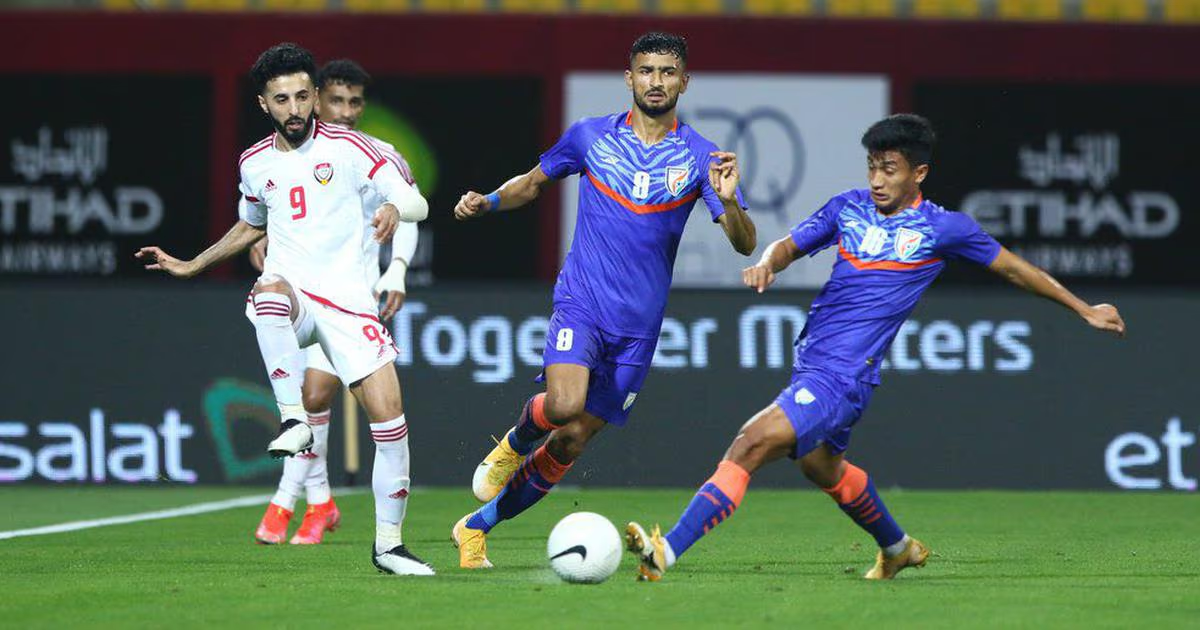
For generations of Indian football fans, qualifying for the FIFA World Cup has remained the ultimate dream. While cricket has often dominated the sporting landscape, football continues to enjoy a passionate following across the country, with supporters hoping to see India compete on the biggest stage in world sport.
Despite producing talented players and enjoying periods of success in Asian football, India has never appeared in the FIFA World Cup finals. Yet over the last two decades, there have been moments that have offered hope, belief and a glimpse of what could be possible in the future. As India looks ahead to future qualification campaigns, it is worth revisiting the country's closest brushes with World Cup qualification and examining how far Indian football has progressed.
India's World Cup story dates back to 1950 when the country technically qualified for the tournament in Brazil after several Asian nations withdrew. However, India ultimately did not participate, and the opportunity passed into football history. The nation's golden era followed shortly thereafter under legendary coach Syed Abdul Rahim. India won gold medals at the 1951 and 1962 Asian Games and finished runners-up at the 1964 AFC Asian Cup. However, as other Asian nations invested heavily in football development, India gradually fell behind.
The 2002 Campaign: Closest by Numbers
Among all modern qualification campaigns, the road to the 2002 FIFA World Cup remains India's closest attempt in purely statistical terms. Drawn alongside the United Arab Emirates, Yemen and Brunei, India produced several impressive performances. The campaign began with a memorable 1-0 victory over the UAE, a result that immediately raised hopes of progression.
India also secured two draws against Yemen and completed home-and-away victories over Brunei. By the end of the group stage, the Blue Tigers had accumulated 11 points from six matches. Unfortunately, the UAE finished on 12 points and claimed the sole qualifying spot. India missed out by a single point.
More than two decades later, it remains the closest India has come to advancing from a World Cup qualification group in the modern era.
The qualification cycles that followed exposed the gap between India and Asia's established football powers. In the 2006 qualifiers, India faced formidable opponents in Japan and Oman. The challenge proved too great, and the campaign ended early. The 2010 qualification journey concluded with elimination against Lebanon, while the 2014 campaign saw India fall to the UAE.
These years highlighted several structural challenges facing Indian football, including limited grassroots development, inadequate infrastructure and a lack of regular exposure to high-level international competition.
A turning point arrived during the qualification cycle for the 2018 FIFA World Cup. Under coach Stephen Constantine, India began laying the foundations for a more competitive future. The team defeated Nepal in the first round and progressed further into the qualification process.
Although India eventually finished bottom of a difficult group featuring Iran, Oman, Turkmenistan and Guam, the campaign coincided with a significant rise in FIFA rankings and growing confidence within the squad. The performances suggested that Indian football was moving in the right direction.
Why the 2022 Campaign Stands Out
While the 2002 qualifiers remain India's closest attempt numerically, many observers regard the 2022 FIFA World Cup qualification campaign as the country's strongest overall effort. Placed in a challenging group alongside Asian champions Qatar, Oman, Afghanistan and Bangladesh, India entered the campaign as underdogs.
The defining moment came on September 10, 2019. Facing eventual World Cup hosts and reigning Asian champions Qatar in Doha, India produced one of the finest defensive performances in its history. Goalkeeper Gurpreet Singh Sandhu delivered a heroic display as India secured a memorable 0-0 draw.
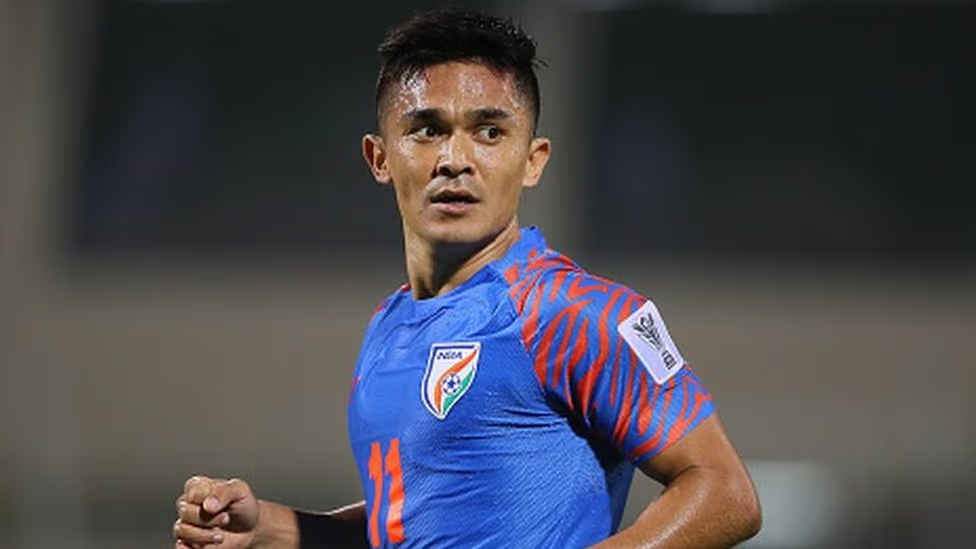
The result sent shockwaves across Asian football and demonstrated that India could compete against elite opposition. India also pushed Oman close in a narrow 2-1 defeat and later defeated Bangladesh 2-0 during the centralised qualification phase. However, draws against Bangladesh and Afghanistan ultimately proved costly. India finished the campaign with seven points from eight matches and failed to advance.
Despite that disappointment, the campaign generated genuine optimism. For perhaps the first time in decades, Indian football supporters could realistically imagine the national team competing in later qualification rounds.
The Missed Opportunity of 2026
The expansion of the FIFA World Cup to 48 teams significantly increased Asia's qualification slots for the 2026 edition. Many believed it represented India's best opportunity in years. The campaign started positively, including an important victory over Kuwait. However, disappointing results against Afghanistan and Kuwait prevented India from capitalising on the expanded pathway.
The team ultimately finished third in its group and missed out on progression.
India's World Cup dream remains alive, but several challenges remain. Grassroots development, youth academies, coaching standards and exposure to elite competition continue to require significant investment.
At the same time, there are reasons for optimism. The growth of professional leagues, improved training facilities, increased sports science support and stronger youth development pathways are helping create a better environment for future generations. While India has yet to reach the FIFA World Cup, the foundations are stronger than they have been in decades.
The 2002 qualifiers remain the closest India came in terms of points. Yet the 2022 campaign, highlighted by the famous draw against Qatar, may ultimately be remembered as the moment Indian football truly began believing that World Cup qualification is not just a dream, but a realistic long-term objective.
Based on the article provided by the user.
Comments (0)
to post comments, replies, and votes.
Loading comments…