Will India Ever Play a FIFA World Cup? The Long Road from Passion to Participation
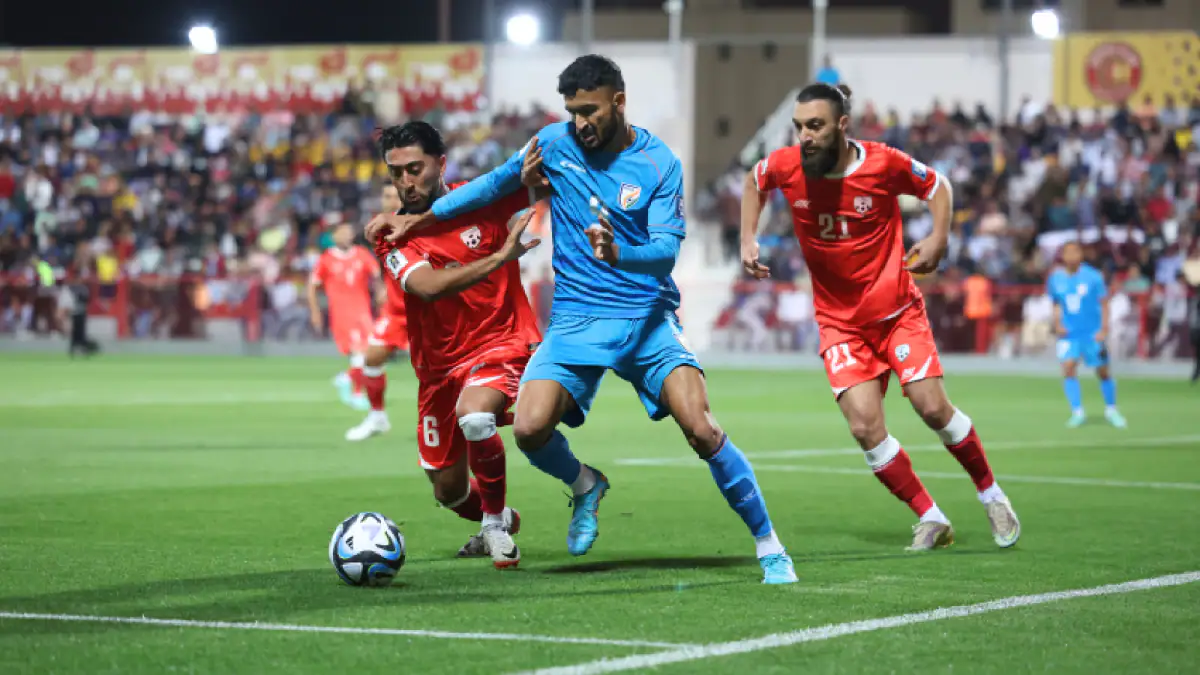
Can India qualify for the FIFA World Cup? Despite a passionate fanbase, Indian football still faces major challenges in grassroots development, governance and infrastructure.
Every four years, the FIFA World Cup captures the imagination of millions across India. Streets in Kerala, West Bengal and Goa are draped in the colours of Brazil, Argentina, Germany and Portugal. Cafes overflow with football fans, television ratings surge, and social media buzzes with discussions about tactics, players and predictions.
Yet, amid all the excitement, one familiar question resurfaces: Will India ever play at a FIFA World Cup?
For decades, that question has remained unanswered. Despite being the world's most populous nation and home to one of football's most passionate fanbases, India has never qualified for the FIFA World Cup. While countries with significantly smaller populations have achieved the feat, India continues to struggle even to progress beyond the early stages of Asian qualification.
With the World Cup now expanded to 48 teams and Asia receiving more qualification spots than ever before, many believe the opportunity is greater than it has ever been. However, the road to football's biggest stage remains far more complicated than simply having additional qualification places.
Few countries celebrate the World Cup like India despite having no representation on the field. Football enjoys immense popularity in several regions, particularly West Bengal, Kerala, Goa and parts of the Northeast. Stadiums regularly host passionate supporters, European clubs enjoy enormous followings, and international tournaments receive massive television audiences.
Ironically, while India has become one of FIFA's biggest commercial markets, its national team remains absent from the sport's grandest tournament.
The contrast is striking. Indian journalists regularly travel to cover the World Cup, broadcasters compete for media rights, and global football brands invest heavily in the Indian market. Yet the national team has never managed to qualify.
An Expanded World Cup Brings Hope
The expansion of the FIFA World Cup from 32 to 48 teams has increased Asia's direct qualification places from four or five to eight, with an additional playoff opportunity. The new format has already opened the door for nations like Uzbekistan and Jordan, who have qualified for the World Cup for the first time. For India, this expansion theoretically improves qualification chances. However, reality paints a different picture.
India currently sits 136th in the FIFA rankings, well behind not only established Asian powers like Japan, South Korea, Iran, Saudi Arabia and Australia but also behind emerging nations such as Jordan and Uzbekistan. Jordan is ranked 63rd in the world, while Uzbekistan occupies 52nd place. Both have spent years building sustainable football structures before finally earning their breakthrough.
India, meanwhile, has slipped backwards after briefly entering FIFA's top 100 in 2023.
Almost every discussion about Indian football eventually returns to the same issue: grassroots development. Former India captain Baichung Bhutia has consistently maintained that qualification is possible but only through sustained long-term planning rather than quick fixes. According to Bhutia, India's biggest challenge is not the lack of talent but the absence of an ecosystem capable of identifying, nurturing and developing young players over several years.
That sentiment is echoed by former international Shyam Thapa, who believes the country is failing to bring enough children into football. India's youth participation remains significantly lower than leading football nations. While cricket academies continue to attract thousands of aspiring youngsters, football often takes a back seat, particularly among middle-class families who see cricket as offering better career opportunities.
This creates a cycle where fewer talented players enter structured football programmes, reducing the quality of future generations. Without widespread participation at the grassroots level, building an elite national team becomes considerably more difficult.
Player development is only one part of the equation. The administration of Indian football has come under increasing scrutiny in recent years. The All India Football Federation (AIFF) introduced Vision 2047 as an ambitious roadmap to transform Indian football and significantly increase participation levels.
However, several of those objectives remain largely unrealised. The uncertainty surrounding the Indian Super League has only added to those concerns.
Once viewed as the catalyst for Indian football's professional growth, the league recently faced major operational challenges after difficulties in securing commercial partnerships delayed the season and created uncertainty for clubs and players alike. A stable domestic league remains essential for producing players capable of competing internationally.
Without strong professional competitions, the pathway from youth football to the national team becomes fragmented.
Asian Cup Must Come Before the World Cup
While World Cup qualification dominates public discussion, many within Indian football believe the immediate objective should be far more realistic. Consistent qualification for the AFC Asian Cup would provide Indian players with regular exposure against stronger opponents and help bridge the competitive gap. Sunil Chhetri has previously emphasised the importance of taking incremental steps rather than focusing solely on the World Cup. Establishing India among Asia's top 15 or 20 teams would create a far stronger platform for future World Cup qualification attempts.
Unfortunately, India failed to qualify for the next AFC Asian Cup after disappointing performances in the qualification campaign, highlighting how much work remains.
One of the biggest discussions surrounding Indian football today involves Overseas Citizens of India (OCI). Current regulations require players holding foreign passports to surrender their nationality before representing India. The AIFF has been advocating for policy changes that would allow OCI players to represent the national team without renouncing their existing citizenship.
Such a move could significantly strengthen India's talent pool. At the current FIFA World Cup, several players of Indian origin are representing other nations, including Australia's Nishan Velupillay, Qatar's Tahsin Mohammed, New Zealand's Sarpreet Singh and Congo's Samuel Moutoussamy.
Adding players of that calibre would undoubtedly improve the national team's competitiveness. However, even if the policy changes, it cannot replace the need for robust domestic player development.
Perhaps the most striking aspect of modern international football is that success is no longer determined by population size. Countries such as Curaçao and Cabo Verde, each with populations smaller than many Indian districts, have qualified for the FIFA World Cup. Jordan, with around 11 million people, and Uzbekistan, with approximately 37 million, have also reached football's biggest stage through sustained investment in coaching, youth development and football infrastructure.
These nations demonstrate that long-term planning often outweighs demographics.
India's population of over 1.4 billion should theoretically provide one of the world's deepest talent pools. The challenge lies in identifying, developing and retaining that talent through an organised football system.
Can India qualify for the FIFA World Cup? The answer is yes but not in the immediate future.
The expanded tournament certainly improves India's chances, but qualification will require far more than favourable mathematics.
The country needs a stable domestic league, stronger grassroots programmes, better coach education, improved governance, greater investment in academies, enhanced sports science and regular exposure to higher-quality international competition.
Equally important is patience. Football development is measured over decades, not election cycles or tournament cycles. India possesses the passion, the fanbase and the potential to become a competitive football nation. What it still lacks is the consistent ecosystem that transforms potential into performance.
Until those foundations are firmly established, Indian fans will continue watching the FIFA World Cup from the stands and television screens rather than seeing the Blue Tigers compete on football's biggest stage. The dream remains alive, but turning that dream into reality will require sustained commitment from administrators, clubs, coaches, players and the broader football community for many years to come.
Comments (0)
to post comments, replies, and votes.
Loading comments…