Foreign Coaches, New Hope: Can India Return to the Top of Asian Games Wrestling?
 Follow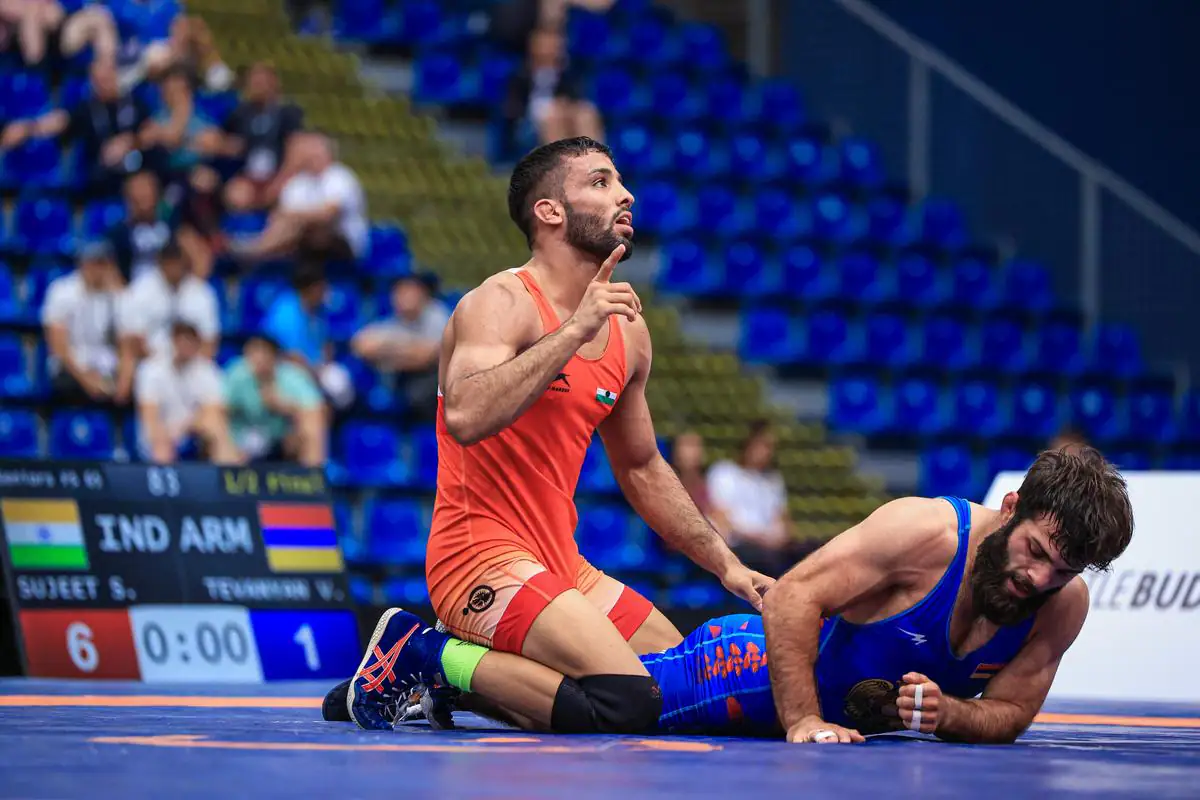
For decades, wrestling has been one of India’s strongest medal-producing sports at the Asian Games.
Yet while the country has repeatedly found its way onto the podium, the gold medal has often proved elusive. As Indian wrestlers prepare for the 2026 Asian Games, the central question is no longer whether they can win medals, but whether a new technical setup can finally take them back to the top step.
India’s wrestling history at the Asian Games is built around several iconic names. The breakthrough came at Jakarta 1962, when Maruti Mane, Malwa Singh and Ganpat Andalkar all won gold medals. Chandgi Ram continued that success at Bangkok 1970, while Rajinder Singh and Kartar Singh added titles in 1978. Kartar Singh returned eight years later to win another gold in Seoul, while Satpal Singh triumphed at the 1982 New Delhi Games.
After Kartar Singh’s 1986 triumph, however, India endured a 28-year wait for another Asian Games wrestling gold. That drought was finally broken by Yogeshwar Dutt at Incheon 2014, when he won the 65kg freestyle title.
The resurgence gathered pace four years later in Jakarta-Palembang. Bajrang Punia successfully captured gold in the 65kg category, while Vinesh Phogat made history by becoming India’s first female wrestling gold medallist at the Asian Games, winning the 50kg division.
But the momentum was interrupted at Hangzhou.
At the 2023 Asian Games, India returned with six medals one silver and five bronze but no gold. Deepak Punia came closest, reaching the 86kg final before losing 0-10 to Iran’s Olympic champion Hassan Yazdani. Aman Sehrawat won bronze after narrowly losing his semifinal to Japan’s Toshihiro Hasegawa, while Bajrang Punia, the defending champion, was beaten by Iran’s Rahman Amouzad in the 65kg semifinal.
The women faced similar obstacles. Antim Panghal lost her 53kg quarterfinal to Japan’s Akari Fujinami, while Sonam Malik and Kiran Bishnoi were eliminated in the semifinals. The pattern was clear: Indian wrestlers had enough physical ability to reach the latter stages but struggled when opponents imposed technically sophisticated styles.
That is precisely where the biggest change ahead of the 2026 Asian Games has come.
India has reorganised its high-performance wrestling structure around an international coaching team. Georgian Emzarios “Shako” Bentinidis is leading the men’s freestyle programme, Russia’s Gogi Koguashvili has taken charge of Greco-Roman wrestling, Japan’s Kosei Akaishi is overseeing women’s freestyle, while American Ian Butler has been appointed High Performance Director.
The appointments are significant because each coach brings expertise against one of the major wrestling systems India must overcome in Asia.
Bentinidis is concentrating on counter-attacks, leg-attack recovery and edge-of-the-mat defence in men’s freestyle. Koguashvili brings the Russian Greco-Roman school, with an emphasis on upper-body control and parterre wrestling. Akaishi’s role is particularly intriguing in women’s wrestling, where Japan has established itself as the continental benchmark. His work focuses on hand-fighting, ankle-pick counters and tempo control. Butler, meanwhile, is tasked with modernising conditioning, weight management and performance monitoring.
There are already signs that the restructuring could be producing results.
At the 2026 Asian Wrestling Championships in Bishkek, India won 17 medals, including two gold, seven silver and eight bronze. Sujeet Kalkal emerged as one of the strongest indicators of India’s medal potential. The 23-year-old won the 65kg Asian title and currently carries a 15-bout international winning streak. His 8-1 victory over Uzbekistan’s Umidjon Jalolov in the Asian final demonstrated the combination of technical patience, re-attacks and defensive improvement that India has been seeking.
Check Full Asian Games Coverage
Aman Sehrawat also remains central to India’s gold-medal hopes. The Olympic bronze medallist has returned to 57kg after competing at 61kg, where he won silver at the Asian Championships. His recent Budapest Ranking Series gold provides further evidence that he remains capable of challenging the continent’s best.
Antim Panghal represents another important opportunity in the women’s competition. A two-time World Under-20 champion and senior World Championship medallist, she now has access to Akaishi’s expertise against the very opponents who have troubled her previously.
The challenge, however, remains formidable.
Japan continues to set the standard in women’s wrestling and the lighter men’s categories. Iran remains a major force in men’s freestyle and Greco-Roman wrestling, while Uzbekistan, Kazakhstan, Kyrgyzstan and North Korea can produce technically difficult matchups. India will need more than physical conditioning to overcome these opponents; it will need tactical discipline, efficient scoring and the ability to win close exchanges.
The good news for India is that the current setup is designed precisely around those weaknesses.
A clean sweep is unrealistic, but the possibility of gold is no longer merely aspirational. Sujeet Kalkal in 65kg represents perhaps India’s clearest opportunity, while Aman Sehrawat has the pace and experience to challenge for the top step. In the women’s divisions, medals may be more achievable than gold, but the technical intervention of Akaishi could narrow the gap against Japan.
India’s wrestling story has always been one of peaks followed by prolonged gaps. From the three gold medals of 1962 to Kartar Singh’s second title in 1986, from Yogeshwar Dutt’s revival in 2014 to the double triumph of Bajrang Punia and Vinesh Phogat in 2018, the country has shown that it can produce Asian champions.
Now comes another test.
The difference in 2026 may be that Indian wrestlers are no longer being asked to rely on athleticism and individual brilliance alone. With a centralised programme and elite foreign coaches bringing specialised technical knowledge, India has a clearer route from podium finishes to gold.
Whether that translates into the top step will be decided on the mat. But after missing out on gold in Hangzhou, Indian wrestling enters the 2026 Asian Games with perhaps its most structured opportunity yet to reclaim the crown.
Comments (0)
to post comments, replies, and votes.
Loading comments…