Gukesh and Sindarov Fight to a 60-Move Draw as World Championship Match Remains Level
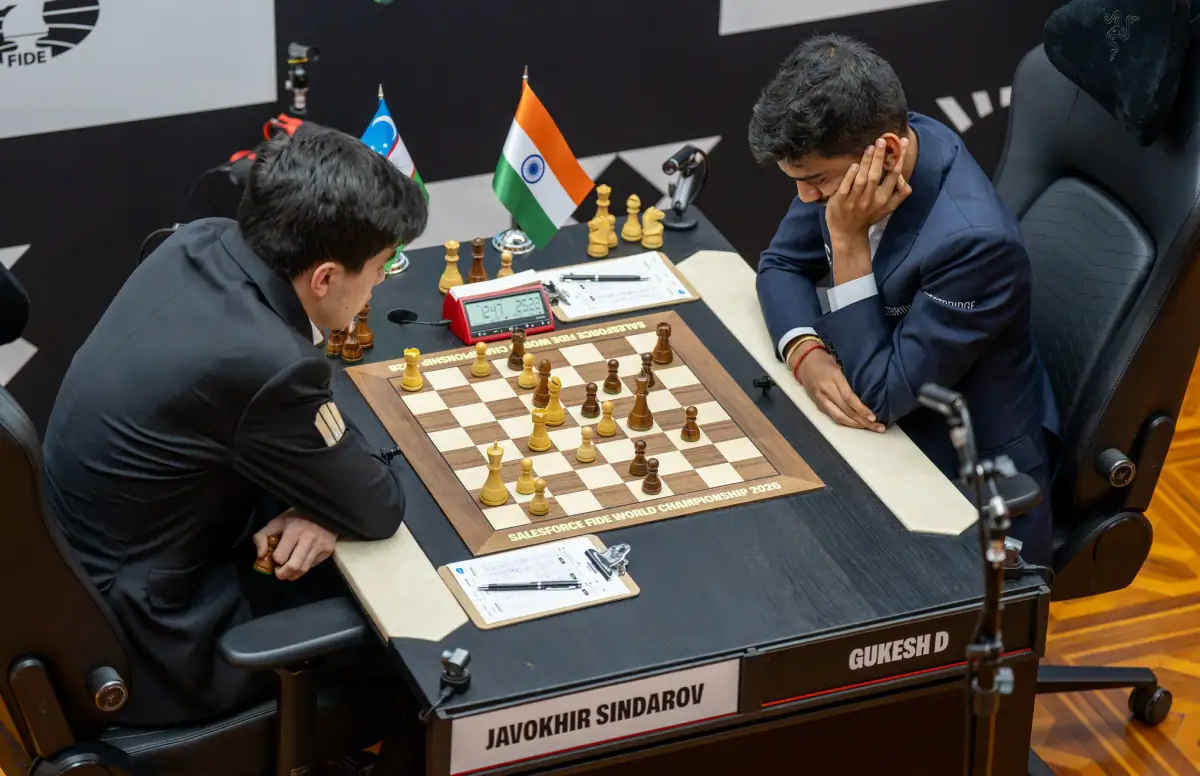
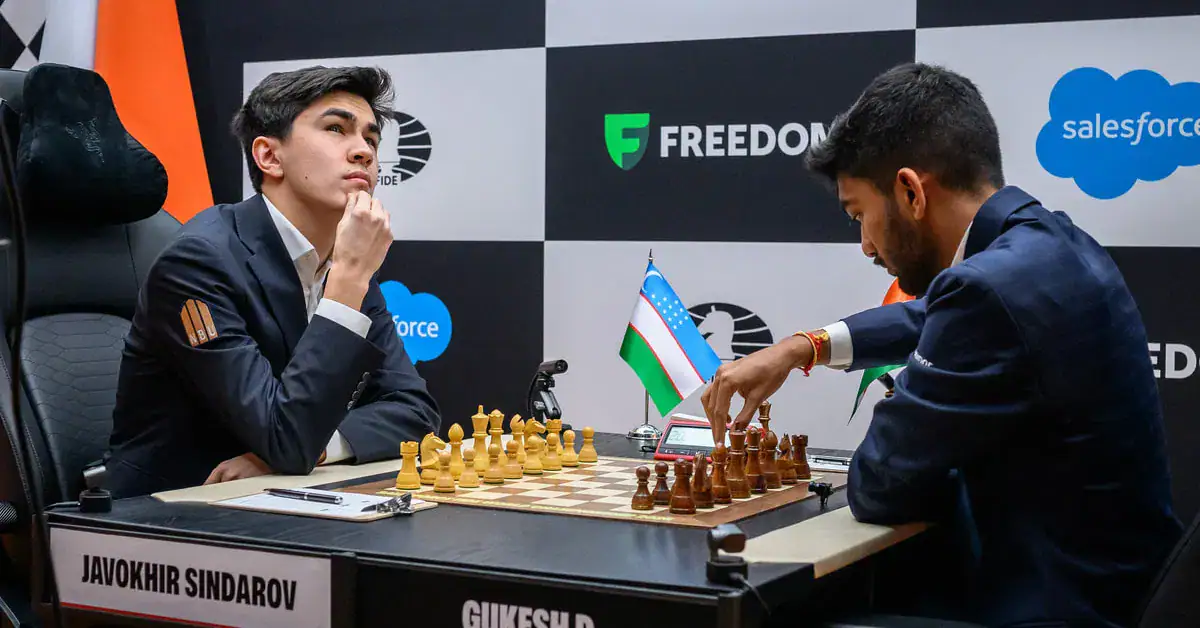
Gukesh and Javokhir Sindarov draw Game 3 after 60 moves in Geneva, leaving the Salesforce FIDE World Championship Match 2026 level at 1½–1½.
The Salesforce FIDE World Championship Match 2026 remains finely balanced after another absorbing contest between defending champion Gukesh Dommaraju and challenger Javokhir Sindarov.
Game 3 in Geneva ended in a draw after 60 moves, leaving the match score at 1½–1½ as both players head into the first rest day. Unlike the relatively shorter encounters in the opening games, the third game offered a longer strategic battle, with opening preparation, difficult positional decisions and a tense moment against the clock. Neither player managed to establish a decisive advantage, and accurate defence in the endgame eventually brought the contest to a close.
The game also saw Gukesh introduce an interesting variation in the Ruy Lopez, giving Sindarov an unexpected opening challenge to navigate.
Sindarov had the white pieces and opened with 1.e4 after the ceremonial first move was made by Mike Klein, Chess.com Senior Journalist and Content Creator. Klein had consulted colleagues beforehand about the preferred first move, with the majority favouring 1.f4. Sindarov, however, opted for the familiar 1.e4.
The first major talking point came when Gukesh played 5...Be7, introducing the Rio de Janeiro Variation of the Berlin Defence in the Ruy Lopez.
The move has historical significance. It was frequently used towards the end of the 19th century and has appeared occasionally in top-level encounters since. One notable example came in Game 2 of the 1981 World Championship match, when Viktor Korchnoi employed it against Anatoly Karpov in an attempt to surprise his opponent.
For Sindarov, the variation appeared to be an unexpected departure from his immediate preparation. The challenger spent time recalling his analysis and navigating a line that may not have featured in his morning preparation.
He eventually found a promising continuation, including 12.Nc3, a move that had appeared in only three earlier games. Gukesh continued following his preparation until 16.b3, but then took considerable time before deciding to exchange queens.
Opposite-coloured bishops offer a long battle
The position that followed gave the impression that Black might be gaining the initiative. However, Sindarov's 22.Nc5+ led to an endgame featuring opposite-coloured bishops. Such endings are often associated with strong drawing chances, but the presence of all the rooks meant there was still room for both players to create problems. Neither side appeared willing to settle immediately, and the game continued into a prolonged positional struggle.
One of the critical moments, according to the players, came after Gukesh moved his bishop from f5 to c4. The Indian later admitted that he was not entirely satisfied with this manoeuvre. It gave Sindarov an opportunity to initiate a kingside pawn break with 29.f4, an attractive idea that could have increased the pressure on Black.
However, the challenger was also critical of his own decision-making. In the post-game discussion, Sindarov felt he had played f4 too quickly and should first have prepared the advance with 29.h3. Gukesh, meanwhile, acknowledged that he had overlooked the possibility of f4. His ability to recognise the danger and find a safe continuation helped him keep the position under control.
The most uncomfortable moment for Sindarov came as the players approached the 40-move time control. Determined to calculate the position carefully, the Uzbek challenger allowed his clock to run down to just eight seconds before making his 40th move. It was a tense situation, particularly with the possibility of losing on time if he failed to move before the clock expired.
Fortunately for Sindarov, the position had simplified sufficiently for him to complete the move without hesitation. The time-control rules added to the pressure. Both players receive two hours for the first 40 moves. From move 41 onwards, they receive an additional 30 minutes to complete the game, alongside a 30-second increment per move.
Having safely crossed the time control, Sindarov could approach the remaining phase without the immediate threat of running out of time.
Accurate defence brings Game 3 to a close
The final phase offered little opportunity for either player to force a breakthrough. Sindarov defended accurately, while Gukesh was unable to create sufficient winning chances from the position. After 60 moves, the players agreed to a draw, bringing another demanding encounter to an end.
The result leaves the World Championship match tied at 1½–1½. Neither player has managed to establish an early lead, ensuring that the contest remains wide open.
Friday, November 27, is the first rest day of the match. The break offers both players an opportunity to recover after three demanding games, while their respective teams will use the time to analyse the opening choices and prepare new ideas.
The fourth game is scheduled for Saturday, November 28, at 3 PM local time at the Fondation Martin Bodmer in Cologny, Geneva. With the scores level, the next encounter becomes another important opportunity for either player to seize the initiative. Three games have produced three draws, but the match is still in its early stages. The battle for the world title remains very much alive.
Comments (0)
to post comments, replies, and votes.
Loading comments…