Sreeshankar Eyes High-Altitude Boost as Simbine Classic Marks Key Step in 2026 Season
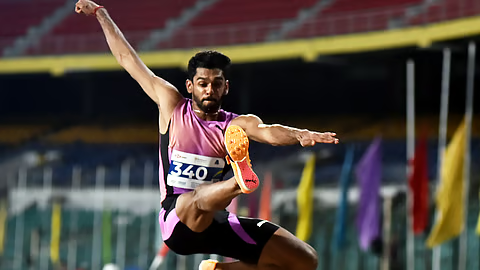
Sreeshankar’s 2026 campaign enters a significant phase as the Indian long jumper prepares to compete at the Simbine Classic in Pretoria on April 28.
Sreeshankar’s 2026 campaign enters a significant phase as the Indian long jumper prepares to compete at the Simbine Classic in Pretoria on April 28.
The World Athletics Continental Tour Silver-level meet will not only provide strong international competition but also present a unique variable altitude that could play a decisive role in shaping performances. Pretoria, situated at a relatively high elevation, offers conditions that are often favourable for horizontal jumps. Reduced air resistance at altitude can aid speed on the runway, potentially translating into longer distances. For an athlete like Sreeshankar, whose approach speed and take-off efficiency are key strengths, the venue could provide an opportunity to push beyond early-season marks.
The competition also comes at a time when Sreeshankar is building momentum. He opened his season at the Indian Open Athletics Series 1 in Bengaluru with a winning jump of 8.15m. More importantly, his series reflected consistency five jumps above 8 metres, including 8.09m, 8.13m, 8.15m, 8.12m, and 8.10m, along with a near miss at 7.99m. Such a sequence is significant in long jump. While a single big effort often draws attention, the ability to repeatedly cross the 8m mark indicates control over technique and rhythm. It suggests that Sreeshankar is operating within a stable performance range rather than relying on isolated peaks.
In the broader Indian context, only two athletes have crossed the 8m mark in 2026 so far Lokesh Sathyanathan with 8.21m and Sreeshankar with 8.15m. This places Sreeshankar firmly among the leading long jumpers in the country, while also setting up an internal benchmark that could drive further improvements. However, the transition from domestic meets to international competition introduces a different level of challenge. The Simbine Classic will feature a stronger field, where margins are narrower and consistency across attempts becomes critical. It also serves as a testing ground ahead of a packed season that includes major multi-sport events and global competitions.
Sreeshankar’s preparation reflects this shift in focus. Currently training in Potchefstroom, South Africa, he is part of a high-performance environment supported by the Target Olympic Podium Scheme (TOPS). The training camp is designed to align technical refinement, physical conditioning, and competition readiness. Training at altitude ahead of competition also offers a physiological advantage. Athletes often experience improved endurance and recovery, while also adapting to conditions that can enhance performance during competition. For a long jumper, where explosive power and speed are crucial, such preparation can make a measurable difference.
The Simbine Classic, therefore, is not just another competition. It represents a strategic step in Sreeshankar’s season planning. Competing in similar conditions to his training base allows for continuity, reducing variables and enabling him to focus on execution. Technically, Sreeshankar’s recent performances suggest improvements in maintaining speed through the board and converting it effectively into distance. His Bengaluru series showed minimal drop-off between attempts, indicating stability in approach and take-off phases.
At the same time, there remains scope for incremental gains. In long jump, improvements often come in small margins refinements in stride pattern, adjustments in take-off angle, or better control during flight and landing. The high-altitude conditions in Pretoria could amplify these gains, provided execution remains consistent. Another key aspect of this competition is timing. Early-season meets are often used to establish baseline performance levels. Sreeshankar’s 8.15m has already set a strong starting point. The next phase involves building on that mark, gradually approaching peak performance as the season progresses.
The larger objectives for 2026 are clear. With events such as the Asian Games, Commonwealth Games, and the World Athletics Ultimate Championships on the horizon, each competition becomes part of a structured progression. The Simbine Classic fits into this framework as both a performance opportunity and a benchmark. From a competitive perspective, achieving distances beyond 8.20m would strengthen Sreeshankar’s position internationally. While he has previously demonstrated the ability to reach such marks, consistency at that level against stronger fields will be crucial.
Equally important is handling competition dynamics. International meets often involve tighter schedules, varied conditions, and higher pressure. The ability to adapt within these environments is as critical as physical preparation. For Indian athletics, Sreeshankar’s progression holds broader significance. Long jump has seen gradual improvement in the country, but sustained performances at the global level remain limited. Athletes like Sreeshankar and Lokesh Sathyanathan represent a phase where consistency is beginning to match potential.
The Simbine Classic, therefore, is more than a single event. It is a marker in a longer journey one that aims to bridge the gap between national success and global competitiveness. As Sreeshankar prepares to take the runway in Pretoria, the expectations are measured but optimistic. The conditions are favourable, the preparation structured, and the trajectory upward.
In long jump, where centimetres define outcomes, every competition contributes to progression. For Murali Sreeshankar, April 28 offers another opportunity to refine, compete, and move closer to the distances that define global excellence.
Comments (0)
to post comments, replies, and votes.
Loading comments…