A New Test of Belief: India’s Women Hockey Team Head to Japan With LA 2028 in Sight
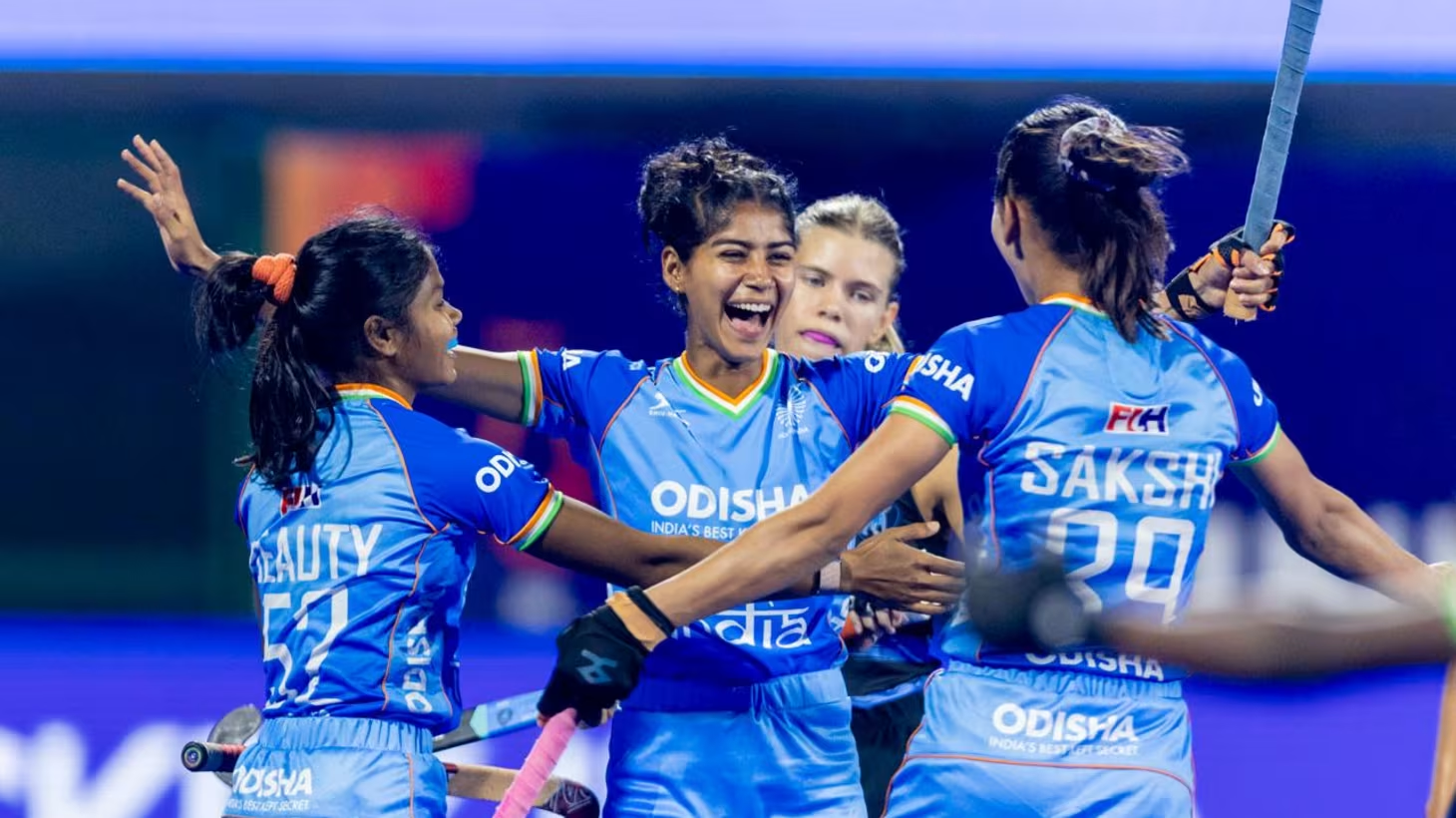
India’s women’s hockey team head to Aichi-Nagoya 2026 after a breakthrough year, with Asian Games gold and direct LA 2028 Olympic qualification as the ultimate targets.
There is a different feeling around the Indian women’s hockey team this time.
Not the cautious optimism that often accompanies a new campaign. Not the pressure of trying to recover from another disappointing tournament. Instead, India heads to Japan carrying something far more valuable evidence.
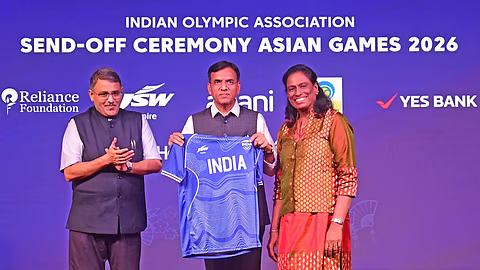
Evidence that this team can compete with the best. Evidence that a new identity is taking shape. And, perhaps most importantly, evidence that the long road towards the Los Angeles 2028 Olympic Games can be travelled with genuine ambition. Captain Salima Tete and her teammates departed Bengaluru on Tuesday for the Aichi-Nagoya 2026 Asian Games, where India will attempt to win gold and secure direct qualification for the LA Olympics.
The timing could hardly be better.
A year that changed the conversation
When Sjoerd Marijne returned to the Indian women's programme earlier this year and was formally appointed Chief Coach in January, the focus was clear: improve fitness, build stronger connections within the group and create a collective identity. The transformation has been visible.
India first reached the final of the FIH Hockey Women’s World Cup Qualifiers in Hyderabad, remaining unbeaten before narrowly losing the final. More importantly, the team had already secured its World Cup ticket by defeating Italy 1-0 in the semifinal.
Then came Auckland. At the FIH Hockey Women’s Nations Cup, India went through the tournament unbeaten. They defeated the USA, Japan and Uruguay in the pool stage before producing a commanding 6-0 semifinal victory over Chile.
The final against hosts New Zealand provided another test. India passed it with a 2-0 victory, lifting the title and earning promotion to the FIH Pro League. But even that achievement was eventually surpassed.
India arrived at the 2026 Women's World Cup with reason to believe, but few could have predicted how far the campaign would go. A fifth-place finish became the best result in the tournament's history for India since the inaugural edition in 1974. The achievement was not built around one fortunate result. India lost only once throughout the competition and repeatedly showed that they could stand their ground against higher-ranked opposition.
They held China, England and Australia to draws, defeated South Africa 6-1 and finished their campaign with a statement 3-1 win over fifth-ranked Germany. For a team accustomed to being judged primarily on whether it could reach the latter stages of major tournaments, the World Cup provided something new: consistency against elite opposition.
That experience now travels with them to Japan.
The Asian Games are not simply another tournament on India's calendar. There is a direct Olympic qualification place attached to the women's hockey gold medal.
Under the LA 2028 qualification system, the highest-placed eligible team at the Asian Games will earn an Olympic quota place, provided it has not already qualified through another route. For India, the equation is therefore uncomplicated.
Gold means Los Angeles.
That adds another layer of significance to every match, even though the team will need to avoid looking beyond the immediate challenge.
Salima Tete understands the balance required.
“We are going into the Asian Games with a lot of confidence, but we also know that every tournament brings a new challenge,” the captain said.
The recent successes have given India belief, but Tete knows belief alone will not win the title. Consistency, discipline and execution will determine whether the team can turn its recent progress into an Asian Games triumph.
India has been drawn in Pool B with hosts Japan, Thailand, Singapore, Indonesia and Uzbekistan. The campaign begins against Uzbekistan on September 20, followed by Indonesia on September 21. Thailand awaits on September 23 before India faces Japan on September 25. The pool stage concludes against Singapore on September 27.
The schedule gives India an opportunity to build momentum before the decisive matches arrive, but there is little room for complacency. Japan, in particular, will present an interesting challenge. As hosts, they will have the home crowd behind them, while the tournament's knockout stages will bring an entirely different level of pressure.
The quarter-final stage begins on September 30, with the semifinals also scheduled that day. The gold-medal match follows on October 2. By then, India's recent achievements will count for very little.
They will have to start again.
Experience meets the next generation.
The squad arriving in Japan combines players who have already experienced the biggest stages with younger athletes increasingly becoming important contributors. Savita remains a key presence in goal, while the squad also features established campaigners such as Navneet Kaur, Neha, Nikki Pradhan, Lalremsiami and Sushila Chanu Pukhrambam.
Alongside them is a younger group that has increasingly been given responsibility during India's recent international run. That blend could become one of the team's biggest strengths.
The experienced players understand tournament pressure. The younger members bring energy and, importantly, have already been exposed to international-level competition during India's recent resurgence.
The last few months have changed what can reasonably be expected from this Indian team. The Nations Cup proved they could win. The World Cup proved they could compete consistently against stronger opposition. The Asian Games will ask a different question: can they finish the job when the stakes are highest?
India are not travelling to Japan simply to extend a good run of form. They are carrying the opportunity to turn an exceptional year into something historic.
For Salima Tete and her teammates, the route is straightforward, even if the task is not. Five pool matches. Then the knockout stage. Then, potentially, one final game for gold. And beyond that gold medal lies something even bigger: a ticket to Los Angeles.
After everything this team has achieved in 2026, the Asian Games offer perhaps its most important opportunity yet.
This time, India is not chasing belief. They are taking it with them to Japan.
Comments (0)
to post comments, replies, and votes.
Loading comments…