Asian Games 2026 Men’s Freestyle Wrestling Preview: Can India Break Through a Loaded Field in Nagoya?
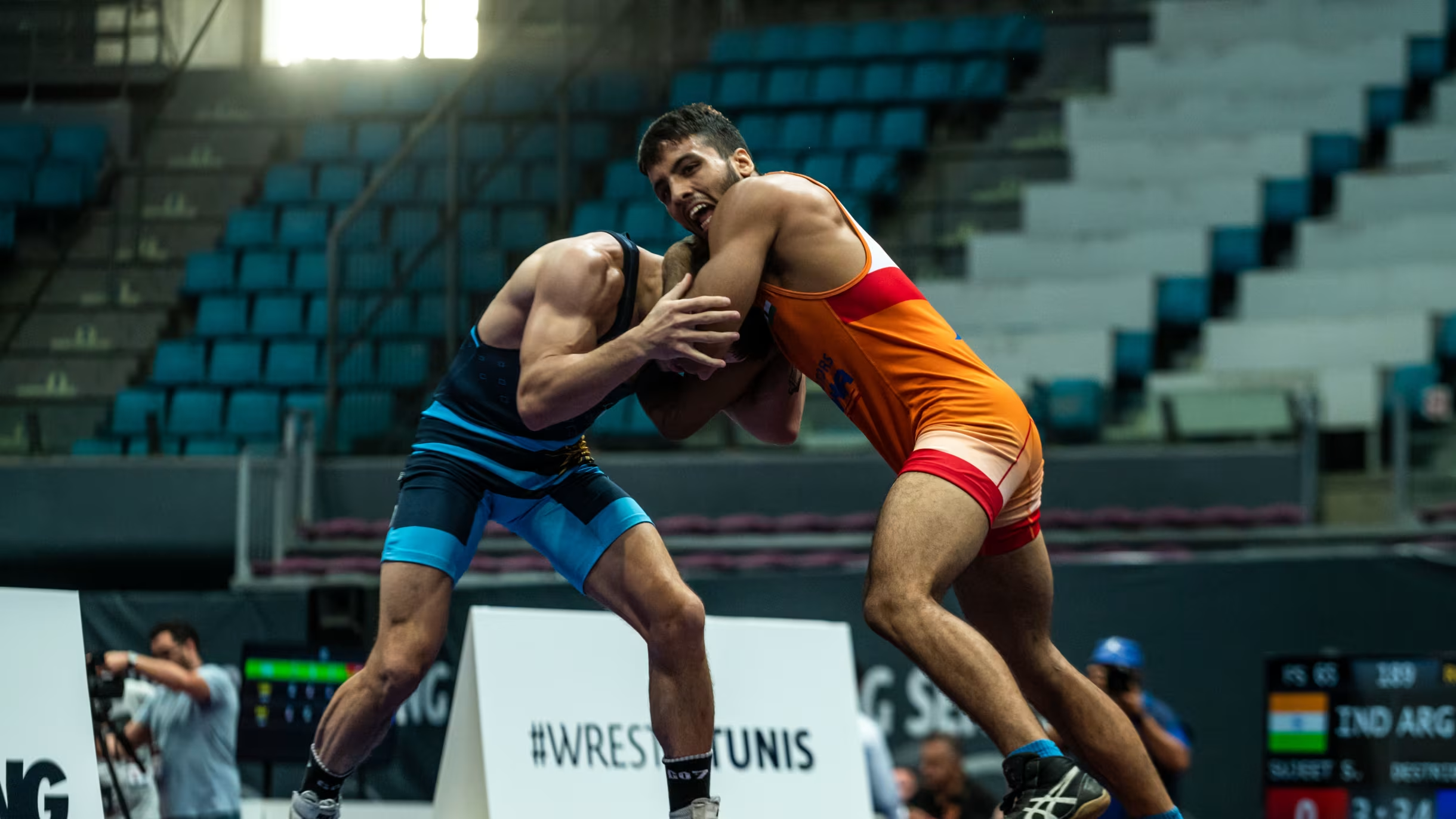
India’s men’s freestyle wrestling campaign at the Aichi-Nagoya Asian Games 2026 promises to be one of the toughest tests of the country’s next generation.
The entry list brings together Olympic champions, World champions, Asian champions and some of the strongest wrestling programmes on the continent across all six Olympic freestyle weight categories.
The competition will feature 57kg, 65kg, 74kg, 86kg, 97kg and 125kg, with the men’s freestyle events scheduled for October 1 and 2 at the Nagoya City Inae Sports Center. The preliminary nominal entries feature wrestlers from across Asia, with the 65kg division the largest at 24 competitors and the 57kg field containing 21.
For India, the spotlight will be firmly on Aman Sehrawat, Sujeet Kalkal and Deepak Punia, while Sagar Jaglan and Rajat Ruhal will attempt to make their mark against some of the continent’s biggest names.
Aman Sehrawat carries India’s biggest hope
The 57kg category is arguably India's strongest medal opportunity. Aman Sehrawat, the Paris 2024 Olympic bronze medallist and former Asian champion, enters the competition with an aggressive wrestling style built around relentless pace, ankle attacks and exceptional conditioning.
But his path to the podium will be difficult. Uzbekistan's Gulomjon Abdullaev is one of the biggest threats in the division. The Olympic and Asian medallist has previously caused Sehrawat major problems, defeating the Indian by technical superiority at the 2024 Asian Olympic Qualifiers.
North Korea's Chong Song Han adds another major obstacle after emerging as a Senior World Championship gold medallist. China's Wanhao Zou, Iran's Ali Momeni and Japan's Yamato Ogawa further strengthen an already deep field.
For Sehrawat, the key will be maintaining his trademark pace without becoming vulnerable to counter-attacks. A potential rematch with Abdullaev could be one of the most tactically fascinating bouts of the tournament.
Sujeet faces a 24-man minefield
If 57kg is India's biggest medal opportunity, 65kg could be its biggest challenge. Sujeet Kalkal has the technical ability to compete with elite opponents, but he will have to navigate the largest field of the men's freestyle competition, with 24 wrestlers entered.
At the top of the bracket is Japan's Kotaro Kiyooka, the reigning Olympic champion. Kiyooka's low-level attacks, ankle laces and counter-wrestling make him the man to beat.
Uzbekistan's Umidjon Jalolov brings considerable physical strength, while Kyrgyzstan's Ernazar Akmataliev is another major danger. Iran's Abbas Ebrahimzadeh and Kazakhstan's Nachyn Kuular add further depth. Sujeet's strengths lie in rapid level changes and low-ankle sweep singles, but he will need to combine that attacking ability with defensive discipline. With so many high-quality wrestlers in the bracket, one poor opening bout could end his medal hopes immediately.
At 74kg, India will be represented by Sagar Jaglan, a World U20 and U23 medallist. The division is headlined by Uzbekistan's Razambek Jamalov, the Paris Olympic champion, who enters as the clear benchmark. Jamalov combines tactical positioning, leg counters and sweep singles, making him exceptionally difficult to score against.
Tajikistan's Viktor Rassadin, Iran's Younes Emami and Kazakhstan's Nurkozha Kaipanov provide further elite opposition. Japan's Yoshinosuke Aoyagi is another intriguing name. Having moved up from 70kg after winning World and Asian medals, his speed and continuous head snaps could create problems for larger opponents.
For Jaglan, success will depend on controlling the centre, winning inside ties and preventing opponents from dictating the pace.
Deepak Punia’s move to 97kg is fascinating
Perhaps the most intriguing Indian storyline comes at 97kg, where former World silver medallist Deepak Punia returns to major competition in a new weight category. Punia built his reputation at 86kg, winning a World Championship silver medal and an Asian Games silver medal. Now he must deal with larger and stronger opponents.
Japan's Arash Yoshida, Kazakhstan's Rizabek Aitmukhan and Iran's Amirali Azarpira headline the division. Yoshida combines Japanese low-single attacks with powerful underhook wrestling. Aitmukhan, a World champion at 92kg who has moved up, brings length and dangerous sweep singles. Azarpira, meanwhile, is an Olympic bronze medallist with explosive double-leg attacks.
Punia's experience will be crucial, but moving up requires tactical adjustments. He will need to control the centre, prevent opponents from attacking his legs and use his counter-wrestling intelligently.
At 125kg, India will field Rajat Ruhal in a 12-man bracket led by Iran's Amir Hossein Zare. Zare is a multiple-time World champion and Olympic medallist who combines immense physical strength with relentless forward pressure. Bahrain's Shamil Sharipov is another major contender, while Uzbekistan's Khasanboy Rakhimov and Japan's Taiki Yamamoto provide additional threats.
For Ruhal, the immediate priority will be surviving the opening exchanges and preventing elite heavyweights from establishing dominant grips. At heavyweight, small positional mistakes can result in decisive scores, making defensive discipline particularly important.
India faces Japan, Iran, Uzbekistan and Central Asia
The overall entry list makes one thing clear: India will not have an easy route to medals. Japan brings Olympic champions such as Kiyooka and Jamalov. Iran has Zare and Azarpira, while Uzbekistan features Abdullaev and Jamalov. Kazakhstan and Kyrgyzstan also possess deep wrestling programmes capable of producing multiple medalists.
India's best chance of challenging these established powers will come through its ability to win the close tactical exchanges that decide major wrestling bouts.
The format provides some protection through double repechage. Wrestlers defeated by either finalist can enter the repechage, giving them a second route towards a bronze-medal bout.
The Indian men's freestyle team arrives with an opportunity to improve on recent continental performances. The wider Indian wrestling programme managed only one silver and five bronze medals across all three styles at the 2022 Asian Games, according to the entry-list assessment. Aman Sehrawat is the clearest candidate to challenge for gold, while Sujeet Kalkal and Deepak Punia could provide further medal opportunities.
But the field is loaded with champions. For India, the Asian Games will therefore be less about reputation and more about execution. Sehrawat must overcome proven counter-wrestlers, Sujeet must survive a brutal 24-man bracket, and Punia must prove that his experience can compensate for the physical challenge of moving to 97kg.
The six men's freestyle categories will be contested across October 1 and 2.
By the end of those two days, India will know whether its next generation has taken another major step towards becoming a consistent force in Asian wrestling.
Comments (0)
to post comments, replies, and votes.
Loading comments…