Asian Games Hockey: The Four Captains Who Led India to Gold in 1966, 1998, 2014 and 2023
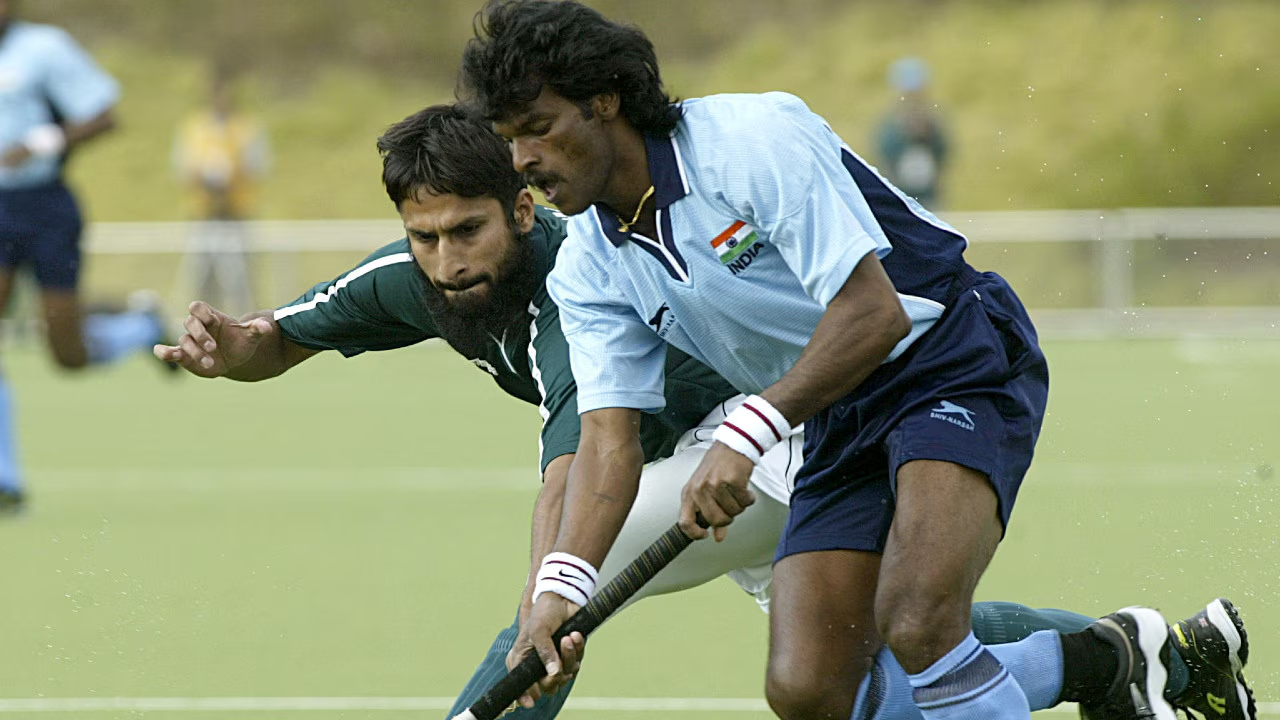
Indian hockey has a long and celebrated history at the Asian Games, and behind every gold-medal triumph has been a captain capable of carrying enormous expectations.
Across different generations, four leaders stand out for guiding India to the top of the Asian hockey summit: Shankar Laxman in 1966, Dhanraj Pillay in 1998, Sardar Singh in 2014 and Harmanpreet Singh in 2023.
Each captain led India in a different era, with different styles, teammates and challenges. Yet there is one striking similarity in their campaigns: each played a central role in turning India's ambition into gold.
India's 1966 Asian Games triumph in Bangkok was one of the defining moments of the country's early hockey history. Shankar Laxman, one of India's most respected goalkeepers, captained the side during a campaign in which India remained perfect, winning all five of their matches.
For a goalkeeper to captain a team in an era when Indian hockey was still heavily associated with attacking flair, Laxman's leadership represented another important quality: composure. His presence at the back provided India with the confidence to play their natural attacking game. The 1966 gold medal also strengthened India's position as one of the dominant forces in Asian hockey. Laxman's five victories from five matches remain a remarkable captaincy record and established the first of the four gold-medal leadership stories explored here.
Dhanraj Pillay: Six wins from six in 1998
More than three decades later, India once again reached the top of the Asian Games podium, this time with one of the most charismatic players in Indian hockey history leading the way.
Dhanraj Pillay captained India to gold at the 1998 Asian Games in Bangkok, and the campaign was flawless. India won all six of their matches, giving Pillay a perfect 6-0 record as captain. Pillay represented a completely different generation of Indian hockey. Dynamic, aggressive and capable of changing games with individual brilliance, he became one of the most recognisable faces of Indian sport.
His leadership came at a time when Indian hockey was attempting to re-establish itself as a major force. The 1998 gold was therefore about more than another medal. It was a statement that India could still produce teams capable of dominating the continent.
The fact that Pillay's team did not lose a single match makes his Asian Games campaign particularly memorable. Six matches, six victories and a gold medal placed him firmly among India's most successful hockey captains.
India had to wait another 16 years for its next Asian Games hockey gold. When that moment finally arrived at the 2014 Asian Games in Incheon, Sardar Singh was the man wearing the captain's armband.
Sardar was the midfield engine of his generation. His ability to control possession, dictate the tempo and connect defence with attack made him an influential figure in India's modern hockey structure.
India's 2014 campaign was not completely perfect, with the team recording five wins from six matches. But what mattered was the ability to deliver when the tournament reached its decisive stages. The gold medal was particularly significant because it secured India a direct qualification spot for the 2016 Rio Olympics. For Indian hockey, the achievement carried importance beyond the Asian Games itself.
Sardar's leadership consequently became part of a broader revival in Indian hockey. His generation helped establish a more physically demanding and tactically organised Indian side, laying foundations for the even more successful period that followed.
Harmanpreet Singh: Seven wins from seven in 2023
The latest chapter belongs to Harmanpreet Singh, who captained India to gold at the 2023 Asian Games in Hangzhou.
If Laxman had five wins from five and Pillay had six from six, Harmanpreet went one step further: seven matches, seven victories. The 2023 triumph was another landmark for Indian hockey. India went through the tournament unbeaten and demonstrated the depth, defensive structure and attacking quality that had developed in the modern era.
Harmanpreet's own importance to the team extended well beyond captaincy. As one of the world's leading drag-flickers, he was a major weapon from penalty corners while also carrying responsibility as a leader on the field.
The perfect campaign also delivered a crucial reward: India secured direct qualification for the Paris 2024 Olympics. The team subsequently went on to win a bronze medal in Paris, making the 2023 Asian Games triumph an important part of India's continued resurgence.
Four captains, four generations, one legacy
The records of these four captains tell the story of Indian hockey's evolution.
Shankar Laxman: 5 wins from 5.
Dhanraj Pillay: 6 wins from 6.
Sardar Singh: 5 wins from 6.
Harmanpreet Singh: 7 wins from 7.
The numbers are impressive, but their significance goes beyond win-loss records. Each captain inherited the responsibility of leading India at a different stage of the sport's journey.
Laxman represented the era of Indian hockey's traditional dominance. Pillay became the face of a generation seeking to restore India's stature. Sardar led the transition into a more modern, physically demanding game, while Harmanpreet has emerged as the leader of a team combining India's traditional attacking instincts with modern tactical discipline.
Four captains. Four Asian Games gold medals. Different eras, different challenges and different styles of leadership — but the same result.
India at the top of Asian hockey.
Inspired by Stick2Hockey
Comments (0)
to post comments, replies, and votes.
Loading comments…